Black Rifle Coffee Company serves coffee and culture to people who love America. We develop our explosive roast profiles with the same mission focus we learned as military members serving this great country and are committed to supporting veterans. Shop Black Rifle Coffee Today!
If you’ve ever brought a prayer to God and heard only silence in return, you’re in good company. The psalmists knew that experience well.
What’s remarkable about these songs to God is their honesty. David doesn’t tidy up his pain before bringing it to his heavenly Father. He cries out, complains, and even argues: “How long, O Lord? Will You forget me forever?” (Ps. 13:1). There’s no performance here, no careful phrasing. This is the honest cry of a man laying his anguish before the One he trusts with it. That trust is the thread that runs through the psalms, even the ones written in the darkest moments. Keep reading......
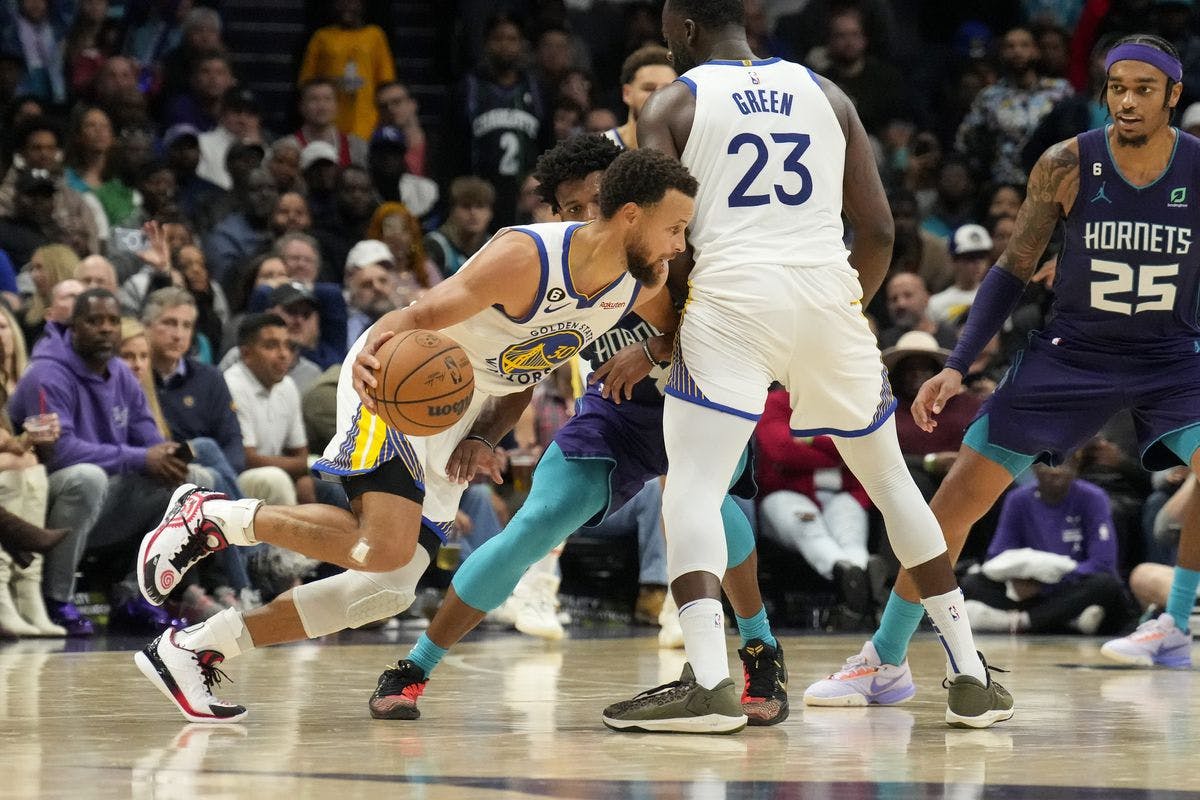
The pick and roll stands out as one of basketball's most effective offensive strategies, and its success hinges on players mastering the fundamentals through high-quality pick and roll basketball drills.
When executed properly, this play can become an unstoppable force against defenses. But mastering its execution requires a deep understanding of spacing, timing, and communication among teammates.
To truly harness the power of the pick and roll, focused drills are essential. Players setting the screen must learn the optimal positioning and angles to maximize their effectiveness, while also being aware of defensive positioning. Meanwhile, the ball handler must develop the ability to read defenses in real time, making quick decisions to drive, shoot, or pass based on how the defense reacts to the screen. Incorporating situational drills that mimic game scenarios can be a game-changer.
By practicing various pick and roll setups against different defensive strategies, players gain invaluable experience and confidence. They learn not just the mechanics of executing the play, but the various options at their disposal when faced with defensive adjustments.
By prioritizing practice and deeply understanding the fundamental principles behind the pick and roll, teams can transform this play into a cornerstone of their offensive strategy, making it a decisive weapon during games.
But coaches will need the correct drills to start that process. This is why we’ve included three pick and roll drills from some of the basketball community’s most respected thought leaders.
Greg White, hailing from Bentonville West High School in Centerton, Arkansas is a coaching luminary with over two decades of experience. In 2023, he was honored as the 6A West Coach of the Year and led his team to seize their first conference championship & past the 100-win plateau.
His extensive career boasts 250+ wins as a varsity head coach, and he’s renowned for his contributions to the basketball community as a mentor at Snow Valley Basketball School and a frequent speaker for USA Basketball.
Coach White’s ‘The Screening Game: Using Different Angles & Types for Success’ course conveys what he calls the pin down shooting drill that’s based off a pick and roll. The drill begins with three lines of players, one at each wing and one at one of the blocks.
The weak side wing line has the first two players in line each holding a ball. The other wing then goes down to the block and sets a pin down screen, which prompts the post player to flash to the wing and receive a pass from one of the players with a ball.
As soon as the screen is set, the screener will roll to the post and receive a pass from the other player with a ball.
Another variation of this can be for the post player to curl around the screen and roll back toward the basket, while the initial screener can pop back out to the wing and shoot the jump shot, essentially switching positions from the initial variation.
With 24 years of professional coaching experience, Liam Flynn has spent time as an NBA Consultant and coached in the German Bundesliga, Chinese CBA, and the New Zealand NZNBL.
In addition to that, Coach Flynn has amassed six years of coaching experience in the Australian First Division (NBL), 15 years of coaching experience in the Australian Second Division, and 20 years of coaching experience at the Junior Elite Level in Australia. He received his Master's in Sports Coaching at the University of Queensland in Brisbane, Australia.
Coach Flynn’s ‘The Art of the `Mid Pick and Roll` course conveys a pick and roll drill that he loves against flat coverage (where the defender who is guarding the screener positions themselves almost at the same level as the on-ball screen when it arrives).
This drill is a 2 on 2, and is focused on seeing the different opportunities that arise when the pick comes at different places on the court. So the ball handler should start by dribbling around the perimeter to a specific place on the court. Once there’s a signal, the post player will come up and set the screen, and then roll toward the basket once the screen is set.
Once that roll occurs, the ball handler will ideally make the pass while both defenders are engaged in the screen, which will hopefully open up the lane. But this will depend on the timing of the screen and where on the court it takes place.
Dave Severns is currently a basketball scout for the Indiana Pacers. Before that, he spent 14 years in the NBA as Director of Player Development for the LA Clippers from 2010-2016, Director of Player Development for the Chicago Bulls from 2008-2010, and Pro Personnel Scout for the LA Clippers from 2016-2021.
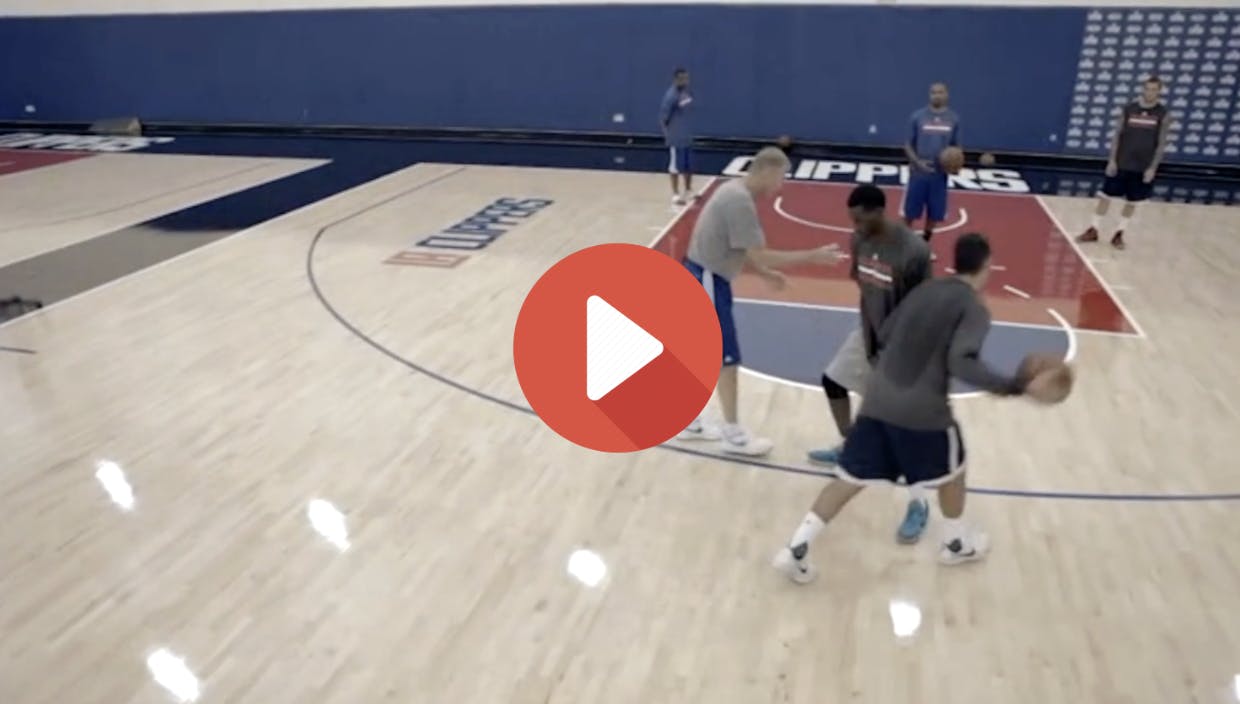
In his ‘Pick & Roll Offense 101’ course, Coach Severns details a high/mid pick and roll drill, which starts with a post player getting a screen at the three point line. The ball handler will dribble to the elbow before pulling up for a jump shot, while the screener will roll and receive a pass from a coach who’s along the baseline and shoot a shot at the other elbow.
The key here is that the guard is influencing their defender one way, which will open the roll opportunity for the screener against a man-to-man defense.
Everyone has a role to play in the National #YouthSports Strategy! Learn more about the strategy and ways to get involved from @HealthGov: https://bit.ly/2lQ85f6
Duo may be one of the most misunderstood plays in football. Many coaches identify it as an inside zone, but it is actually a gap scheme. The rules, footwork, hand placement, and read of the running back are distinctly different than on a zone play.
The teams that understand it best utilize a certain kind of formation structure that creates advantages and allows them to run the ball against what even appears to be a stacked box.
NFL veteran offensive line coach Paul Alexander explains the duo and how it is different than inside zone in this video. Alexander explains, “Most call it an INSIDE ZONE play… even many coaches and television analysts have it confused. But it’s not ZONE. It’s GAP.”’s GAP.” If you want to run gap schemes but are not comfortable with your linemen pulling, then Duo is the play for you.Why Duo?
While it may be misunderstood, it is an extremely valuable play for an offense to run the ball effectively. Doug Socha, head coach at Keiser University explains why you should utilize the Duo play in this video. Are you an RPO offense? Perfect! You can utilize Duo in your RPO game.
There’s no one better to answer that question than long time NFL coach and offensive line guru, Jim McNally. This is an especially good run against the 3-4 and under front which have increasingly been utilized by defenses. McNally diagrams the play against both fronts and gives some technique coaching points in this video:
It is used extensively in the NFL, but that does not mean it is complex. One of the best offenses in the NFL, the Baltimore Ravens, used it extensively last season because it fits their philosophy of being simple. The Pistol set with Lamar Jackson is a big part of the equation in creating the advantage. Coach Alexander explains how it fits into the philosophy and strategy of the Ravens offense in this video.
If you are looking for that one play that can provide your offense simplicity, versatility, and an attitude, then the Duo play is worth researching further.
Best of luck as the re-opening of football nears!
Sports help kids #GetActive and learn new skills – but don’t forget about fun! Learn about @HealthGov’s National Youth Sports Strategy and help make fun the top priority in #YouthSports: https://bit.ly/2lIHPUc
In today’s passage, Jesus tells a parable about a wealthy man whose fields produced abundantly. Instead of sharing his surplus, he planned to tear down his barns and build bigger ones to store everything for himself. He could live comfortably for years on what he’d accumulated—eating, drinking, taking life easy.
The problem wasn’t the man’s wealth. It was what he chose to do with it. His focus was on himself: “my crops,” “my barns,” “my goods.” This rich man didn’t choose to share with those in need or be generous toward God. He believed he could secure his future through accumulation, mistaking material abundance for true security.....Keep reading......
Chances are that you will either be running a wide zone yourself or facing it at some point in the future. It’s a play that teams use from the NFL through high school because of its ability to distort the defense and create running lanes for the back. The nature of the movement caused by the scheme makes it one of the best runs to execute RPO and Play Action off of as well.
Three offensive line experts, and original members of “The C.O.O.L. Mushroom Society” know this play better than anyone and continue to innovate their coaching points and techniques on the play.
Let’s start with Jim “Mouse” McNally, long time NFL line coach, now NFL consultant teaching the techniques on the front side of the play.
When blocking a defender aligned outside,the first step is critical. Done right it puts the blocker on the path to reach or distort that defender to open the running lane. The images show varying alignment techniques and the variations in technique required.
The first shows a wide aligned defender. It starts with a drop step that allows the blocker to get on an angle that he can reach the defender or if the defender runs to stay outside, the lineman is in a position to use force to distort him out.
As the width of the defender alignment decreases, the drop step will still be deep to set an angle to cover the defender up, but the variation will be in the punch. In this example, McNally demonstrates the step and then a punch to the outside number:
In this next example, the defender is tightly aligned to head up. The drop step is executed, and then the blocker will rip with his backside arm to get in a position to avoid and climb to level 2 knowing that he has a lineman coming from behind. If the defender runs to not get reached, he will stay square on him and run him.
McNally explains these techniques and more in this video (click on the image to play):
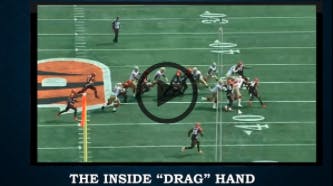
Taking it a step further, Paul Alexander believes the key to sustaining the block is the backside drag hand. He learned from Alex Gibbs how the drag hand should be used to grab the inside of the chest plate. He teaches that in this video and includes a technique he learned from Howard Mudd on how to reach a wide aligned defender:
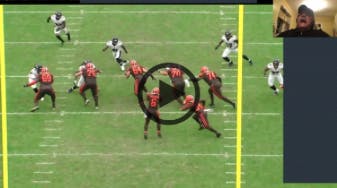
The wide zone is a team scheme. Everyone needs to do their job properly because the ball could actually hit behind any of their blocks.This is certainly true with the backside. Bob Wylie illustrates on video how Kevin Zeitler helps open a lane with his block as the backside guard by taking the defender past the “read spot of the back.”
Since the 80’s these coaches have been getting together annually to continue to share ideas and innovate at the C.O.O.L. Clinic. In 2021, the Wide Zone ruled as the topic of interest. Packers Coach Adam Stenavich, Titans Coach Keith Carter, Notre Dame Coach Jeff Quinn, Oregon Coach Alex Mirabal and Ohio State Coach Greg Studrawa all presented on the wide zone play.
The schemes we’ve learned throughout the boom in virtual clinics have definitely increased our football knowledge especially in “what” the scheme is. Now it’s time to refine and research the “how” and there’s no one better to learn that from than the originators of the “Mushroom Society.”
Want to help kids stick with sports? Prioritize fun and #PhysicalActivity over competition in #YouthSports programs. Learn more in @HealthGov’s National Youth Sports Strategy: https://bit.ly/2lQ85f6
US Sports Network News! Having fun and helping the peeps'. Using Sports as a platform to Inform, Educate, Inspire, While Entertaining you with the best of sports, talk, music, and fun. Be on the lookout for our frequent 'Teachable Moments' This will be a sports and media experience like you never expected. We always welcome your feedback. If you like us or even if you don't, we are always going to love you! Thanks for stopping by!