View the content of this inline frame with your browser
Sports USA Radio



Even if you are a personal trainer, have trained one particular team, or own your own gym, organizing a school-wide training program has very unique challenges. This course is a detailed description of how to design and implement workouts and how to navigate scheduling and logistical concerns.
For the last 13 years, Exclerate Athletic Development has been training individual athletes, high school programs, entire athletic departments, and club programs, while also offering consulting services for schools and programs that are looking to develop their own school-wide program. During that time, we have won 6 Ohio State Championships, in 5 sports, at 4 different schools. One of our greatest accomplishments has been winning an individual or state championship, at every school, within the first four years and within the first cycle of athletes. Along with winning 6 Ohio State Championships, we have also been the State Runner-Up 6 times in 6 different sports and to the Final Four 4 times in 3 different sports.
On top of this, our athletic development program has been used by Midland Baseball in Cincinnati, Ohio. During this time, we have won 5 AABC National Championships and finished Runner-Up once.
In this course, the following information will be covered:

The Christian life is an active life—one given over to working, serving, sharing, and loving. It’s tempting to think that being a believer mostly means showing up for church each week and putting something in the offering plate. Those are good habits. But Jesus’ final charge to His disciples encompassed far more.
In today’s passage, Jesus tells His followers to “go therefore and make disciples of all the nations” (v. 19). Notice He doesn’t say “convert” or “recruit” but “make” disciples. A disciple is someone who walks alongside, watches, learns, and slowly becomes like the teacher. That kind of formation doesn’t happen automatically. It takes place over meals and loving conversations, through friendships and seasons, as faith becomes visible in how we live. Keep reading......

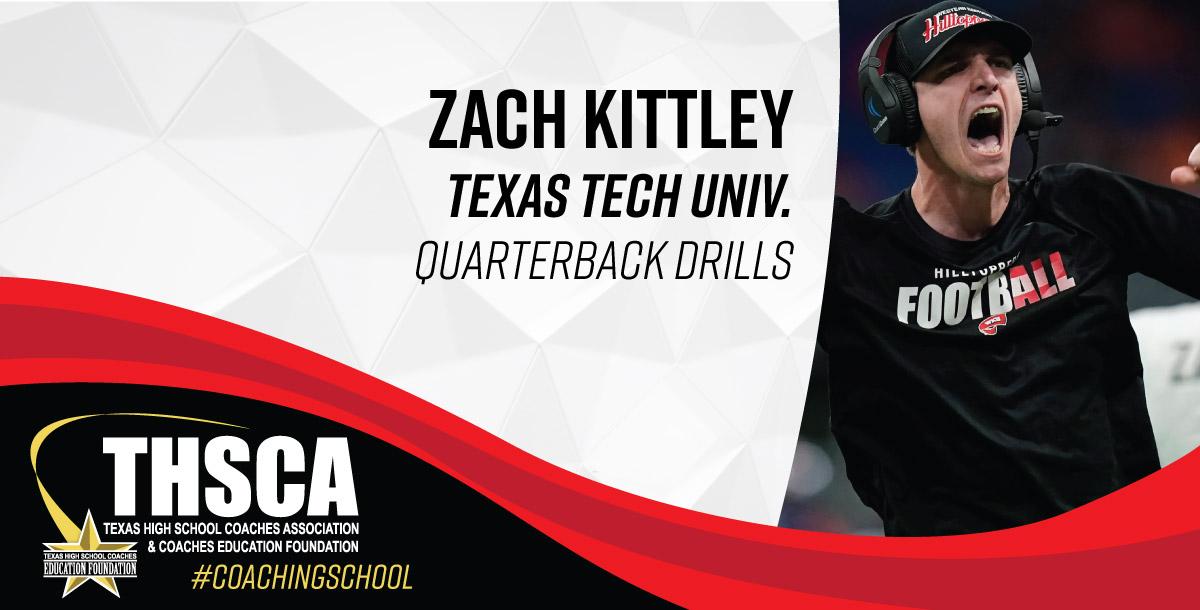
Simply click the ‘Book This Course’ button at the top right of this page, place your order, and you’ll gain immediate access to the training. Take a closer look at how Coach Zach provides an overview of quarterback drills training!
Zach Kittley - Texas Tech (QB's)
Lecture Title: Quarterback Drills with Zach Kittley
Zach Kittley, the architect behind one of the nation’s top offenses this past season at Western Kentucky, returns to his alma mater as Texas Tech’s offensive coordinator and quarterbacks coach under head coach Joey McGuire. This will be Kittley’s second stint on the Texas Tech coaching staff after previously serving in various roles on Kliff Kingsbury’s staff from 2013-17, rising from a student assistant to graduate assistant and assistant quarterbacks coach his final three seasons. Kittley worked alongside Kingsbury in the development of Patrick Mahomes II as a graduate assistant, tutoring the future NFL MVP into becoming the nation’s leading passer in 2016 and an eventual top-10 selection by the Kansas City Chiefs. He worked with Bailey Zappe this past season at Western Kentucky, leading the future New England Patriots draft pick to an FBS record with 5,987 passing yards and 62 touchdowns. Last December 2, 2024, Zach Kittley was named Florida Atlantic's Hagerty Family Head Football Coach. Book this course....
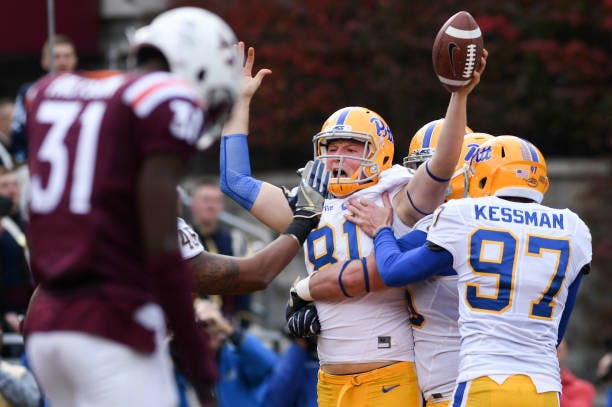
The teams that you face now are usually of equal or greater caliber.
Solid offensive performances are still built around the core of what you do that has got you to this point. However, being able to strategically add an explosive play through the use of some kind of deceptive or trick can provide the spark plug you need to overcome your opponent.
Here’s Five Keys for Using Trick Plays:
Know your opponent and what players on defense are quick to react to an initial key. Plan your attack here.
Decide when and where are the appropriate time to use these plays. Most of the time these plays are effective when the game is tight.
Set up the play to fit into what you do. Use looks and formations that are already part of your game plan. A formation the defense hasn’t seen sometimes causes them to play less aggressively and could be an indicator that you are doing something out of the ordinary.
Practice your plays but not too much. Give it a few team reps and over the week and that’s all. If there is a key mechanic involved with ball handling or a pass, let the players involved practice it separately.
Have fun! These plays are always fun when they work out and the players love to execute them.
There are many possibilities for the tricks you can design. Here’s three unique trick plays to get your creative juices flowing.
#1) “Tony Disco” from Shawn Liotta
Shawn Liotta has plenty of gadgets that work. This is one he let his players name and they called it “Tony Disco.” It’s a variation of Philly Special, and is great in the red zone. The Speed sweep action gets the defense flowing immediately and leaves them exposed on the opposite flank for the TD.
#2) “Razorback” by Rick Darlington
He’s known for his explosive offense, and he’s not shy about using trick plays. Coach Darlington put this play into his arsenal after seeing Gus Malzahn run it while he was at Arkansas, thus the name. Again, sweep action gets the defense moving and both the player aligned at QB and the TE on the crossing route are wide open. Coach loves this play against defenses who play man coverage.
#3) Eric Marty’s Tight End Toss Pass
Eric Marty, offensive coordinator at Grambling features another play borrowed from one of the great coaches in the game, Steve Spurrier. This is one that has fly motion, a toss to the tailback, and a throw to a tight end that delays his release. All of the action in the backfield, and the initial block of the TE allows him to get lost in the secondary even though, as Coach Marty points out, they prefer not to run it against this coverage. It works anyway. It’s another play that’s good in the red zone.
Trick plays are always an opportunity to change the game and put your team ahead.
Here’s one more resource with all-22 video of 95 trick plays if you are still looking for ideas.


The sprint out game provides a diverse package that builds upon other components of the passing game. Overall, the concepts used in an offense can be adapted to fit the quarterback on the move.
Sprint out fits into any offense and any type of personnel grouping. It’s simple to teach and it gives an offense efficiency in moving the ball down the field.
Kevin Kelley, who spent the 2021 season as the head coach of FCS passing leader Presbyterian, starts by pointing out a flaw in the thought process that many coaches mention as why to not sprint out...that it “takes away half of the field.” His answer is simple. You aren't taking away half of the field because they have to cover the other half of the field.
The ability to move the pocket and the launch point of the quarterback can help create and attack holes in defensive coverage.
Moving the launch point certainly is a way to alleviate pressure and get the quarterback cleaner looks. For the offensive line, the movement will help them as well.
As mentioned, changing the launch point to deter pressure is a big benefit offered by the sprint out passing game. The protection is relatively simple and doesn’t require the refined technique of the dropback game. Where the dropback game protection forces an offensive lineman to deal with two-way go’s as well as having to be sound in twists and stunts, the movement of the pocket simplifies both technique and scheme.
Matt Drinkall, TE Coach at Army, begins with the understanding of protection being full-gap 7- man protection. He doesn’t like to call it turnback. He sets it up so there are two protecting the front side edge. His version of sprint out allows the QB to get on the move but be set up to throw which he feels gives a higher completion percentage, especially when moving to the opposite side of his throwing arm. Here’s how he does it.
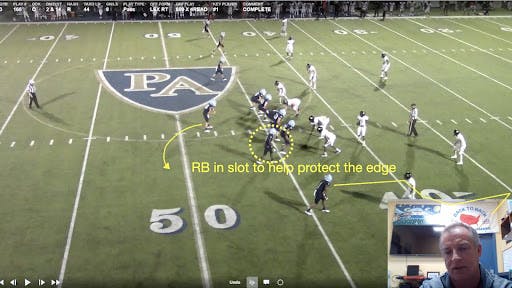
With a spread set, the protection can be adapted to six-man with the single running back utilized to protect the front side edge.
Like Coach Drinkall, Eric Marty, now the offensive coordinator for the USFL Michigan Panthers doesn’t teach the protection as a turnback, and he never asks a lineman to reach a frontside defender. This philosophy makes it much easier for the offensive line. He explains how they protect against an even front with the single running back assigned to the frontside edge.
Concepts
The concepts for sprint out can be very simple and build off of each other. Coupled with some compliments, this is a segment of an offense that defensive coordinators will have to spend time planning to stop.
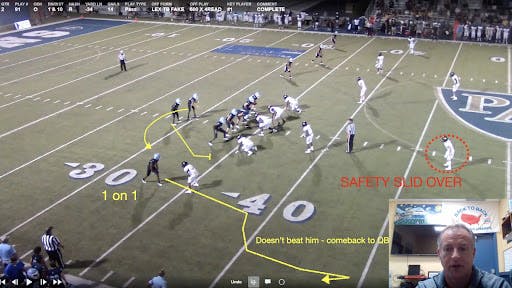
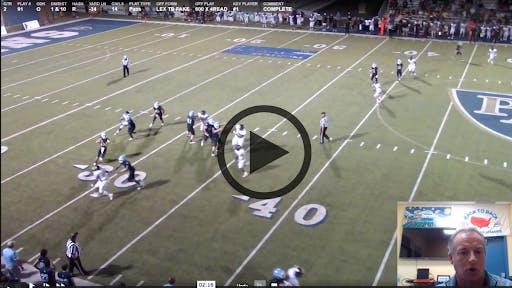
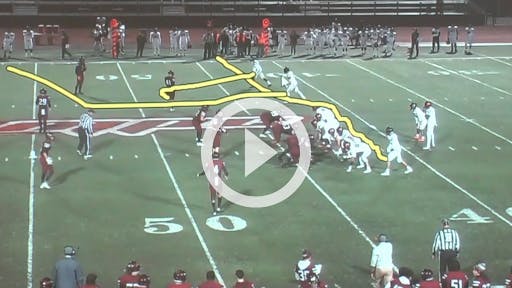
To start with, sprint out can be used from any type of formation 3x1, 2x2, 3x2, and 4x1. For Coach Kelley, it starts with something simple like a one-on-one to the single WR side. The safety is slid over and not in a great position to help. The WR will run and out-and-up but come back if he doesn’t beat the corner as illustrated below.
In this example, Coach Kelley moves the running back into empty to put him in a position to help on the edge. The same out-and-up with comeback rule is run.
He illustrates the multiplicity of the concept and when run against looks that he shows is unstoppable when executed properly, Coach Kelley breaks down all of these examples in this video
Once more receivers are added to the sprint out, the possibilities of how to attack the defense expand. Coach Drinkall likes to incorporate some form of smash with one route attacking vertically and another route attacking the flat. He explains his outside concept in this video.
Many offenses utilize the Snag concept which allows for a quicker timing from dropback as well as multiplicity from the types of 3-man surface formations and personnel groups. Coach Marty loves the concept as part of his sprint-out attack. Like Drinkall mentions, it does create a type of smash concept with a high-low to stretch the defense and attack zone coverage. It also creates some natural traffic for defenders to negotiate which makes it a great man-beater as well. He explains it here.
Those are just a few examples of how concepts can be adapted to sprint out. The idea is to be efficient in teaching so that dropback and sprintout concepts do not need to be exclusive to one category. The carry-over will cut down teaching and allow for route technique to be perfected.
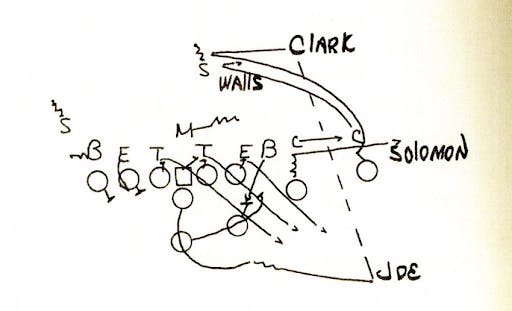
It fits into any field zone and virtually any down and distance. Bill Walsh made a living on Sprint Right Option with his Hall of Fame quarterbacks Joe Montana and Steve Young. Sprint right option is still a play that can be seen at every level of football. Many times it is a play reserved for the goal line area because it creates rubs and allows receivers to get open in an area with reduced vertical space. (see diagram below):
Coach Kelley carries an entire menu for this area of the field. He shares his variations in this video.
Complimentary plays
In general, any effective concept in an offense warrants the use of complimentary plays. Defenses work hard to take away effective plays thus opening opportunities to use other plays to exploit the weaknesses the defense creates to stop a concept.
Coach Drinkall thinks about how movement affects a defensive back who has to stop the sprint out and he creates concepts to take advantage of that.
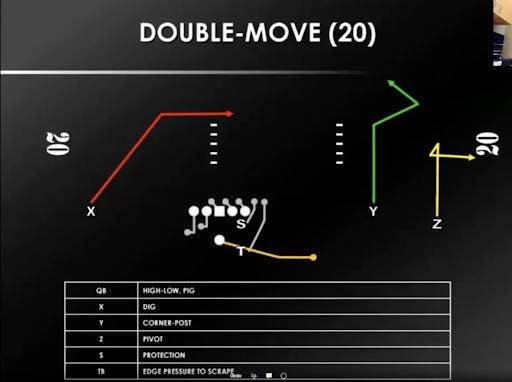
His first idea is to tag a double move which takes advantage of an overplay by the defensive back. When the defender is jumping a corner route, utilizing a corner-post allows for a big play opportunity. Remember, in his version of the sprint out, the QB sets his feet to throw, thus making this a viable option. It would be much more difficult on the run for the QB. He illustrates it in this diagram.
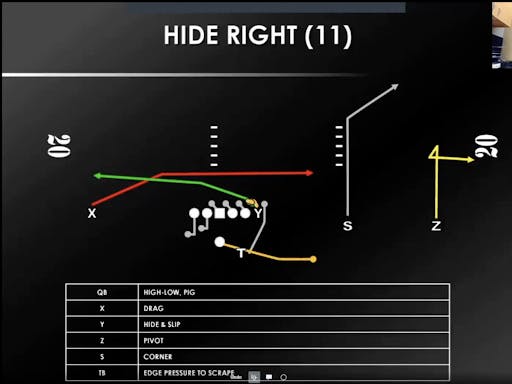
Compliments don’t have to be shot plays all of the time. Simply attacking the linebacker movement to the sprint out side creates opportunities for a short pass and run after catch with a drag or shallow.
In addition, throwback screens, sprint draws, and even trick plays can be built off of the sprint out concept.
Changing the launch point is a smart way to take away the effectiveness of pressure. Because it can incorporate the concepts used in dropback, it’s an efficient way to provide the offense multiplicity. With a little thought, even a small package can be developed for an offense to realize these benefits.

 " "
" "