Our website is bursting with over 500,000 products, across a variety of
easy to search categories. Simply Wholesale offer a vast range of
products, ranging from home decor, furniture, electronics, pet supplies,
fashion, beauty, jewelery, sporting goods.
When warm weather arrives it's time to think about new lawn games. This knock-down toss game by Randy & Travis Machinery is one you'll play over and over. With its X-shaped base it can stand anywhere-concrete lawn or even sand. The concept is simple. Learn more......
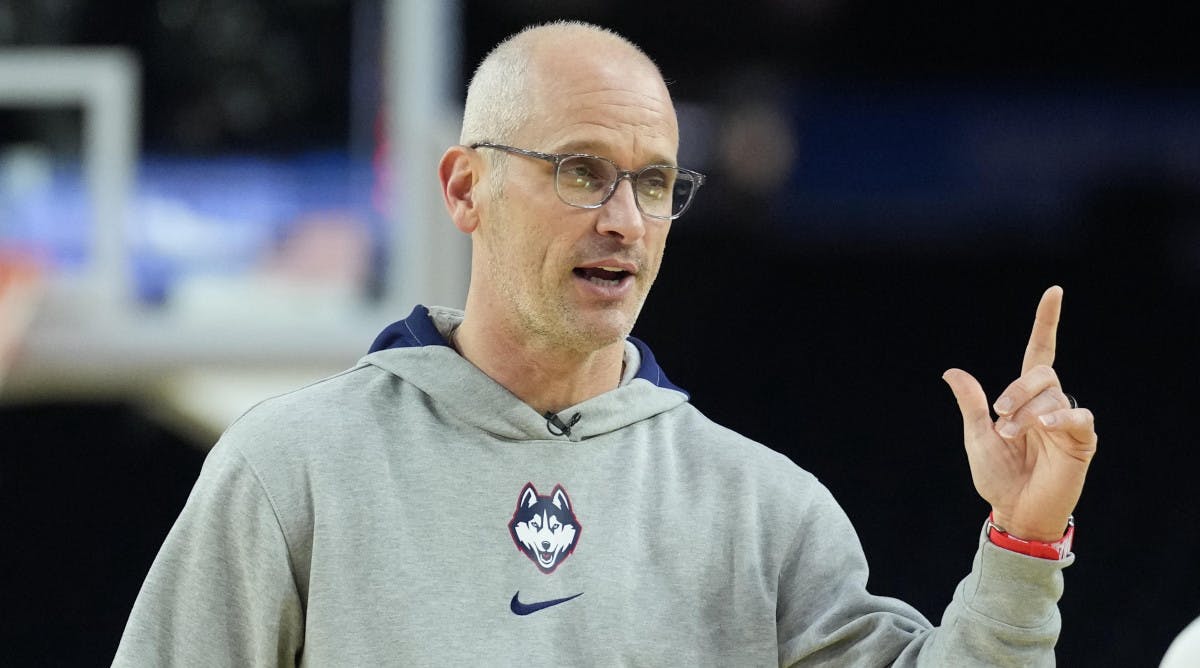
The UConn Huskies men's basketball team has established themselves as the preeminent force in college basketball, securing consecutive NCAA championships through their sophisticated and multifaceted offensive approach and college basketball practice plans. Esteemed coach Dan Hurley's offensive philosophy has transformed the Huskies into a juggernaut that opponents simply cannot contain.
UConn's offensive brilliance stems from their exceptional balance. Unlike teams that rely heavily on a single star player or particular offensive scheme, the Huskies deploy a fluid system that maximizes each player's strengths. Their inside-out approach creates defensive dilemmas for opponents who must contend with UConn's powerful post presence while simultaneously respecting their perimeter shooting.
Ball movement defines the Huskies' attack. Their willing passers consistently find the open man, resulting in high-percentage shots. UConn's offense functions less as five individuals and more as a cohesive unit with the basketball flowing naturally to create optimal scoring opportunities.
Their spacing and floor balance deserve particular recognition. The Huskies stretch defenses with shooters positioned strategically around the arc while maintaining threats near the basket. This spacing creates driving lanes and passing angles that allow UConn to attack from multiple positions on the floor.
Perhaps most impressive is UConn's adaptability. They can play uptempo or grind out possessions, dominate inside or rain threes, depending on matchups and game situations. This versatility makes them nearly impossible to prepare for and explains their sustained success across different tournament opponents.
With consecutive championships secured, UConn's offensive philosophy has established a modern blueprint for college basketball success—one built on balance, unselfishness, adaptability, and collective excellence rather than individual heroics.
UConn utilizes an extensive offensive playbook that they return to whenever they need to create offense. In his ‘UCONN Huskies Basketball Video Playbook’ clinic, Scott Peterman (who has coached at the NCAA Division 2, NAIA, and JUCO Levels as well as high school) details over 120 plays that UConn has used on offense. We have pulled five of them that you can install into your own basketball offense.
The first UConn offensive play we’re going to discuss starts with the ball handler bringing the ball up with their four teammates at the four corners of the paint. Both guards are on the blocks while the post players are at the elbows.
One guard back cuts to the far side corner while the other guard slips across the paint, where they will receive a back screen from the post player on the far side elbow. After that screen, that guard will flash to the wing, where they’ll get a pass from the ball handler.
Then that same post player will set a screen for the other post player at the other elbow, prompting the guard with the ball to come across the top of the key and look for the guard in the corner, the initial ball handler crashing to the paint, or the post player still at the elbow. And if a shot isn’t there, a pick and roll can then be run along the wing.
Chin Floppy
This next UConn set play starts with the ball handler dribbling along the wing before doing a dribble handoff with the corner guard who’s flashing up. At the same time, the post player on the near-side block cuts up to the elbow.
From there, the post player who’s at the weak side elbow sets a down screen for the wing in the other corner. The ball gets swung to this player, then the post player who cut up to the elbow sets a back screen for the initial ball handler while the other post player who started on the weak side elbow sets a ball screen.
Then the initial ball handler received a baseline screen, which should open them up on the weak side corner.
This next UConn play is called Delay Downslip, and starts with three wings and a primary ball handler with the center on the block.
The play begins with the center popping to the top of the key before receiving a pass from the ball handler. The ball handler then slips a down screen for the near wide wing player in the corner before cutting to the basket, ideally receiving a pass from the center and getting an easy layup.
Double Flare
The next play is called Double Flare, which begins with the ball handler along one wing before a guard in the far corner receives a double screen from the two post players, who are each positioned at the top of the key.
Once this guard receives the ball, the post player who set the first screen for them will pivot then set a second screen for the other post player who will be closer to the top of the key. While this is occurring, the initial ball handler and the other wing will exchange places on the weak side.
After receiving the screen, the post player can either cut to the basket or flare to the three-point line depending on their skill set or what becomes available.
The fifth and final UConn play we’re sharing is called Horns Flare, which begins with the two post players at the elbows and two guards along each wing. The ball handler will get a screen from the strong side post player at the elbow.
From there, that screener will receive a flare screen from the other post player at the other elbow. If this screen is overplayed, the one receiving the screen can cut toward the basket.
Sports help kids #GetActive and learn new skills – but don’t forget about fun! Learn about @HealthGov’s National Youth Sports Strategy and help make fun the top priority in #YouthSports: https://bit.ly/2lIHPUc
Kwame Brown joins the show in a special appearance to discuss Stephen A. Smith's threat toward Cam Newton. But before we get to Kwame, Jason explains that the Chicago Bulls' release of Jaden Ivey is additional evidence that the NBA is scared of the LGBTQ movement. In fact, Jason contends that the Alphabet Mafia controls American sports. Anthony Walker, Virgil Walker, and Dre Baldwin further the discussion regarding sporting events embracing Pride Night and the backlash Ivey is experiencing. Also, Jason breaks down another Stephen A. Smith breakdown over Cam Newton’s claim that loyalty isn’t a factor in the media today.
OneHanesPlace is your online outlet for Playtex, Just My Size, Bali and Hanes. Enjoy low prices on a huge selection of bras, panties, hosiery, socks, activewear, shapers, more!
Josh Pate joins Crain & Cone to discuss several coaches, both older who could be under pressure as well as newer who could have great first season, around college football. Now streaming on US Sports Radio.
The NordVPN service allows you to connect to 5600+ servers in 60+ countries. It secures your Internet data with military-grade encryption, ensures your web activity remains private and helps bypass geographic content restrictions online.
Maidenform.com offers bras, panties and shapewear for modern women with their own fashion sense. Shop for t-shirt bras, bralettes, push-up bras, thongs, hipsters, boyshorts, body shapers and more at attractive prices.
She grew up in church.She wanted to be the next Beyoncé.
She chased Greek life, black culture, fame, validation, and the “full experience.”
Then God confronted her with one sentence:
“It’s either Me or Delta.”
In this powerful conversation, LaLa Jenkins shares her testimony of growing up in church but not truly knowing Christ, being pulled into black idolatry, celebrity obsession, sexuality, step culture, Delta pledging, and ultimately being called out by God. Now streaming on US Sports Radio
Duo may be one of the most misunderstood plays in football. Many coaches identify it as an inside zone, but it is actually a gap scheme. The rules, footwork, hand placement, and read of the running back are distinctly different than on a zone play.
The teams that understand it best utilize a certain kind of formation structure that creates advantages and allows them to run the ball against what even appears to be a stacked box.
NFL veteran offensive line coach Paul Alexander explains the duo and how it is different than inside zone in this video. Alexander explains, “Most call it an INSIDE ZONE play… even many coaches and television analysts have it confused. But it’s not ZONE. It’s GAP.”’s GAP.” If you want to run gap schemes but are not comfortable with your linemen pulling, then Duo is the play for you.
Why Duo?
While it may be misunderstood, it is an extremely valuable play for an offense to run the ball effectively. Doug Socha, head coach at Keiser University explains why you should utilize the Duo play in this video. Are you an RPO offense? Perfect! You can utilize Duo in your RPO game.
There’s no one better to answer that question than long time NFL coach and offensive line guru, Jim McNally. This is an especially good run against the 3-4 and under front which have increasingly been utilized by defenses. McNally diagrams the play against both fronts and gives some technique coaching points in this video:
The best running teams are using it!
It is used extensively in the NFL, but that does not mean it is complex. One of the best offenses in the NFL, the Baltimore Ravens, used it extensively last season because it fits their philosophy of being simple. The Pistol set with Lamar Jackson is a big part of the equation in creating the advantage. Coach Alexander explains how it fits into the philosophy and strategy of the Ravens offense in this video.
If you are looking for that one play that can provide your offense simplicity, versatility, and an attitude, then the Duo play is worth researching further.
Best of luck as the re-opening of football nears!
Coach Keith
Everyone has a role to play in the National #YouthSports Strategy! Learn more about the strategy and ways to get involved from @HealthGov: https://bit.ly/2lQ85f6
Being able to throw strikes is the most important part of youth baseball pitching. We have all seen youth baseball games that drag on forever because the pitcher can’t put the ball over the plate.
While most kids are worrying about trying to throw the ball as hard as possible, or asking when they can learn how to throw a curveball, actual success on the mound stems from throwing consistent strikes.
And because a kid’s enthusiasm for baseball is strengthened by succeeding, teaching kids how to be accurate while pitching is a paramount part of increasing their enthusiasm for the sport.
Coach Scott Shepperd knows a thing or two about properly teaching pitchers. Shepperd recently served as pitching coach at the University of Texas, San Antonio for two seasons. Prior to that, Shepperd was the pitching coach for Hallmark at Incarnate Word the previous two seasons. Under his tutelage, the Cardinals pitching staff lowered the team's ERA by more than three runs per game. His nine years of coaching at the Division 1 level have taught him a ton about what it takes to build and maintain a successful pitching staff.
And while succeeding in Division 1 baseball requires much more than succeeding at the game’s lower levels, the first and foremost part of the equation is throwing strikes.
Shepperd’s ‘Developing Strike Throwers’ course takes coaches through all of the different components of teaching accuracy on the mound. He details the various mental and physical aspects that go into this endeavor, and we have pulled a few of our favorite lessons from Shepperd’s course, and distilled them into easily digestible sections that should provide you with a better idea of how to make your own pitching staff throw consistent strikes.
One of the most common misconceptions when it comes to throwing consistent strikes is that pitchers should remain on the corners of the strike zone. This is often because young catchers will be setting up on the outside corner, prompting their pitcher to throw it there because they’re afraid of their pitcher leaving it over the middle.
Aside from when the game plan is to expand the zone in a strikeout situation, Coach Shepperd instructs his catchers to always set up over the strike zone’s middle.
“We’re encouraging the pitcher to throw the ball over the plate, and encouraging contact,” Coach Shepperd says.
He then discusses how he never uses the term “perfect pitch” with his pitchers. The reason he avoids doing so is because it makes pitchers feel a need to pinpoint a ball to a specific spot, rather than execute their pitch to one segment of the strike zone. And this usually doesn’t lead to good outcomes.
One important point Coach Shepperd alludes to in this section is that the art of executing pitches has just as much to do with the catcher as it does with the pitcher. The way a catcher sets up, frames, and generally receives the ball can often be the difference between a ball and a strike.
This is important for youth catchers to understand as well, so they can keep that in mind as they continue to progress in the sport.
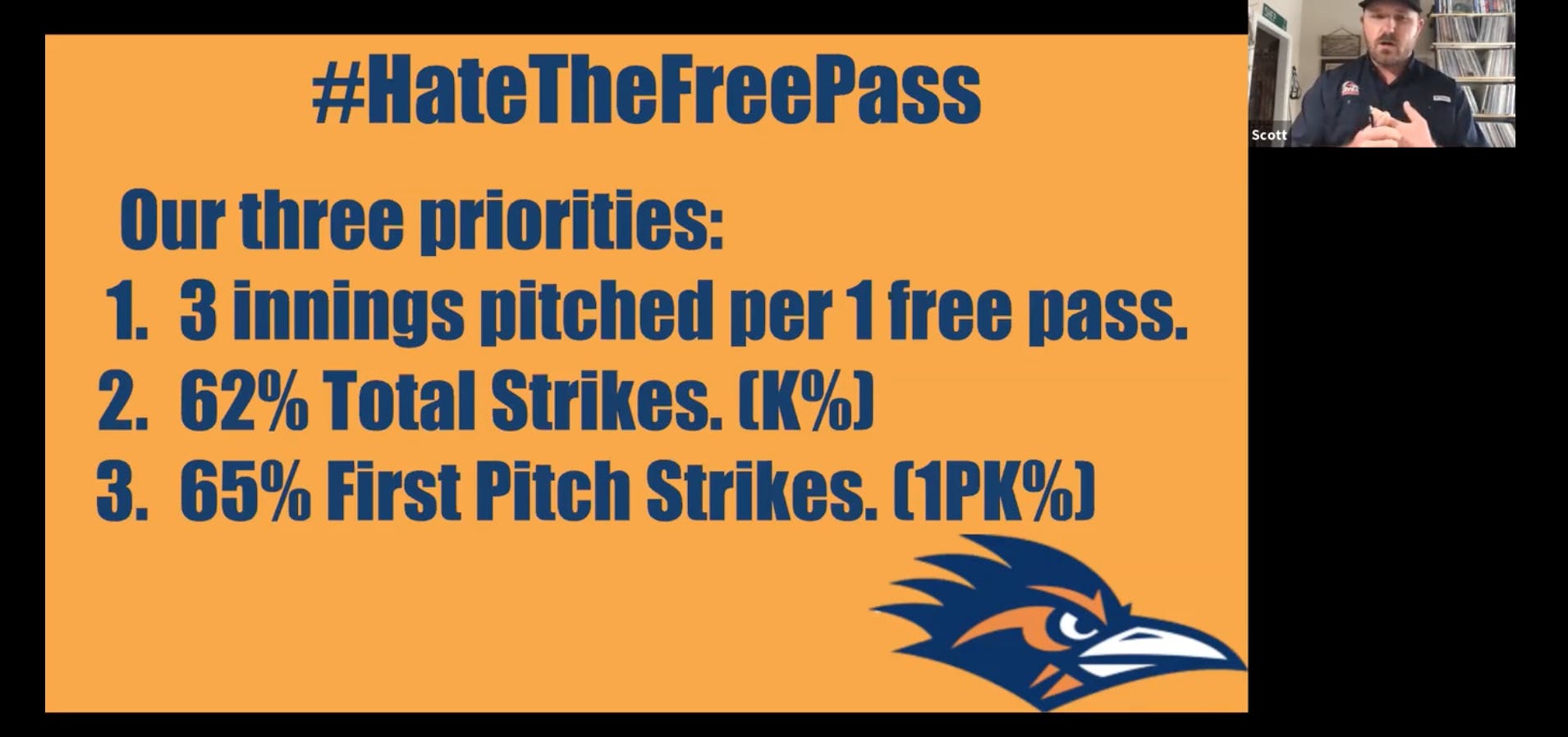
Coach Shepperd keeps his pitching staff’s focus on three priorities when they’re on the mound. Those three priorities (in order) are:
1. Only allow 1 free pass for every 3 innings pitched.
2. Have a 62% strike percentage.
3. 65% first pitch strikes.
The first priority is simple. For every three innings pitches, only allow one free pass (a walk or a hit by pitch). This equates to less baserunners, which equates to less runs scored and more games won.
The reason that Coach Shepperd decided on 62% for total strikes is because that was the MLB average for strikes that were thrown in the season he created these three priorities. And since then, Coach Shepperd has found that if his pitching staff has thrown 62% or more strikes in a game then it usually amounts to a good performance.
Coach Shepperd notes that the 65% first pitch strikes is the third priority because it’s the toughest to achieve. Yet, he keeps it at that number because it gives his pitchers a reachable goal, but is still tough.
Of course, none of these numbers are realistic if you’re coaching youth baseball. But the point is that regardless of what level you’re coaching at, minimizing free passes, throwing strikes, and throwing first pitch strikes should be a central priority for you.
Another important point Coach Shepperd drills into his players’ heads is that they’re in control of the game. They have the ball in their hand, and they’re in the diamond’s center. Yet, all they need to do is hit those three priorities to be a hero for his team.
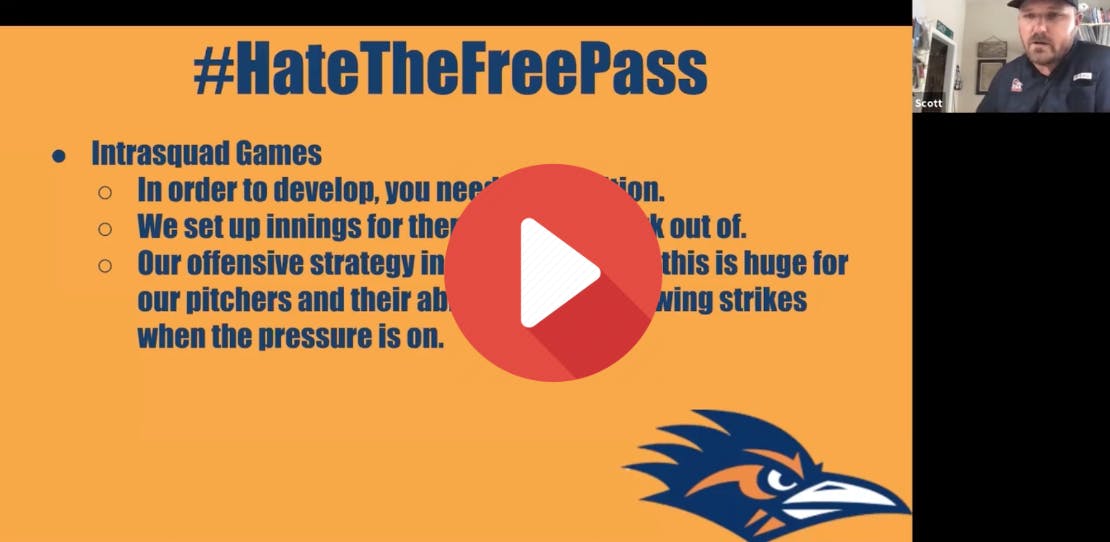
Coach Shepperd claims that intrasquad scrimmages (when his team divides into two smaller squads and plays) is, “our biggest factor in developing strike throwers, because we play a lot of them.”
He then discusses how his pitchers need to compete and feel the pressure during these moments when the games don’t count, so that they’re prepared for those feelings when the games do begin to matter.
In these intrasquads, Coach Shepperd will curate scenarios for his pitchers to perform under (such as, entering the game with runners on first and second base with no outs), in order to get those necessary repetitions.
Feeling the pressure is a main reason why pitchers struggle to throw strikes. Which is why getting pitchers acclimated to the pressure as early and as often as possible is crucial.
If your youth team doesn’t have enough players to field a full intrasquad scrimmage, you could set up a live batting practice, where a pitcher faces a series of hitters with little or no fielders aside from a catcher.
Utilizing Coach Sheppherd’s wisdom will have your pitchers executing strikes in short order.
Sports help kids #GetActive and learn new skills – but don’t forget about fun! Learn about @HealthGov’s National Youth Sports Strategy and help make fun the top priority in #YouthSports: https://bit.ly/2lIHPUc
US Sports Network News! Having fun and helping the peeps'. Using Sports as a platform to Inform, Educate, Inspire, While Entertaining you with the best of sports, talk, music, and fun. Be on the lookout for our frequent 'Teachable Moments' This will be a sports and media experience like you never expected. We always welcome your feedback. If you like us or even if you don't, we are always going to love you! Thanks for stopping by!