View the content of this inline frame with your browser
Sports USA Radio


Presented on US Sports by: Gorilla Wear
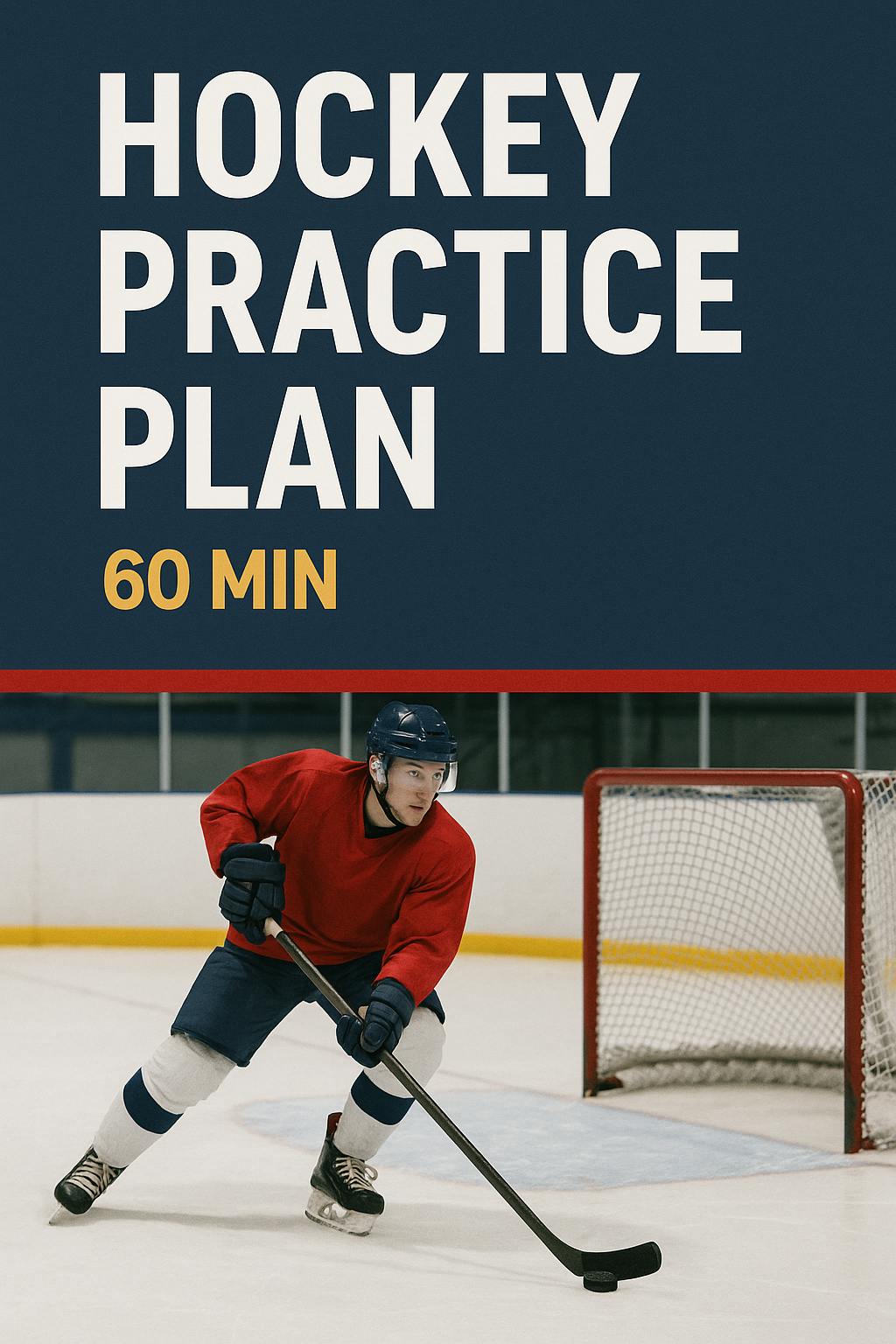
Designing a great hockey practice plan isn’t just about filling the hour—it’s about using that time to maximize player development, build habits, and prepare for real-game situations.
In this guide, you’ll get:
- A complete breakdown of how to structure your practice
- Example drills for each time segment (from warm-up to game play)
- Two proven drills pulled from elite-level coaching clinics
- Links to video demonstrations of featured drills
_____________________________________________________________________________________________________________________
Why a Hockey Practice Plan Matters
As a coach, you have a limited window to teach, correct, and motivate. A well-built plan keeps players engaged and ensures you’re hitting the right development goals each day.
A simple 60-minute practice might look like this:
0–10 minutes: Dynamic Warm-up – Get players moving and focused
10–25 minutes: Skill Development – Build core puck and skating skills
25–40 minutes: Situational Drills – Reinforce breakout habits and reads
40–50 minutes: Small-Area Games – Build pressure, pace, and creativity
50–60 minutes: Special Teams/Scrimmage – End with energy and fun
Presented on US Sports by: Dr Berg
Dr. Berg’s Electrolyte Powder supports hydration, healthy muscles, and high energy.
______________________________________________________
_______________________________________________________________
0–10 min: Dynamic Warm-Up
Drill 1: 3-Lane Warm-Up Skate
Objective: Activate key muscle groups and improve skating coordination
How it Works:
- Players skate in 3 lanes across the ice
- Each lane includes a different skating element (quick feet, crossovers, edge work, backward)
- Add pucks in later rounds to challenge puck control
Coaching Tips:
- Keep reps short and high energy
- Integrate communication (e.g., call for pucks, tap sticks, shout colors)
- Emphasize balance and edge control
_____________________________________________________________________________________________________________________
10–25 min: Skill Development
Goal: Build and refine technical skills in a focused, high-rep environment.
Work on: Skating, Shooting, Passing, Stickhandling, etc
Drill 2: Passing Progression Series (3 drills, 1 set-up)
Objective: Improve passing accuracy and awareness in multiple game-like situations
How it Works: Three-part drill series
- Stationary Passing – Players pass while standing still
- Passing Under Pressure – Add light pressure to challenge quick decisions
- Passing on the Move – Players pass while skating forward and backward
Coaching Points:
- Emphasize crisp tape-to-tape passes
- Keep head up and communicate through each rep
- Smooth transitions between stages for realistic pace
_____________________________________________________________________________________________________________________
25–40 min: Situational Drills
Goal: Teach team concepts like breakouts, offensive entries, or D-zone coverage
Drill 3: 2-on-1 Continuous
Objective: Reinforce offensive decision-making under pressure
- Drill starts with a 2-on-1 attack
- Defender stays, two new attackers enter for a new 2-on-1
- Cycle continues
Variations:
- Limit passes
- Reward goals with an extra attacker
_____________________________________________________________________________________________________________________
40–50 min: Small-Area Games
Goal: Push tempo, compete, and develop under pressure
Drill 4: Corner Battles
Objective: Build compete level, puck protection, and angling
- 1v1 or 2v2 in a corner or below the goal line
- Play for 20–30 seconds max
- Winner earns possession, next players jump in
_____________________________________________________________________________________________________________________
50–60 min: Scrimmage or Special Teams
Goal: Reinforce power play and penalty kill systems, finish with energy, have fun!
Drill 5: Sled Dog Race Drill
Objective: Build explosive lower-body power and skating strength through resistance
How it Works:
- One player kneels on the ice
- A partner grabs their stick or jersey and pulls them to the far blue line
- Run it as a race or timed event for fun competition
Coaching Points:
- Emphasize strong posture and stride from the pulling player
- Reinforce lower-body drive and arm movement
- Use cones or designated lanes to stay organized
Drill 6: Controlled Scrimmage (Half-Ice with Constraints)
Add constraints like:
- Goals only off passes
- One-touch rule
- Only 2 passes allowed in the zone
Let players have fun but still build habits.


Presented on US Sports Radio by: Champion Sportswear

Presented on US Sports by Blockchain Council.

Have you ever felt as if God were giving you the silent treatment? Perhaps you prayed and asked Him for direction but didn’t hear a thing.
When the Lord doesn’t appear to be answering our prayers, it’s natural to struggle. We may feel disappointed, discouraged, confused, or even angry. Some of us begin to wonder whether God has forgotten us altogether.
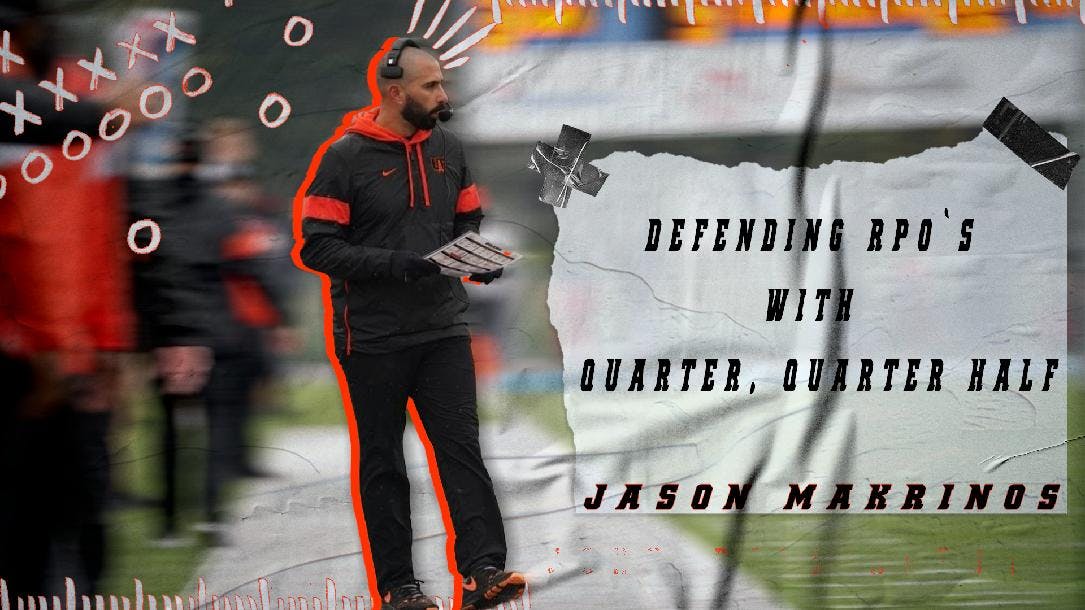
Good defenses and defensive coaches evolve, and that’s exactly what has happened for Jason Makrinos and the University of Findlay defense. Having lived in a quarters world for a long time, Coach Makrinos felt that his defense was constantly in conflict. That’s not a good thing in an RPO era where placing players in conflict is a key for offensive success.
That led him on a search for something better and allowed him to evolve his defense. He found it with quarter-quarter-half coverage. It gave him a run fit of a Cover 3, which allows a plus one in the box, but still allows him to be in a split safety coverage that allows him to play the field and the boundary how he would like it.
In 2019, it helped the Oiler defense to a #5 ranking nationally in turnovers. Everyone knows the importance of turnover margin as a key factor in winning.
Prior to coming to Findlay, Makrinos was the co-defensive coordinator at FCS Duquesne University. Makrinos coached a defense that statistically improved in multiple important measurables including: points allowed, pass defense, interceptions, and third down defense. In that season, the Dukes' red zone defense was seventh in the country in the FCS. He has the Oilers on that trajectory as well.
For Makrinos, quarter-quarter-half, or Cover 9, was an answer that helped take his defenders out of conflict. Playing coverages that allow for multiple forms of run support from a two-high look can allow for numbers advantages over offensive alignments.
A key to stopping RPO is determining where you want the ball to go. It’s something that you want to be able to dictate differently from week to week. The offense is always trying to manipulate the defense, but Makrinos takes that same approach to his game plan and what he is going to allow the offense to do, and what he will absolutely have the defense take away.
Why is this important? Maybe one week you face a top talent receiver who is dangerous with the ball in space. You probably want to take that option away and put it in the hands of someone different. Maybe the next week the running back is a difference maker that can pick up big chunks when there’s not an extra hat to stop him, but the receivers are average. Committing your numbers to stop the run would be the move that week. Considering what your defenders do best is also a factor. Strategic flexibility is a key to defensive success.
Consideration also becomes where on the field you want the ball. Do you want it on the field or the boundary? Where do you want your extra run support? These are all important considerations in game planning, and in designing your defenses for multiple answers.
This is an approach that is effective for the Oilers and Makrinos shares their Evolution, Communication and Structure, as well as their base Cover 9 Trick in free these videos:
The idea of having strategic flexibility on defense really allows you to put your players in the best situations. That’s alway been a number one priority for every staff I have coached on, and I am sure it is true for you. The way Coach Makrinos explains and illustrates this in his course gives you a powerful weapon in taking away the offense does best as well as highlighting your own strengths.
Get his course “Defending RPO’s with Quarter-Quarter-Half” and have better answers for your defense!
He shares his Cover 6 & Cover 9 as well as the various techniques and adjustments he uses, and illustrates all of it with game film. This offseason is a chance to evolve your defense, and like it was for Coach Makrinos, quarter-quarter half may be the answer.
Want to hear more Makrinos strategy and philosophy? Listen to him take a Deep Dive on Defense “Creating Turnovers” on Coach and Coordinator.

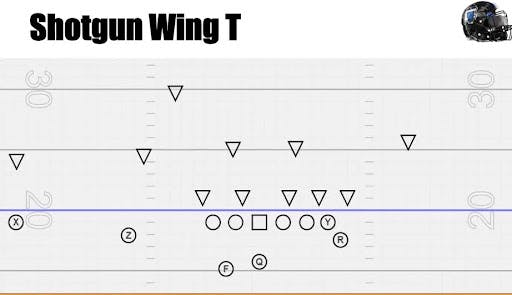
In the evolving game of football, offensive strategies are continuously changing to stay one step ahead of defensive schemes. One such evolution is the incorporation of the Run-Pass Option (RPO)on (RPO) into the traditional Wing-T offense offense. The Wing-T has long been the standard of high school and college football, known for its out of the box formations and deceptive running plays. But as defenses adapt, coaches are looking for innovative ways to take advantage of their offensive strengths. Enter the RPO—a game-changing concept that is giving Wing-T teams new life.
The Starting Point: Moving Out of the Traditional Under Center Formation
Before diving into the specific RPO Offense concepts, it’s important to establish one key point: to successfully run an RPO in the Wing-T offense, you need to make the shift from under center to the shotgun formation. Why? The change in positioning immediately creates a better perspective for both the quarterback and the offense as a whole to execute successfully.
When a Wing-T team lines up under center, it typically sees eight or more defenders in the box. This formation can often lead to unfavorable run situations, as there are simply more defenders in the area where the offense plans to run the ball. By transitioning to the shotgun formation and spreading out a receiver or two, the offense can gain a better count of defenders in the box, giving them a better opportunity to exploit mismatches in both the run and pass game.
This was something Nick Gerhts Gerhts, the head coach of Canyon View High School in Arizona, immediately recognized as a significant benefit. In his view, the move to the shotgun offers a clearer look at the defense, creating more opportunities for both the passing and running game. As Coach Gerhts explains in his video breakdowns, the key is not just the shotgun formation itself, but the variety of RPO concepts that can be run once you’re in that setup.
Three Key RPOs for the Wing-T Offense
Once the offense is set up in the shotgun formation, the possibilities for incorporating RPOs to your playbook are infinite. Let’s take a look at three specific RPO concepts that can be run within a Wing-T scheme, each one simple to execute yet capable of creating explosive plays.
1. The "Chevy" RPO: A Simple, Effective Hitch Route
Coach Gerhts is a firm believer in keeping things simple, and one of his favorite RPO concepts is the "Chevy". This RPO play combines a Belly running play with a quick passing option: the hitch route. The idea is to have the quarterback read the defense and make a quick decision.
Execution: The offense runs a Belly play to the right. The quarterback has 3 receivers running short hitches—one to each side of the field. If the quarterback notices an open window with one of the receivers, he throws a quick hitch route. If no one is open, or if the secondary is playing well against the pass, the quarterback hands the ball off to the running back on the Belly play.
Presented on US Sports by Real Life Self Defense.

a situation if the worst ever happens to them… or their family
Why It Works: The simplicity of the hitch route makes it an easy and consistent throw for the quarterback. Since it is a quick pass, it does not require elite arm strength, making it accessible to almost any quarterback. Note, for this RPO play, quarterbacks should be aware of throwing the ball too much inside on the hitch route, as it increases the chance of being picked off. By pairing the hitch route with the Belly run, this RPO effectively keeps the defense honest and forces them to respect both the run and the pass, keeping the defense off balance.
2. The "Buck Out" RPO: Using the Speed Out to Stretch the Defense
The next RPO concept to consider adding to your playbook is the "Buck Out" RPOOut" RPO, which pairs the Buck Sweep with a speed out route for the receiver. The speed out is a quick, boundary-oriented route that is incredibly effective against soft cornerbacks or defenses that are overplaying the inside running game. Coach Danny Norris explains here:
Execution: In this RPO, the offense runs a Buck Sweep, a traditional Wing-T running play designed to stretch the defense horizontally. The quarterback has the option to throw a quick speed out to the receiver lined up on the boundary. This route gets the receiver away from the outside linebacker and provides a quick pass option for the quarterback if the defense is giving up space on the edge.
Why It Works: The Buck Sweep Sweep is a well-established play in the Wing-T offense, and the addition of the speed out route puts even more pressure on the defense. The defense now has to cover both the outside and inside of the field, stretching their coverage and creating more opportunities for big plays. Because the receiver and running back are moving in opposite directions, this exposes the defense and allows the quarterback to make an easy read. Plus, just like the Chevy RPO, the speed out requires minimal arm strength, making it a viable option for almost any quarterback.
3. The "Trap Pop" RPO: Exploiting the Guard Pull with a Short Throw
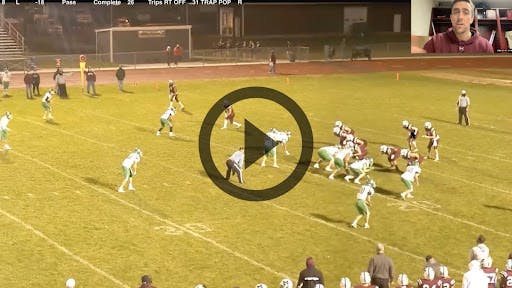
The third RPO concept is the "Trap Pop", which leverages the well-known Trap running play and adds an effective short passing option. The Trap is a highly successful run play, but without an RPO tag, it can sometimes attract too many defenders to the line of scrimmage, particularly linebackers who are disciplined in reading their keys. The Trap Pop RPO fixes that by introducing a quick pass to exploit the resulting defensive movement. Coach Mike Morrisey of Moline HS explains the “Trap Pop” RPO play here:
Execution: The offense runs a Trap play, where the guard pulls and leads the running back through a hole in the defense. The linebackers, reading the run, flow toward the trap action. As they do, the quarterback has the option to throw a short pass, known as the Pop pass, to a receiver or tight end who is likely to be open due to the defensive shift created by the guard pull. The pass is short, making it easy for the quarterback to execute, but it can open up a huge seam in the defense, allowing your big tight end or receiver to make a play in open space.
Why It Works: The Trap play is a strong running scheme, but it often draws extra defenders into the box. By pairing it with a quick Pop pass, the offense can take advantage of this extra pressure and find a vulnerable area in the defense. The beauty of this RPO is that the pass is short and simple, yet it can lead to big plays when executed well due to how it spreads the defense.
The Beauty of RPOs in the Wing-T Offense
What makes these RPO concepts so valuable in the Wing-T offense is that they do not require elite arm talent to be effective. The passes in all three RPOs—Chevy, Buck Out, and Trap Pop—are short and simple, but they create huge advantages for the offense. The key to success is the ability to read the defense quickly and make a fast decision, something that any quarterback can do with some training and practice.
These RPOs give the Wing-T offense a modern twist, allowing coaches and players to continue using the traditional running schemes they know while adding an additional layer of complexity to confuse the defense. The end result is an offense that is difficult to defend, forces the defense to respect both the run and pass, and keeps defenses on their toes throughout the game.
Conclusion: Always Be Growing
Incorporating RPOs into the Wing-T offense is a simple yet powerful way to stay ahead of the defense. As coaches like Nick Gerhts, Danny Norris, and Mike Morrisey have demonstrated, adding just a few RPO concepts to your playbook can have a massive impact on your ability to stretch the defense and make big plays. Whether you’re running a simple hitch route, a speed out, or an explosive Trap Pop, RPO plays provide a way to keep the defense guessing and create a more dynamic offense in this ever changing era of offensive football.

 " "
" "