Four Drills to Sharpen a Baseball Hitter’s Vision at the Plate
Baseball season is approaching fast, and improving a baseball hitter's vision and tracking skills is one of the most effective ways to prepare for the upcoming season.
Here are some reasons why focusing on vision and tracking can provide significant benefits:
1. Enhanced Pitch Recognition: One of the key
elements of hitting is the ability to recognize different pitch types
and their trajectories. By practicing drills that enhance pitch
recognition, hitters can improve their ability to anticipate fastballs,
curveballs, sliders, and changeups. This leads to better decision-making
when it comes to swinging or taking a pitch.
2. Improved Hand-Eye Coordination: Drills
that focus on tracking pitches help develop a hitter's hand-eye
coordination. This skill is essential for making contact with the ball
consistently. By practicing with moving objects—like balls thrown at
different speeds and angles—hitters can train their eyes and hands to
work in unison, which is vital for successful hitting.
3. Depth Perception Training: Visual depth
perception is crucial in determining how far the ball is traveling and
its speed. Drills that simulate various game situations, such as
tracking pitches from different distances or angles, can help players
develop a better sense of depth, allowing them to judge pitch speed and
distance more accurately.
4. Focus and Concentration:
Maintaining focus during at-bats is essential for success. Vision and
tracking drills often require intense concentration and mental
engagement. By consistently engaging in these drills during practice,
players can enhance their ability to focus during games, minimizing
distractions and helping them stay composed under pressure.
5. Game Situational Awareness:
Building vision and tracking skills also improves a player’s overall
awareness of the game. Hitters who are in tune with the pitcher's
mechanics and game scenarios can better assess their situations and make
smarter decisions at the plate.
A hitter's success at the plate begins with how well they see the
ball and react, making these skills vital to their development. This is
why baseball coaches must have several drills and techniques they can
use to sharpen their hitters’ vision.
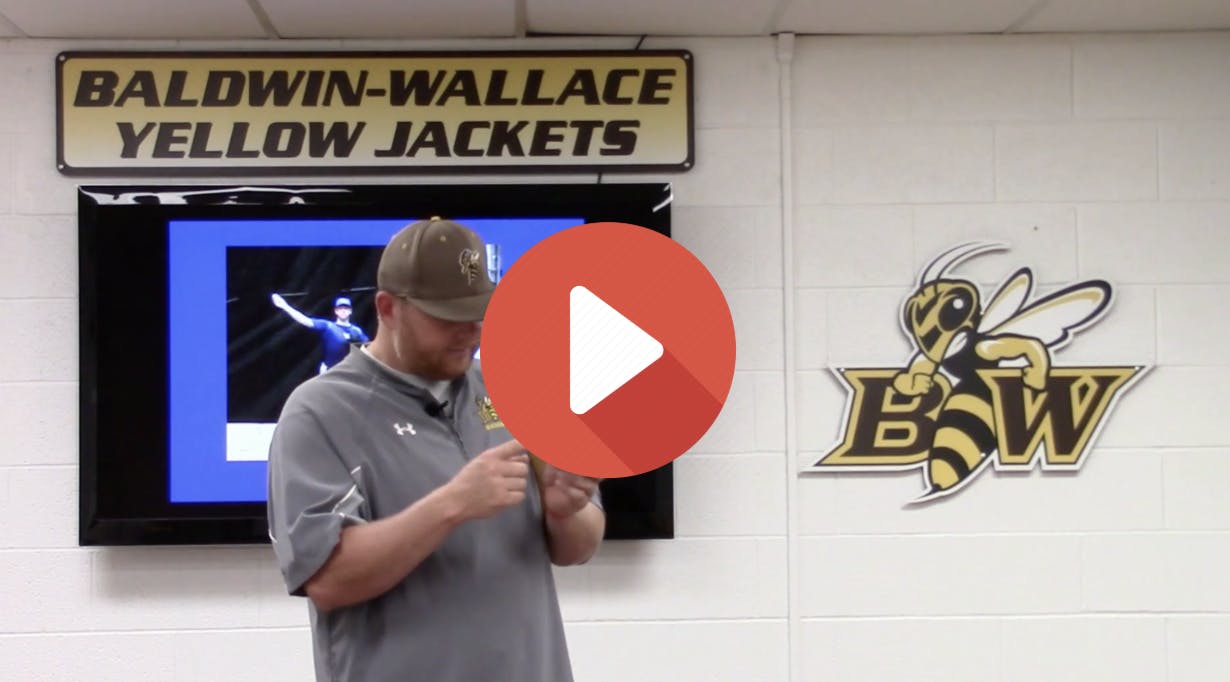
And Brian Harrison could have your perfect solution.
Brian
Harrison enters his 15th season as the Head Baseball Coach at Baldwin
Wallace University in 2025. The 2019, 2023, and 2024 Ohio Athletic
Conference (OAC) Coach of the Year has won 519 career games, including
378 at BW. Harrison has led the Yellow Jackets to the National
Collegiate Athletic Association (NCAA) Division III National Tournament
on seven occasions, including the school's first-ever trip to the
College World Series in 2014 and consecutive appearances in 2022 and
2023.
In his ‘The Complete Hitter’
clinic, Coach Harrison details several drills he has used to improve
his hitters’ vision at the plate, which we’ve included for your use
below.
Thumbs Drill
One hitting vision drill that Coach Harrison
swears by is what he calls the Thumbs Drill. This drill requires no bat,
balls, or batting cage, and instead requires a hitter’s complete focus,
because this drill is difficult despite seeming somewhat simple.
The hitter will put their two hands together with each hand’s
knuckles touching and their thumbs up, all about four inches away from
their face. From there, the hitter is supposed to cross their
eyes (which Coach Harrison suggests doing by looking at one’s nose) to
the point where they can see a third thumb in their vision, which should be positioned in front of the other two thumbs.
Once the hitter can see that third thumb, they’re going to work their hands back and forth in front of their face while still crossing their eyes (and still being able to see that third thumb).
This drill focuses on the two eyes working together, which is crucial for improving vision as a hitter.
Tracking Drills
Coach Harrison goes on to detail three specific
drills that he recommends using when it comes to improving a hitter’s
ability to track pitches.
The first one involves making dime-sized markings of different colors (ideally red, green, and black) on different points of each baseball they’re going to use for batting practice.
From
there, the hitters will step up to the plate against a pitching machine
that’s throwing around 95 mph fastballs. They won’t be swinging at
these balls, but rather saying out loud which color on the ball they see as it heads toward the plate.
The idea behind this drill is that it will force the player to focus intensely on the color, which will ultimately help them pick up on a ball’s spin once they develop that tracking skill.
Coach
Harrison’s next drill is similar, although it’s a bit more difficult
than the first drill and requires swinging the bat. The coach who’s
throwing batting practice (or a pitching machine can be used) is going to tell the hitter to divide the ball into quadrants (top-left, bottom-left, top-right and bottom-right), and that they should focus on hitting the ball at that specific quadrant with each swing.
This will help the hitter to be more situational in their approach when the game rolls around.
Coach
Harrison’s third and final drill in this section is similar to the
previous but will start with front toss. Therefore, this is a great
drill to start with during a hitting session that’s focused on vision
tracking.
With each front toss, the player should be trying to hit the ball on either the outside, middle, or inside part of the ball. This
will allow a player to work on their swing and teach their eyes to lead
the dance in terms of placing the ball at a certain place on the field
while hitting in a game.