
Now Streaming On US Sports Radio!

US Sports Net Today!


Live Play-by-Play, Updates, Highlights and More! on US Sports Network!
[Chrome Users-You may have to click on the play button twice to listen]
US Sports Network Powered By Gorilla Sports!


US Sports Radio
The Las Vegas Raiders Play Here
Fitness and Sports Performance Info You Can Use!
The Scoreboard Mall
The Rock Almighty Shaker Of Heaven And Earth!
The Coolest Links In The Universe!
Showing posts with label Baseball player baseball coach NCAA Baseball 2025 Baseball recruiting High School Baseball MLB Baseball draft prospect. Show all posts

Wednesday, December 3, 2025

US Sports Baseball Feat. The MOST EPIC home runs of 2025! (Ft. Rojas, Springer, Freddie, Judge, Shohei, Raleigh AND MORE!)

The MLB App is the #1 destination for live baseball video and audio, directly on your iOS device. Watch and listen live or on-demand! 
Which home run was the MOST EPIC in 2025?

US Sports Coachlab Baseball: Strength & Conditioning for the High School Athlete......

Presented on US Sports by CoachTube. Strength & Conditioning for the High School Athlete Elevate Your Performance! Join our e-course on Strength & Conditioning for the High School Athlete. Unlock your full potential with expert guidance tailored specifically for high school athletes. This course covers: Movement Issues in Baseball Players T-Spine Hips Ankles And much, much more Don't just train – transform into a powerhouse athlete! Book this course @ https://bit.ly/SandCforHSAthlete


Thursday, November 13, 2025

US Sports Baseball: US Sports Baseball: REACTION to Tarik Skubal and Paul Skenes winning 2025 MLB Cy Young Awards! 🤩

MLB
Download on the App Store


Presented on US Sports by CoachTube.

Featured course:
Pitching Fundamentals, Philosophy, and Drills is designed to be an invaluable resource for coaches and athletes who want to better understand the key elements involved in successful pitching.This course discusses pitching philosophy and points out the underlying elements of sound pitching mechanics.
Book this course:
https://bit.ly/3WPshfH

Video credit:
REACTION to Tarik Skubal and Paul Skenes winning 2025 MLB Cy Young Awards! 🤩
The MLB App is the #1 destination for live baseball video and audio, directly on your iOS device. Watch and listen live or on-demand!
@ Apple - https://apple.co/4gG5LyA
@ Amazon - https://amzn.to/4nSjlku

The Coolest Sports, The Hottest Talk, Music, and Fun.
News you can use
US Sports Radio
http://www.USSportsRadio.net

US Sports Baseball: Throwing Fundamentals: Drills, Techniques, & Tips


Pitching/Throwing Fundamentals, Philosophy, and Drills is designed to be an invaluable resource for coaches and athletes who want to better understand the key elements involved in successful pitching .This course discusses pitching philosophy and points out the underlying elements of sound pitching mechanics.

Book this course:
https://bit.ly/3WPshfH

The Coolest Sports, Talk, Music and Fun.
News you can use.
US Sports Radio
http://www.USSportsRadio.net

Monday, August 18, 2025

US Sports Baseball Four of Former MLB Pitcher Juan Nieves’ Movement-Based Pitching Drills and Illinois Vs. Hawaii Little League Baseball World Series Highlights


  • By Grant Young

Even the most naturally talented pitchers can fall short of their potential when mechanical flaws undermine their performance. 

The relationship between pitching mechanics and that pitcher’s success on the mound is both complex and fundamental to the art of pitching. Elite pitchers possess an integrated system where body movements work in perfect harmony.

When mechanical issues arise, they create a cascade of problems that can limit velocity, reduce command, increase injury risk, and diminish pitch effectiveness.

The kinetic chain in pitching requires precise sequencing—energy transfers from the ground through the legs, hips, torso, shoulder, elbow, and finally to the fingertips. Any disruption in this sequence compromises performance. Common mechanical issues include:

- Inconsistent release points leading to command problems

- Improper weight transfer, reducing velocity potential

- Flying open with the front shoulder, causing arm drag


- Insufficient hip-shoulder separation, limiting rotational power

- Timing discrepancies between lower and upper body movements

Movement on the mound is particularly critical. A pitcher's delivery begins with their stance and initial movements toward home plate. The stride, direction, timing, and body position during this phase establish the foundation for everything that follows. Inefficient movement patterns force the arm to compensate, often leading to decreased performance and increased injury risk.

The most successful pitchers in baseball history have combined natural talent with mechanically sound deliveries. Their movements appear effortless despite generating tremendous force because they've mastered the biomechanical principles that optimize performance.

Ultimately, mechanical refinement represents the bridge that allows raw talent to manifest as consistent excellence on the mound. Regardless of natural ability, pitchers who fail to address mechanical flaws will always perform below their true potential.

Of course, MLB pitchers have come closer to mechanical mastery than anybody else — except perhaps those MLB pitchers who have gone on to become pitching coaches at the highest level, who have both learned and taught pitching mechanics to the world’s best baseball players. 

And that’s exactly what Juan Nieves has done. Nieves played for the Milwaukee Brewers from 1986 to 1988 and threw the first no-hitter in Milwaukee Brewers history. After his playing career ended, he helped lead the 2013 Boston Red Sox to a World Series title as pitching coach.

Coach Nieves’ ‘Movement Based Pitching Techniques’ clinic is designed to break down the pitching delivery into focused, trainable movement patterns using a full progression of over 60 specialized drills, grouped by key areas of development and meant to train the body to move efficiently, explosively, and athletically—the way elite pitchers are built.

We have pulled four of Coach Nieves’ drills and included them as a snippet of what his full clinic can offer you. 

Figure 8 Drill
null

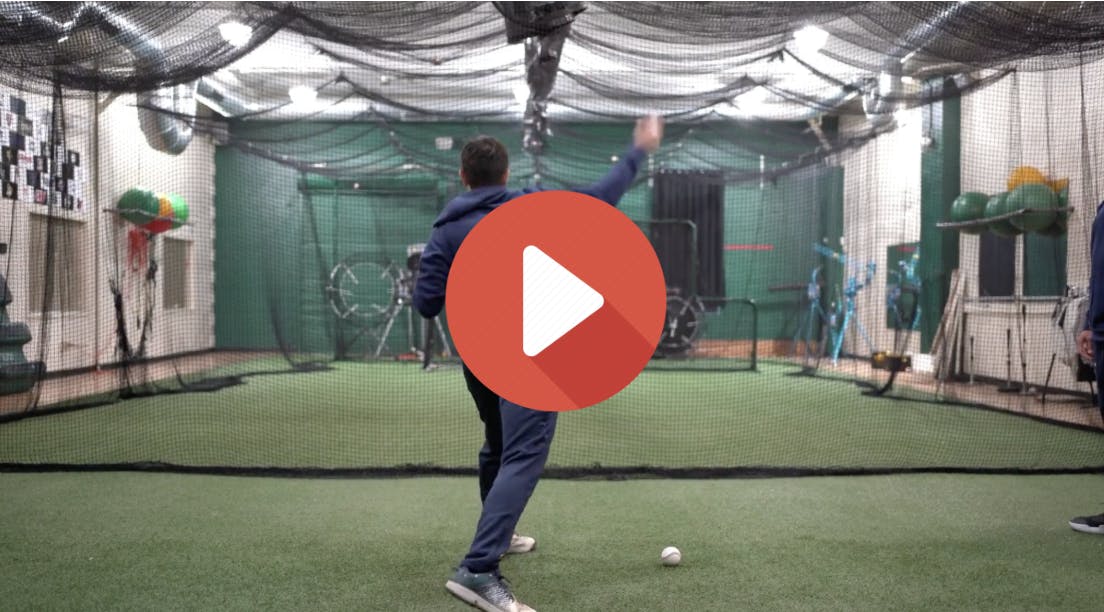
The first of Coach Nieves’ drills is an arm path drill called the figure 8, which is for pitchers to create less than a 90-degree elbow lead. 

The drill begins with the pitcher in their separation position, which simulates when their hands separate during their delivery. They’ll then mimic throwing to the plate, but instead of releasing the ball, they’ll do a figure eight motion with their throwing arm once before getting into their throw (which can be into a net or a fence). 

It’s also important that the pitcher find their rhythm with their lower body while going through their motion.

This is a great pattern for them to be more loose, fluid, and whippy with their arm action and overall delivery. 

Hinge Slide Drill
null

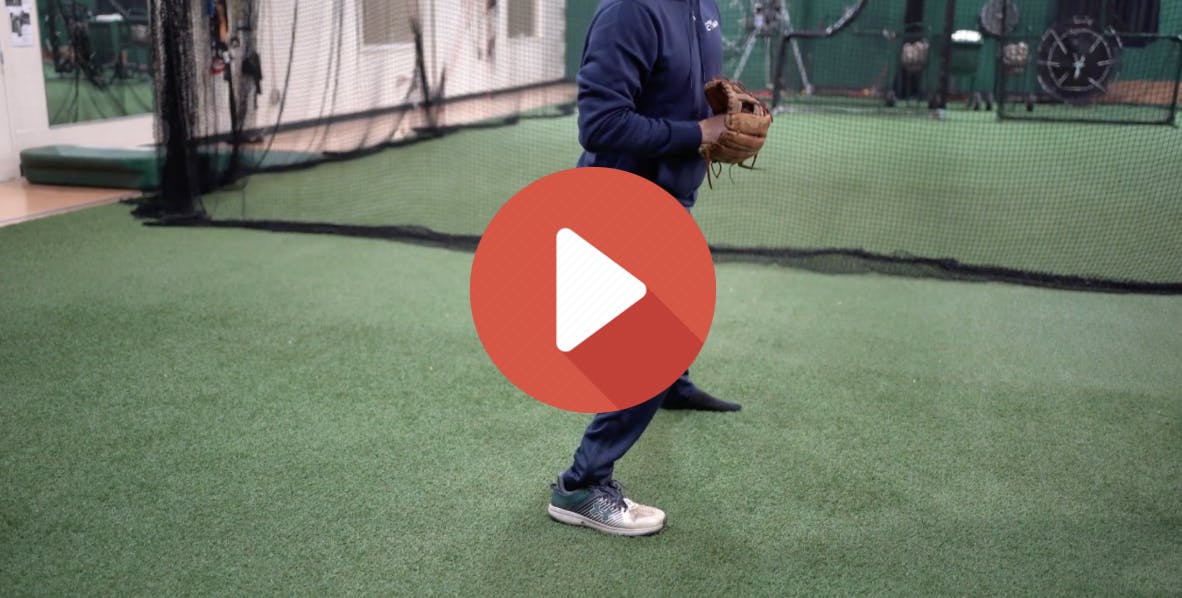
The next drill of Coach Nieves that we’re sharing is the Hinge Slide drill, which requires that a pitcher remove their front shoe (they also need to be on turf, grass, or another surface that will allow their foot to slide) and start in their set position.  

From there, the pitcher will slowly slide forward with their front foot while keeping their body weight on the back foot. They will do this until they reach their separation position, at which they’ll come back to their set and begin again.

The goal here is to feel that hinge slide with the back foot, which will help a pitcher better understand how to generate and sustain force (and thus velocity) with their back leg through their delivery. 

Front Shoulder Closed One-Legged Throws

The next of Coach Nieves’ pitching movement-based drills focuses on coordination and hip movement, ensuring that a pitcher isn’t over- or under-rotating during their delivery.

To address this, the pitcher will be in a set throwing position with their glove arm facing a net (meaning they’re looking to the side). They’ll then lift this leg off the ground and let it swing (while still maintaining their balance) as they make a throw into the leg, which will require them to rotate their hips. 

Scap Retraction Drill
null

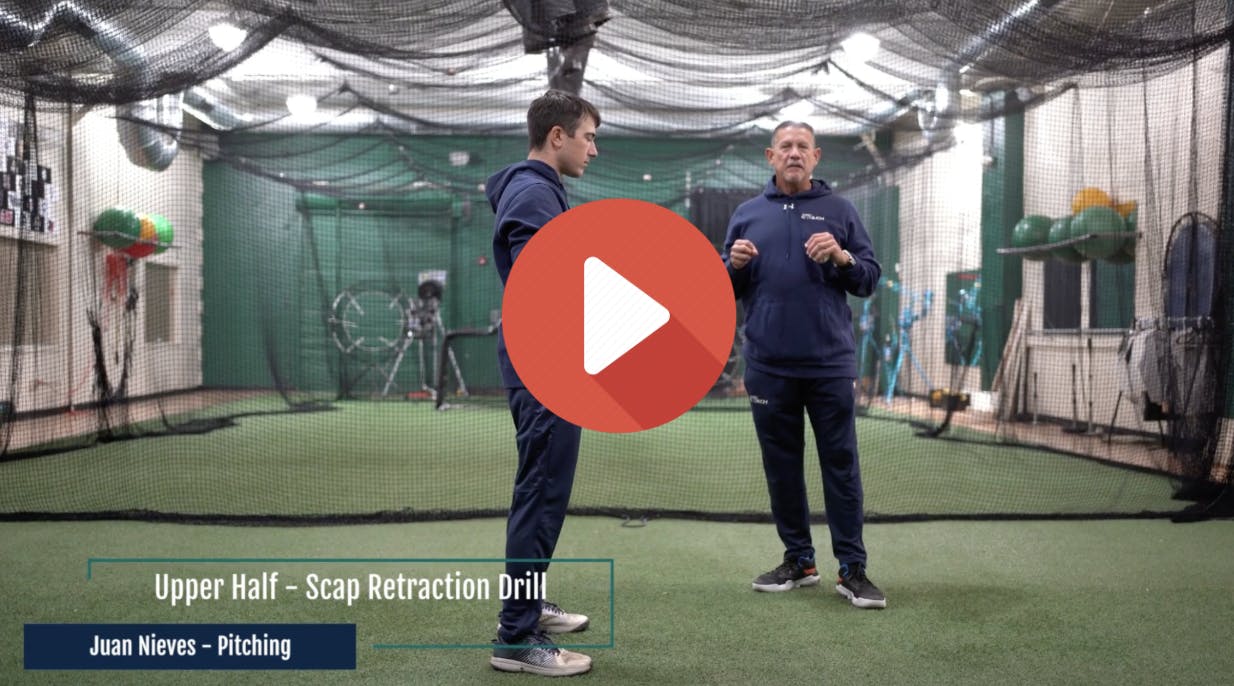
Lastly, Coach Nieves’ scap retraction drill is great for pitchers who, in his words, “put the pinball back” in their throwing motion, which is another way of saying a pitcher who isn’t activating their scaps properly during their delivery.

For this drill, the pitcher will be in their set position, with their glove hand facing the net, with their throwing arm fully extended in front of them. From there, they will bring their throwing arm back as far as possible without losing their natural elbow bend, then rotate and throw into the net. 

NYSS Every Kid In the Game

Saturday, July 19, 2025

US Sports Baseball: How to Teach Hitting to the Next Generation and Highlights from ALL games on 7/18!


  • By Grant Young

Many aspects of hitting will always remain timeless. 

Hitters will always want to shorten up and defend the zone with two strikes. They’ll be looking for a fastball or sitting on something else specific during a hitter’s count. And they’re sure to assert that they’ve checked their swing even if it’s clear they didn’t. 

Yet, many components of youth baseball hitting (especially about how it’s taught) have evolved in the modern era. For example, most hitting coaches have come around to having their hitters try to launch fly balls instead of trying to smack ground balls. 

But there are still some coaches who are struggling to adapt their lessons to the new generation of hitters. And that’s where Jerry Weinstein comes in.

Coach Weinstein is a legendary baseball coach who most recently served as the Catching Coordinator for the Colorado Rockies. Coach Weinstein also managed Team Israel at the 2017 World Baseball Classic qualifier, and returned as the head coach in the main tournament, managing Team Israel at the 2017 World Baseball Classic in South Korea and Japan in March 2017, where the team was 4-2 overall in the tournament. He has also served as the Rockies Offensive Coordinator and the manager of the Rockies Class A affiliate. 

Before joining the Rockies, Weinstein, who has over 40 years of coaching experience, was the pitching coach for the Cal Poly (San Luis Obispo) baseball team from 2001-05. Prior to his coaching stint with the Mustangs, Weinstein was the Los Angeles Dodgers Director of Player Development in 2000 and 2001 and also served as the Dodgers' catching coordinator in 1999. 

Coach Weinstein’s ‘New Age Hitting With Jerry Weinstein’ course is a masterclass on instilling modern offensive concepts into any team. We’ve pulled a few of the course’s most pertinent lessons to give you an understanding of how Coach Weinstein’s wisdom can propel your offense to a new stratosphere of success. 

Hitting is Balance, Rhythm and Timing

Coach Weinstein is convinced that success as a baseball hitter comes down to three components: balance, rhythm, and timing. 

According to Coach Weinstein, balance in hitting is, “being in your best athletic position throughout your swing.” He goes on to add that understanding the length-tension relationship (where muscles are being stretched during a swing) is an X-factor for hitters. 

This is essentially another way of phrasing the Physics law, “every action has an equal and opposite reaction”. And Coach Weinstein mentions it to make it clear how important the load and backswing are when it comes to hitting.

Coach Weinstein also discusses the importance of rhythm. In order to facilitate this he deems players should work to, “control movement to create timing as a result of small moves.” 

These small moves will depend on each hitter. It can be a swaying of the hips, jerking of the bat, or movement of the hands. But any means of creating rhythm (and, more importantly, aligning oneself with the pitcher’s rhythm) is a huge asset for the modern hitter. 

Coach Weinstein then combines balance and rhythm to discuss timing, which is his major key to a successful hitting swing. 

Coach Weinstein makes sure to note that every hitter’s swing is going to be (and should be) different. All that matters is that the swing is repeatable, accurate, and keeps the hitter healthy.

The goal for these three crucial components to a hitter’s swing is to consistently produce the best version of each hitter. 

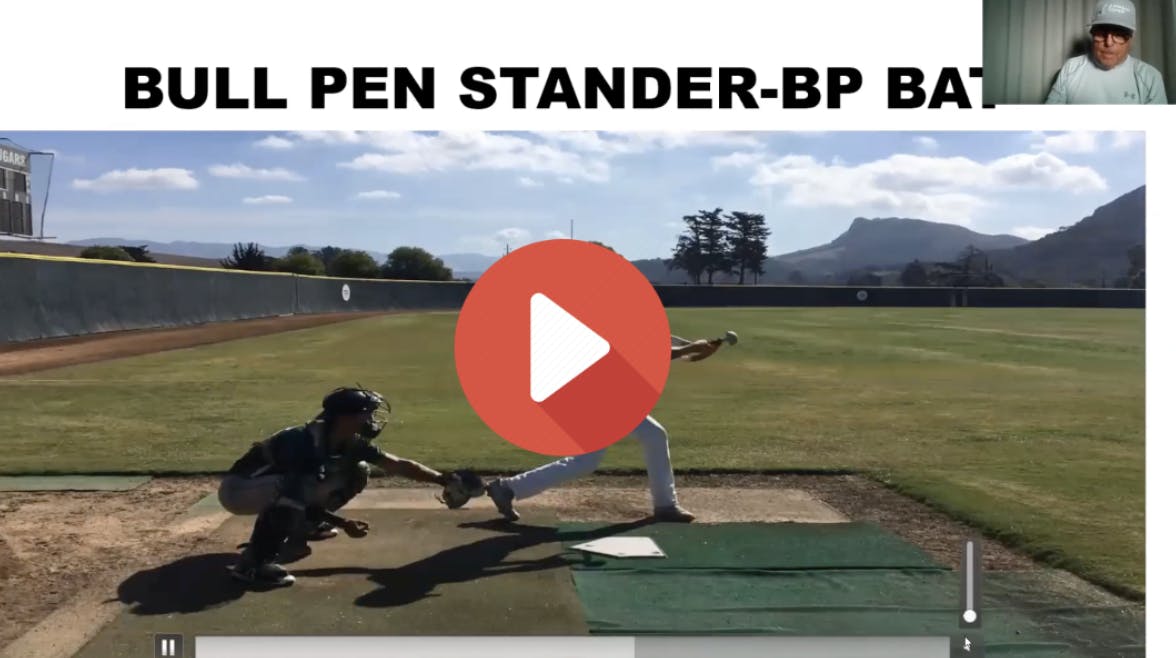
Bullpen Stander (Drill)

null

When it comes to drills Coach Weinstein believes hitters should be taking part in, one underutilized one is what he calls the bullpen stander drill. 

This drill is simple in practice: have your hitters stand in during your pitchers’ bullpen sessions. But Coach Weinstein suggests that hitters should not just be standing in and tracking the pitches they see. They should also be making actual decisions on whether to swing or take. 

This is an extremely effective drill for the hitter because it forces them to replicate the decision that they must make at the plate during each at-bat. Not to mention that it will afford them extra opportunities to see different pitches out of a pitcher’s hand, which should benefit them as well. 

Pitchers will also benefit from having a hitter standing in and tracking their pitches. In addition to this helping them simulate a real appearance, the hitter can also give the hitter feedback on what they’re seeing out of the hand, and whether a certain pitch looks like a ball or strike depending on their swing decision.

Therefore, this bullpen stander drill benefits pitchers and hitters alike. 

Off Center Oppo-Pull

Another great drill that Coach Weinstein recommends is the Off-Center Oppo-Pull drill. 

This drill takes place on the field during a typical batting practice session. Yet, rather than the BP thrower/L-screen being positioned in front of the mound, it will be moved off to in between the mound and third base line. 

The goal here is for left-handed hitters to hit the ball in between the L-screen and the third base line without having any tail or topspin. You’ll also want to put a bat or piece of wood in front of the hitter’s feet so they don’t dive over the plate. 

For right-handed hitters, their goal will be to pull the ball in between the L-screen and foul line (without spin or hook). 

It can also be moved to in between the first base line and mound, which produces opposite effects for the hitter depending on whether they’re a righty or a lefty.

This drill will force the hitter to get a great feel for their barrel and see what their natural inclination is when it comes to driving the ball.

NYSS FB Be A Role Model

Saturday, July 5, 2025

US Sports Baseball: 5 Reasons Why There Is More To Good Base Running Than Just Speed and Giants vs. A's Game Highlights


  • By Brandon Ogle

When a baseball player is fast, the first thing everyone assumes is that they are an elite level base runner. Too often someone with speed will still find themselves getting thrown out all over the field, because they don’t pay attention to the details of becoming a great base runner. Here are 5 reasons any one from slow runners to the elite speed players can become a better base runner.

#1 Ability To Read The Ball Off The Bat

An innate ability to get a great read off the bat can be the difference between a run scored and getting stranded at 3rd base. This skill comes from practice and game experience. The more balls off the bat you see, the more often you will be able realize when you can go ahead and get a great jump and when to hold and see if the ball is caught.

Another major part of this principle is knowing your ballparks - especially your home park. If there is an unusual nook or cranny where you know the ball gets stuck, or if the left field line is really deep, you know that it takes the fielder longer to get there, which allows you to take the extra base.

Be sure to practice these reads every day, anytime you go through base running drills. Before you know it, you won’t even think about whether a ball is going to land in the gap, your instincts will just tell you to go.

#2 Ability To Read The Pitcher

Rickey Henderson is the undisputed greatest base stealer of all time. Henderson was fast, but he will tell you that studying the other pitchers and using your instincts is the reason why he was so successful. 

Every pitcher’s delivery is different. Some take a long time to the plate; others incorporate a slide step to keep the runner honest. Some pitchers will change their timing every pitch, while others are locked in on the hitter. These are all tendencies you can see immediately as the game starts and that will arm your base running game.

Does the pitcher look over twice and deliver the ball every time? Then be ready to take off once you see that second glance. The first game of the 2015 baseball season, featuring Jon Lester of the Cubs versus the savvy Cardinals serves as a great example. Coming into the game, Lester has not made a pickoff attempt to first base since April 30, 2013, a period of 66 starts. The Cardinals knew this information and knew Lester wouldn’t be holding them close, so they ran every chance they got. When Lester did finally throw over a few starts later, he threw the ball into right field

Studying pitchers and learning how to read pitcher tendencies gives you a huge advantage. In the example above Matt Holliday, someone not known for his speed, was able to take second base and get himself in scoring position because the team had studied their opponent and knew how to take advantage.

#3 Become Excellent At Sliding

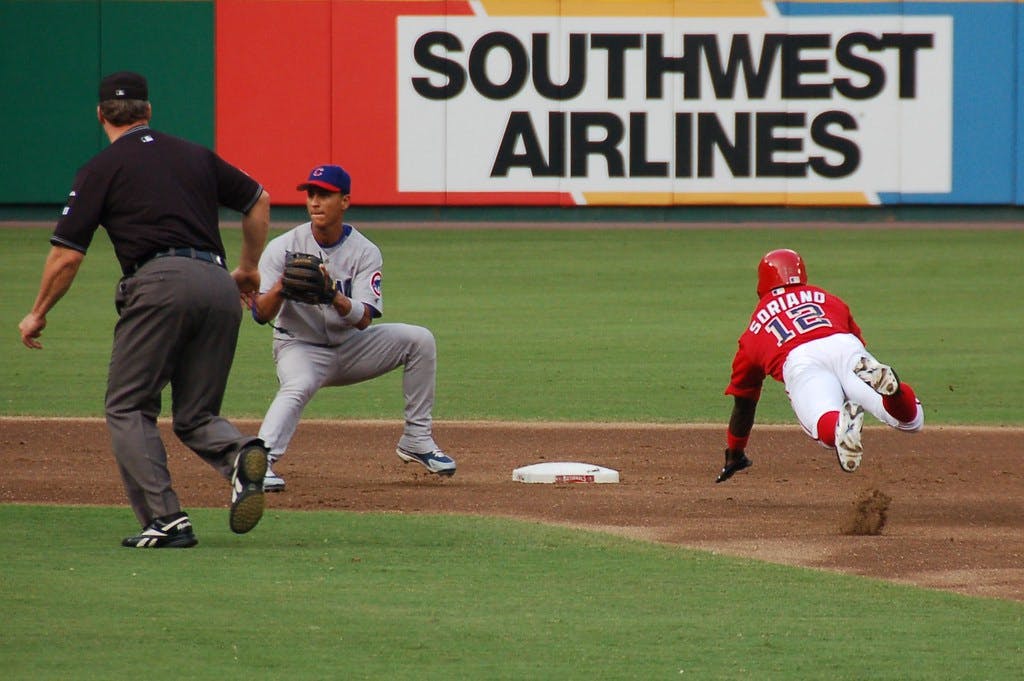
There are players all over baseball that are terrible at sliding. I could write an entire article with images of professional players costing themselves outs by being a poor slider. Here’s an example using Drew Stubbs, an extremely fast base runner. He has 2nd base stolen easily but he doesn’t slide properly, his knee gets dug into he clay and he flips over 2nd base and is tagged out.

There are so many different types of slides that can help avoid tags and put you in an ideal position if done correctly. Pop slides allow you to get to the bag and get on your feet quickly in case you can take an extra base. Hook slides let you slide to the outer or inner edge of the base depending on where the throw comes from. Practice these slides over and over again from a young age. Eventually, they become second nature and you won’t end up on the Not Top 10 like Stubbs.

I also want to take the time to say that sliding incorrectly is very dangerous. Knees are shredded and fingers, wrists and hands broken every year due to bad sliding techniques. Take the time to practice and do it right because trying to come back from a broken wrist is no fun in baseball. Also, don’t dive into first base, it isn’t faster than running through the bag and it almost always ends up badly for the base runner. 

Check out this course that will help you slide like a pro in no time.

#4 Work With And Trust Your 3rd Base Coach

Your 3rd Base coach is your greatest ally in becoming a better base runner. It’s important you work with your 3rd base coach and that they realize your skill level so that they can properly coach you on where to go. I know this is difficult but you should always trust your 3rd base coach. If he is telling you to hold up, then put on the brakes. If he is waving you home then turn on the after-burners.

There will be times when your 3rd base coach is wrong, however they always have the better angle at the play. If you are trying to turn your head and find the ball while running, it is going to slow you down. You will be more likely to miss a base and your body will be out of sync. Your 3rd base coach can see if there is a bobble, or if the fielder fields it cleanly and comes up throwing.

In the end, you will save yourself a lot bad mistakes by listening to and trusting your 3rd base coach. We all know there is no worse look than when you run through a stop sign and get thrown out at the plate, especially with your cleanup hitter standing on deck.

#5 Know The Situation – When To Take The Extra Base

If you read more of my baseball-related articles, you’ll find that I often come back to the principle of being the smartest player on the field and it applies to base running as well. You should always be aware of the situation. Perhaps you are a great base runner and always have the green light to steal, however, your best hitter is standing at the plate with 2 outs and the other catcher has already thrown you out once. This is probably not the best time to try to prove you can beat the catcher. 

This goes back to studying the game and always paying attention. It may be okay to try to stretch a double into a triple early in the game, but you don’t want to get thrown out at 3rd for the first out in a tie game in the 9th inning. Your 3rd base coach should be helping you in these situations as well. If you are striving to be the smartest player on the field, you will more often than not put yourself in the best positions to score.

Conclusion

There are so many poor base runners in the game today that taking these steps to becoming better will set you apart from the rest of your team. Coaches notice when you are working on the little things and sometimes it is as simple as becoming great at the fundamentals: knowing the situation, becoming a better slider and trusting your coaches. 

NYSS FB Be A Role Model 

Saturday, June 21, 2025

US Sports Baseball: The Ultimate Resource For Coaching Youth Baseball and LSU vs. Arkansas: 2025 Men's College World Series highlights


  • By Jackson Chlebowy

Introduction

Anyone who has coached youth baseball can tell you it’s a LOT harder than it looks. From the top of the bleachers, sure it looks simple enough. Sub in kids. Give them some beginner-level advice. Maybe yell at the umpire "a few times".

But what you don’t see from the bleachers is 90% of what it takes to run a youth baseball team. You don’t see the administration, the dealing with parents, the practice planning, the dealing with parents, the offseason workouts, or the dealing with parents.


Presented by Academy Sports & Outdoors.

Okay, dealing with the parents isn’t THAT bad (ignorance is such sweet, sweet bliss).

For those of you either currently involved or anticipating involvement as a youth baseball coach, we’ve put together a comprehensive guide to help you not only survive, but excel with your kids this season. Whether you’re a fresh-faced newbie or a seasoned veteran, you’ll find something of value in this guide, as we cover every single facet of running a youth baseball team. Scroll down to start at the beginning or skip to a chapter of your choice using the table of contents menu in the navigation bar. Every link in this guide is to freely available content, but since there are some incredible resources out there for less than $50, we made sure to link you to a few premium options we highly recommend as well – for those looking to dig even deeper.

_______________________________________________________________________________________________________________________

Chapter 1:

How To Administrate A Youth Baseball Team

null

Some people choose to be youth baseball coaches. Others have that responsibility thrust upon them. Either way, your first thought after the team is officially placed in your hands is probably something along the lines of... HELP ME! There is so much to do before the season even starts, from creating practice plans to setting player expectations. Perhaps you even need to learn the official rules of your specific baseball league. Every little detail is important. And what about volunteers? You’ll almost definitely want some official parent help along the way. How do you make that happen? There’s a lot that goes into administering a youth baseball team. Here are a set of ready-to-go resources that break the whole process down, step by step.

Resources:

5 Keys Every Youth Baseball Coach Should Remember

Official Little League Rules, Regulations, & Policies

10 Important Baseball Rules for Beginners

Coaching Youth Baseball: Tips for the Parent-Coach

5 Ways to Grow Volunteer Participation

Think Like a Parent: Tips for Better Coach-Parent Relationships

5 Tips To Be a Great Youth Baseball Coach

_______________________________________________________________________________________________________________________

Chapter 2:

The Essentials To Running a Great Baseball Practice

null

So you’ve survived the admin and parents (thus far) and it’s finally time for your first practice! Nothing is better than that first day out in the sun, finally practicing the sport itself. That is... if you know what you’re doing. A great baseball practice really just comes down to understanding where your team is at and what they need to work on. Depending on the age group, you’ll also want to keep it as fun as possible while still helping the athletes improve their skills. Finding the right mix between disciplined skills development and simple fun is the goal for any youth practice. With a bit of practice and an unavoidable bit of trial-and-error, you’ll figure it out, no problem. These resources will help you get there as quickly as possible.

Resources:

Drill Rotation – The Basic Framework For Efficient Baseball Practices

Fundamentals -- An MLB Coaching Clinic

3 Coaches Share the Keys to Running Baseball Practice the Right Way

How to Develop Well-Rounded Youth Baseball Players

How To Run A Highly Productive Youth Baseball Practice

Coaching Youth Baseball Tips

Recommended Premium Options:

Coaching Youth Baseball for Ages 5-8

Coaching Youth Baseball for Ages 9-12

Youth Baseball Practice Plans

_______________________________________________________________________________________________________________________

Chapter 3:

Everything You Need to Know About Baseball Equipment

null

Like any modern sport, you need some equipment to play baseball. And you need some extra equipment for certain practice drills as well. Hopefully, you aren’t starting from scratch in this department, but if you are, we have you covered. We’ve even thrown in some fundraising tips (we got your back dawg). But even if you have a wide selection of equipment already available, it’s good to be knowledgeable on what you’re using, what needs to be replaced, and what everything is for. And for the love of all that is good and lovely, we hope your uniform style comes pre-selected for your team. You do NOT want control over that, trust us. You. Do. Not. Want. That. Power. But if it is forced upon you by the hand of fate, see the "How To Handle Parents" guide in Chapter #1.

Resources: Baseball Equipment List: Essential Baseball Gear Checklist

How To Choose Youth Baseball Equipment

Beginner’s Guide: How to Choose a Glove

How To Pick Out the Perfect Pair of Cleats

How To Choose The Perfect Bat

25 Unique Youth Sports Fundraising Ideas

Top 10 Youth Sports Fundraising Ideas That Will Score Big

_______________________________________________________________________________________________________________________

Chapter 4:

Offseason Workouts For Dummies

null

It’s said that championship teams are built in the offseason. While this won’t apply to teams at every level, for older, more competitive teams, offseason workouts are an integral part of in-season performance. We’ve included some great resources for both in-season and offseason workouts in this section. Always remember that safety is your number one concern, especially when working with young athletes. It’s also important that young athletes aren’t pushed too hard until they are both physically and emotionally mature enough to handle it.

Resources:

13 Lesson Baseball Workouts Video Course From A Division 1 Coach

Baseball Training Tips For The Off-Season

Three Baseball Offseason Strength and Conditioning Essentials

Five Crucial Arm Strength Exercises for Baseball Players & Pitchers

Optimizing Your Offseason: A Guide for Adolescent and Teen Baseball Players

_______________________________________________________________________________________________________________________

Chapter 5:

Pre-Game Warmups and Post-Game Cool Downs Your Kids Will Love

null

Injuries are the worst part of sports. At higher levels, they are somewhat unavoidable, even with proper care, but at the youth sports level, most injuries can be avoided with a solid pre-game warmup routine. Warmups and cool downs help athletes keep their muscles in optimal condition. If done correctly, they can also be an enjoyable part of your kids’ game-day routine. Create a collection of warmup exercises your team will love using the following resources.

Resources:

8 Baseball Warmups Your Youth Team Will Love

Warm-Up & Cool Down: Great Stretches for Youth Baseball Players Corbin Hedt - Injuries & Rehab For The Baseball Athlete

Why Does The Body Have To Cool Down After Exercise?

The Only 3 Questions You Should Ask Your Player After A Game

How To Cool Down After A Baseball Match

_______________________________________________________________________________________________________________________

Chapter 6:

Batting Drills & Techniques That Get Results

null

At the end of the day, coaching is all about helping kids improve their game. And that means helping them master the essential baseball skills. Batting is one of the primary skills every young player needs, and the best way to help them improve is through teaching proper batting technique and running them through effective batting drills. Batting is a full-body movement. From head to toe, every muscle contributes to a successful swing. These resources will help you teach your kids to drastically improve their batting game and maybe even master the art of the swing.

Resources:

The Best Way To Learn How To Hit a Baseball

How To Develop Explosive Bat Speed

Youth Baseball Instruction: Advancing from T-Ball to Live Pitching

ProSwing`s Fundamentals to America`s Past Time

How to Properly Bunt in Baseball

Recommended Premium Options:

Coaching Baseball - Power Hitting

The Swing Worth Millions

The Complete Guide To Hitting For Beginners

Coaching Youth Baseball: Power Hitting

_______________________________________________________________________________________________________________________

Chapter 7:

How to Teach Your Kids to Pitch Like Paul Skenes

null

Pitching, like hitting, requires good technique, practice and body control. It’s important that you, as the coach, teach your kids the correct way to pitch and the correct way to rest the arm after pitching. It’s also good to keep in mind that pitching is one of the more difficult skills for young athletes to learn, which is why tee-ball is preferred for younger ages. Be patient and prioritize proper form over immediate results.

Resources:

Pitch Like The Pros – Video Course by Pittsburg Pirates Pitching Coach

Developing a Youth Baseball Pitcher

How to Cultivate Confidence Within Your Pitchers

Understanding The Different Types of Pitches Pitching from the Stretch with Mike Scott

Little League University - Pitching Drills

Tips for Young Baseball Pitchers to Avoid Injury

Recommended Premium Options:

Pitching To Win With Your Fastball – 76 Lessons From Rockies’ Coach Jerry Weinstein

Pitching Mechanics & Drills – Mastering The Delivery How To Throw More Strikes With Sport Psychology

_______________________________________________________________________________________________________________________

Chapter 8:

Baseball Fielding Techniques That Will Carry Your Season

null

For youth baseball, fielding is the most important part of your team’s defensive effort. If your kids can’t field the ball, your team won’t go anywhere. The single best way to coach up a winning youth baseball team is to minimize errors on game-day. Like batting and pitching, training your kids to field well consists of demonstrating the proper technique and then drills, drills, drills, drills, and more drills! Teach fielding to your team first and practice it as often as possible. You can use any of the fantastic drills and strategies outlined in the below resources. Whatever you do, trust us when we say that it’s impossible to over-practice fielding.

Resources:

How To Field A Ball Like A Pro

How Baseball Works: Fielding By Position

Tips to Be a Better Infielder

The 6 F`s of Fielding with MLB Coach Perry Hill

Backing Up Play From the Outfield

Footwork For Fielding Grounders

Recommended Premium Options:  

The Basics of Fielding for Youth Baseball

Ultimate Infield with Perry Hill

George Horton’s Guide To Infield Play

Outfield Play: The Defense’s Secondary

_______________________________________________________________________________________________________________________

Chapter 9:

The Non-Vicarious Way To Manage a Youth Baseball Game

null

It all comes down to this. You’ve practiced. You’ve prepared. You’ve maybe even cried a little (this is a judgement-free zone). It’s GAME DAY! As head coach, you are responsible for managing every aspect of this game, from pre-game warmups to post-game snacks. Whatever you do, DON’T FORGET THE SNACKS! You’re in charge of an entire team. The key is to stay organized and have fun. Simply understanding the basic framework is half the battle, and if you completely screw up game #1, you’ll be a seasoned veteran by game #2.

Resources:

Game Day Advice for Youth Baseball Coaches

Top 10 Mistakes Every Youth Baseball Coach Should Avoid

Using Signs with Youth Baseball Players

Team Culture – Balance of Criticism and Encouragement

30 Healthy Options For Game Day Snacks

NYSS FB Focus on Fun