Now Streaming On US Sports Radio!

US Sports Net Today!


Live Play-by-Play, Updates, Highlights and More! on US Sports Network!
[Chrome Users-You may have to click on the play button twice to listen]
US Sports Network Powered By Gorilla Sports!


US Sports Radio
The Las Vegas Raiders Play Here
Fitness and Sports Performance Info You Can Use!
The Scoreboard Mall
The Rock Almighty Shaker Of Heaven And Earth!
The Coolest Links In The Universe!

Saturday, May 24, 2025

US Sports Lacrosse: Girls Lacrosse: Goalie Basics and Northwestern vs. Boston College: 2025 NCAA women's lacrosse semifinal highlights


Bob Henderson is a defensive specialist that prides himself on giving the opposing offense headaches. The common thread among all winning teams is they have a great defense, with the anchor of that defense being the goalie. Give your team a significant advantage as Coach Henderson shows you what it takes to make your own goalie feared amongst the entire league. 

This course covers:

- Goalie Warmup Drills
- Goalie Stance
- Position in Crease
- Hand, Body & Foot Drills
- Defending Techniques
... and more!

Learn more here 


The Coach

BobHenderson

Bob Henderson

Goalkeeping/Defense Coach for Lacrosse

With a defensive mindset, veteran lacrosse coach Bob Henderson’s job is to make opposing teams miserable. A former three-year starter and record-setting goalkeeper at Stevens Institute of Technology, Henderson has coached with numerous South Jersey and Central Jersey select teams, camps and clinics, and players ranging from the elementary and middle school levels to his work as an assistant coach with the West Windsor-Plainsboro South High School program in New Jersey. His specializes in goalkeeping and defense.  Book this course today!

  NYSS FB Be A Role Model

Friday, May 23, 2025

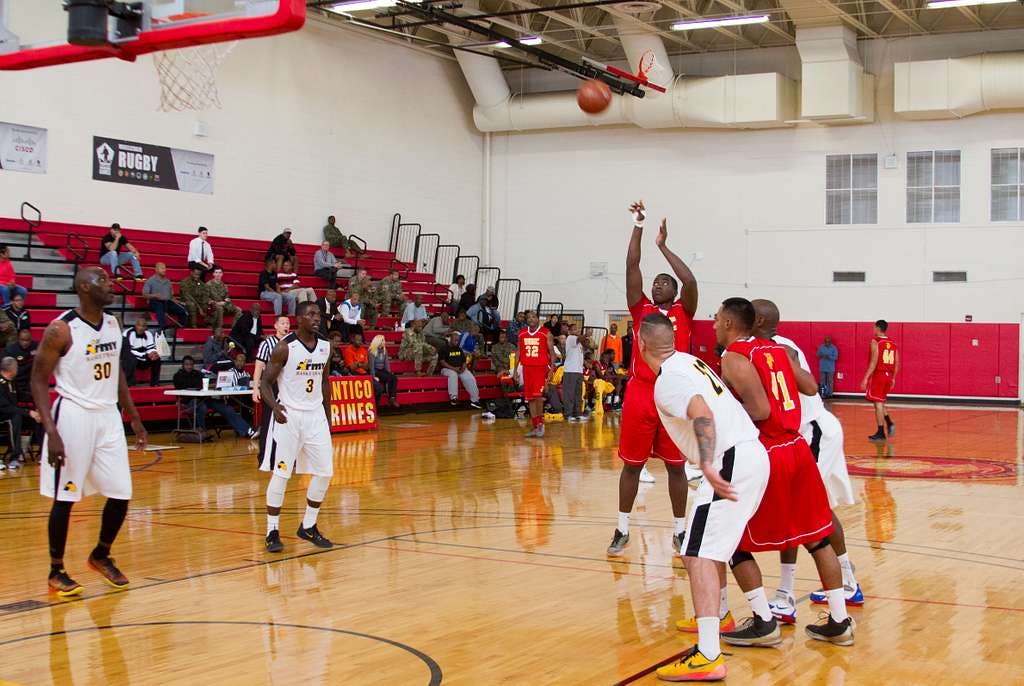
US Sports Basketball: 4 Tips To Instantly Improve Your Free Throw Shooting and #4 PACERS at #3 KNICKS | FULL GAME 1 HIGHLIGHTS |


  • By Tyler Linderman

Improving your free throw shooting is one of the easiest ways to increase your scoring output as a basketball player.  The higher percentage of free throws you are able to make, the more often your coach will find opportunities to have you on the court, especially late in close game situations. Here are 4 tips you can start using today that will help immediately improve your free throw shooting.


1. Establish A Routine


Humans are creatures of habit. This is true for baseball players at the plate, golfers preparing to putt and basketball players preparing to shoot free throws. As a creature of habit, it is helpful to find a routine that you can repeat every time you shoot a free throw. This routine can consist of whatever is comfortable to you, whether it is two dribbles and a spin or swinging the ball around your waist three times.


The key here is to repeat this routine every time you shoot a free throw, whether you are in the gym alone after practice or at the free throw line with the game on the line. Repeating this routine will make you feel comfortable at the free throw line and confident that you will sink each shot as you do in practice.


2. Visualize Success


One of the best tips my high school coach gave me when shooting free throws was to visualize the ball going into the basket. I encourage you to make this part of your routine. Basketball is both a physical AND mental game, and simply visualizing the ball going through the cylinder will increase your confidence and help your body replicate what your mind is seeing.


When shooting free throws, I like to focus on the back of the rim and visualize the ball lightly tapping the back of the rim as it drops perfectly through the arc and bounces straight back to me. Confidence goes a long way in basketball and having the confidence to step up to the free throw line late in a game is half the battle. T


3. Use Your Legs


The majority of shots taken in a basketball game are jump shots, in fact, the free throw is one of the only shots that is a set shot. With a jump shot, a shooter uses his or her legs to provide power for the shot. A good free throw shooter will also use his or her legs to power the shot.

A good basketball shot begins with a bend in the knees, followed by a fluid release, and finishing with a follow-through to the basket. It is important to use your legs when shooting a free throw, because it forces you to maintain the same form as a jump shot and helps provide a repeatable motion.


If you are shooting free throws without using your legs, you will often see your shots come up short or off to the side as the motion is different than any other shot you take. You will also notice that as you get tired, it becomes harder and harder to shoot free throws using only your arms, which brings us to our final tip.


4. Practice When Tired


Consistently shooting free throws in practice is key to becoming a better free throw shooter. However, how often do you find yourself shooting free throws when you are completely rested? Most free throws are shot when you are tired, so you need to be sure to practice free throws when tired. This strategy forces you to use your legs and maintain good form in order to consistently make free throws.


Be sure to practice shooting free throws throughout practice, not just at the beginning or end. Use breaks throughout practice to shoot a few free throws before grabbing your sip of water. After a round of conditioning at the end of practice, shoot 25 free throws. More often than not, the most crucial free throws occur at the end of the game, after you’ve been sprinting up and down the court for 30 minutes.


Practicing free throws while you are tired allows you to be confident and maintain the same form at the end of the game (when you’re exhausted) as you had with fresh legs at the beginning.


You can start putting these 4 tips into practice the next time you step onto the court. Be sure to focus on establishing a routine, visualizing success, using your legs, and shooting free throws throughout practice, even when you are exhausted.

Your just 4 steps away from improving your free throw percentage.

NYSS Twitter Focus on Fun

Thursday, May 22, 2025

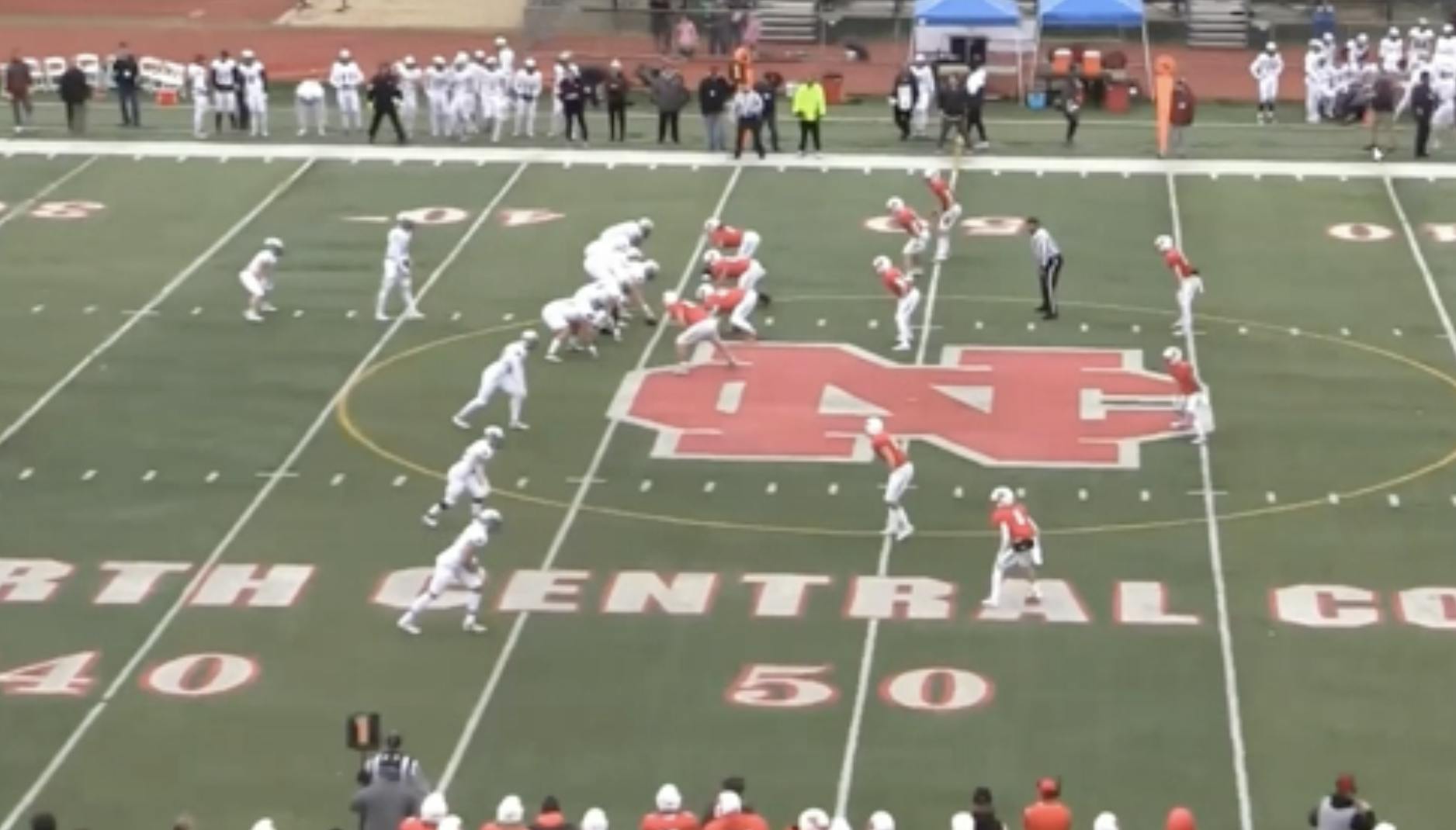
US Sports Football: Unlocking the Power of Gap Manipulation to Limit Explosive Plays


  • By Keith Grabowski

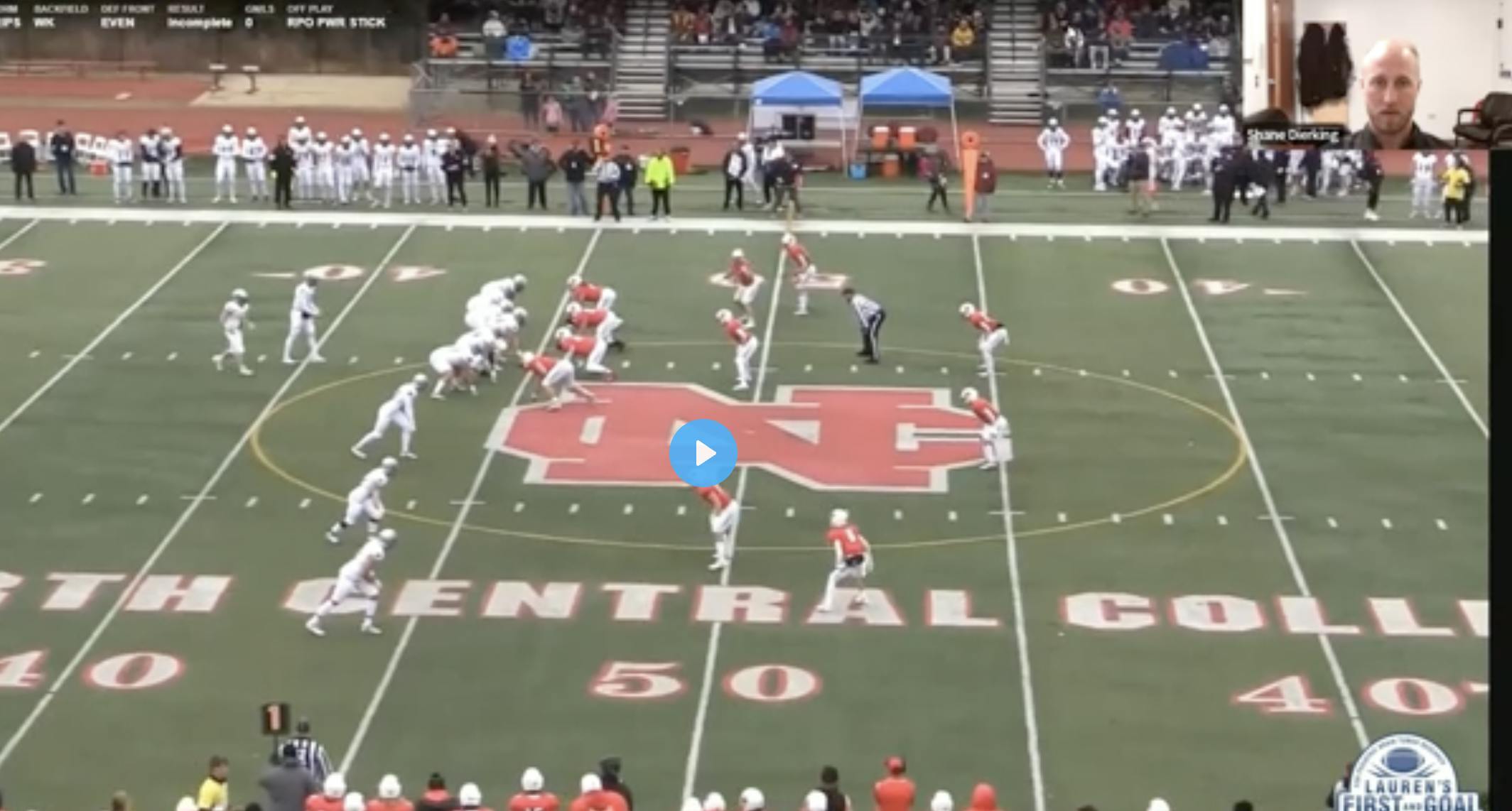
Are offense having their way with your defenders they put in conflict? At the 3rd Annual Lauren’s First and Goal Clinicusers/johnloose"> Lauren’s First and Goal Clinic Shane Direking, Defensive Coordinator at D3 National Champion North Central College, shared his insight on gap manipulation and limiting explosive plays as well as the knowledge and strategies to elevate the performance of your defense. He covered everything from understanding the importance of a tight top-down defense to mastering the art of manipulating gaps.

Defensive Structure and the 30% Rule

Coach Dierking believes the aim of the defense is to make the offense earn their yards by implementing a tight top-down defense while ensuring it never gives up explosive plays. By manipulating gaps, the defense can confuse the quarterback with stems in the secondary, forcing the O-line to adjust tracks, and throw off pass pro communication.

Coach Dierking als wants to avoid giving the quarterback easy access throwsl. By constantly self-scouting throughout a season and implementing a 30% rule. His 30% rule is, when they have an offensive formation and thy’re higher than 30% with a coverage variation against that offensive formation, they look to break the tendency. The 30% rule ensures that they remain multiple in coverage and keep the quarterback guessing.

Gap Manipulation in Football

Coach Dierking utilizes four main techniques to manipulate gaps: gap cancellation, gap call, stunts, and bumping. These tools are crucial for linebackers, Nickel, Mike, and Qill to communicate with the defensive line, and can be based on offense tendencies or game plan by formation.

By mastering these techniques, a defense can effectively manipulate gap fits in the run game and gap cancel tools, allowing them to be more multiple in coverage and keep the offense on their toes.

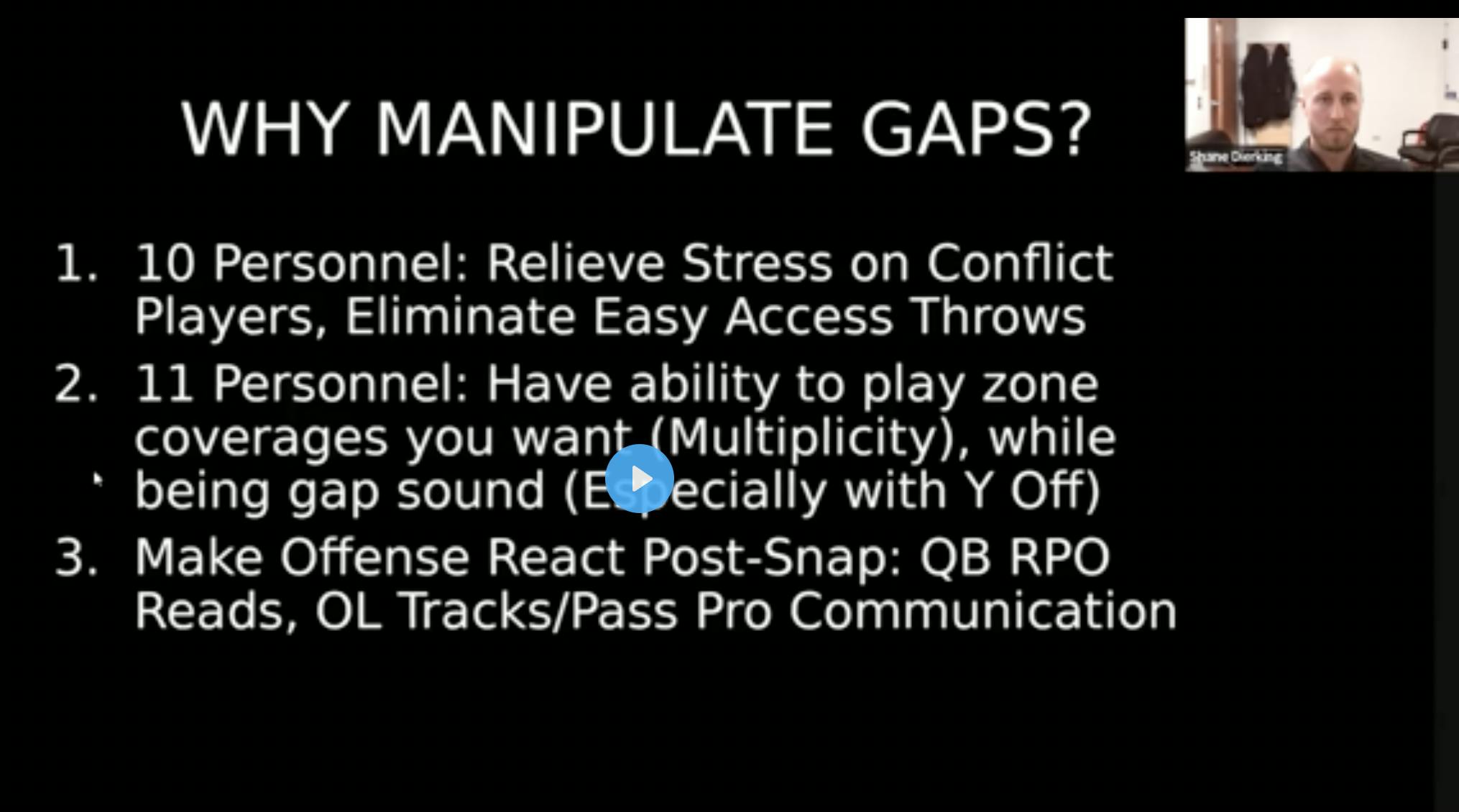
Here’s Coach Dierking discussing “Why Gap Manipulation?” in his clinic talk:

null

The Power of Limiting Explosive Plays

Explosive plays can be a game-changer in football. The chances of scoring in any single drive increase significantly with a single explosive play. By ensuring that the defense never gives up explosive plays, it forces the offense to work harder and increases the chances of the defense creating havoc plays like TFLs, tackles, interceptions, and fumble recoveries.

By making the offense earn every yard, the defense can increase the team’s win-loss percentage and maintain a strong defensive presence on the field.

Let’s take a look at some of the gap manipulations that Coach Dierking explained in his clinic.

2x2 Gap Cancellation

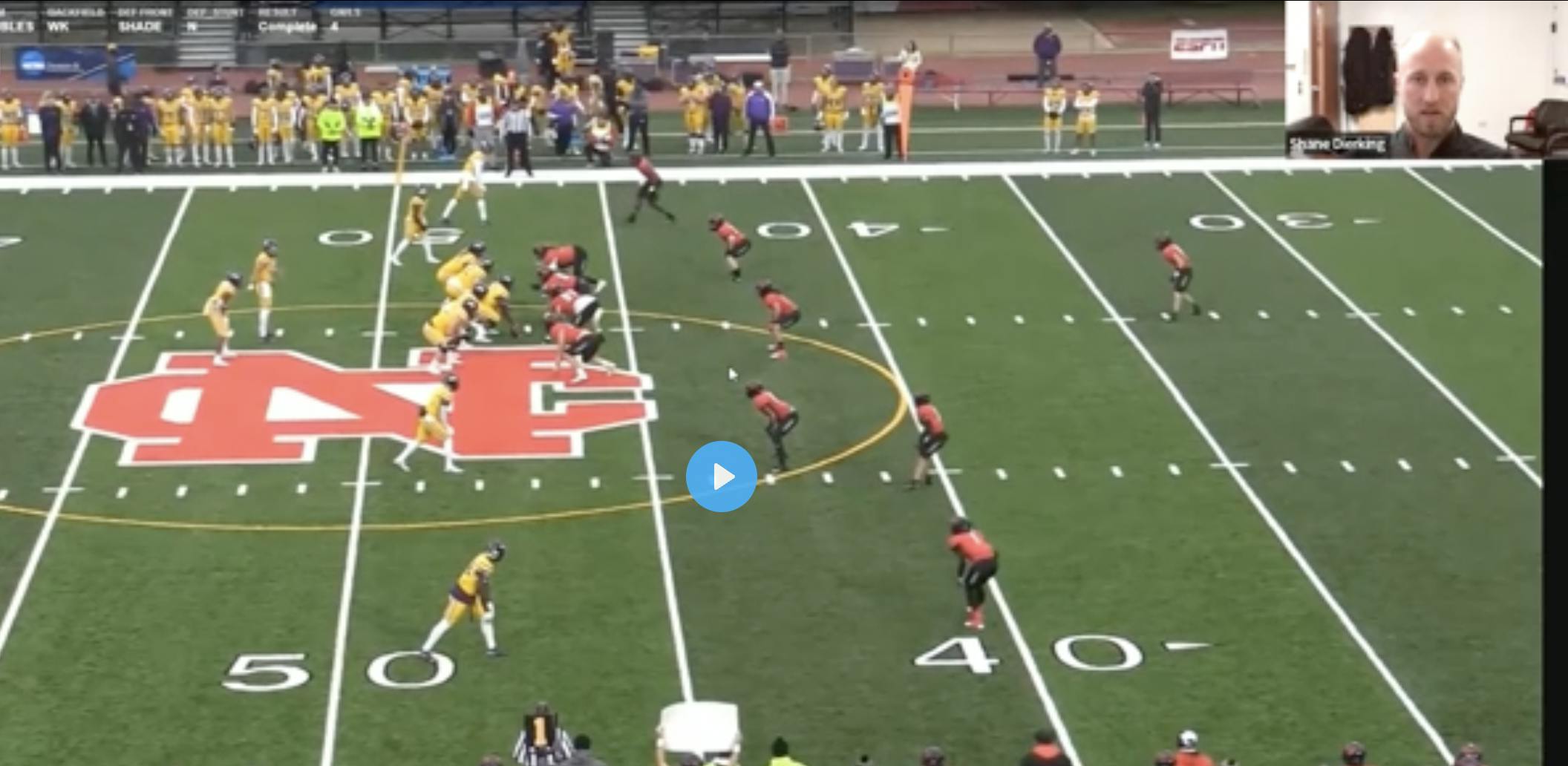
Coach Dierking gives his Will “gap cancelling tools” which allow him to give a call to the defensive line in order to keep himself out of conflict.  These tools are critical in today’s RPO world where the obejective is to put a defender in conflict.  He shares an example of this in this game clip:

null

Bump

Come formations can give a defense issues. Bumping gaps can allow a defense to keep players out of conflict and create better run fits.  Here Coach Dierking shares an example of “Bump” on game film and how they are able to take away the run and defend the stick and almost take it the other way by giving an appearance of a void in the defense.

null

Conclusion

Coach Direking’s clinic provided invaluable insights into putting defenders in a better position through the power of gap manipulation. This is a tremendous resource to gain the insight and examples to evolve your own defense to optimize your run fits and remove conflict.

NYSS Stay In The Game

Tuesday, May 20, 2025

US Sports Baseball: Two Drills to Improve Outfield Movement and Communication and #18 Alabama vs #23 Florida (Rubber Match) 2025 College Baseball Highlights


  • By Grant Young

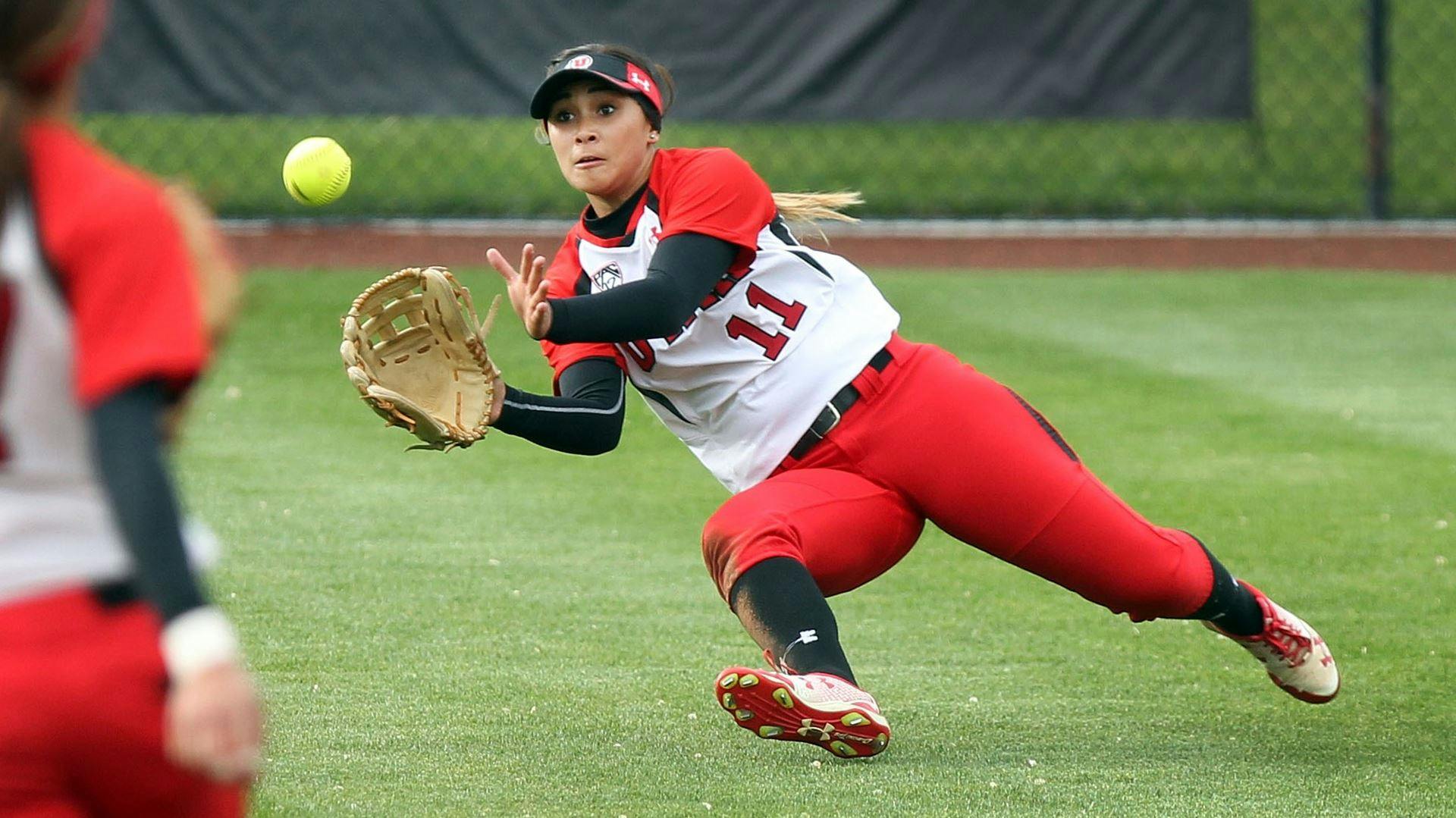
While it may seem that playing in the outfield is one of the most relaxed positions in baseball, coaches know the truth is that the outfield demands a high level of communication, precise movement, and acute awareness. This is why outfield drills are so important. 

One of the main challenges for outfielders is the need to effectively communicate with each other. In many situations, multiple outfielders can converge on a fly ball, and without clear communication, collisions can occur. This risk not only poses a danger to the players involved but can also lead to missed plays that could change the outcome of a game. 

Establishing a system of verbal and non-verbal cues is essential for ensuring that each player knows who is responsible for making the catch. Drills that focus on improving vocal communication and instilling confidence in one another can transform a group of individuals into a cohesive unit.

Additionally, the movement required in the outfield is far from straightforward. It involves not only running but also quick direction changes, timing jumps for catches, and assessing batted balls’ trajectories. Outfielders need to have a keen sense of positioning, understanding the hitters’ tendencies, and knowing when to take aggressive routes to the ball. 

Practicing shifts, angles, and the art of the jump can give a team a significant advantage. Drills designed to simulate different game scenarios can help players develop these critical skills, allowing them to react instinctively during actual games. 

By implementing targeted drills that enhance these skills, teams can minimize the risk of errors and elevate their overall performance, turning what is perceived as an easy position into one of the greatest strengths of the team.

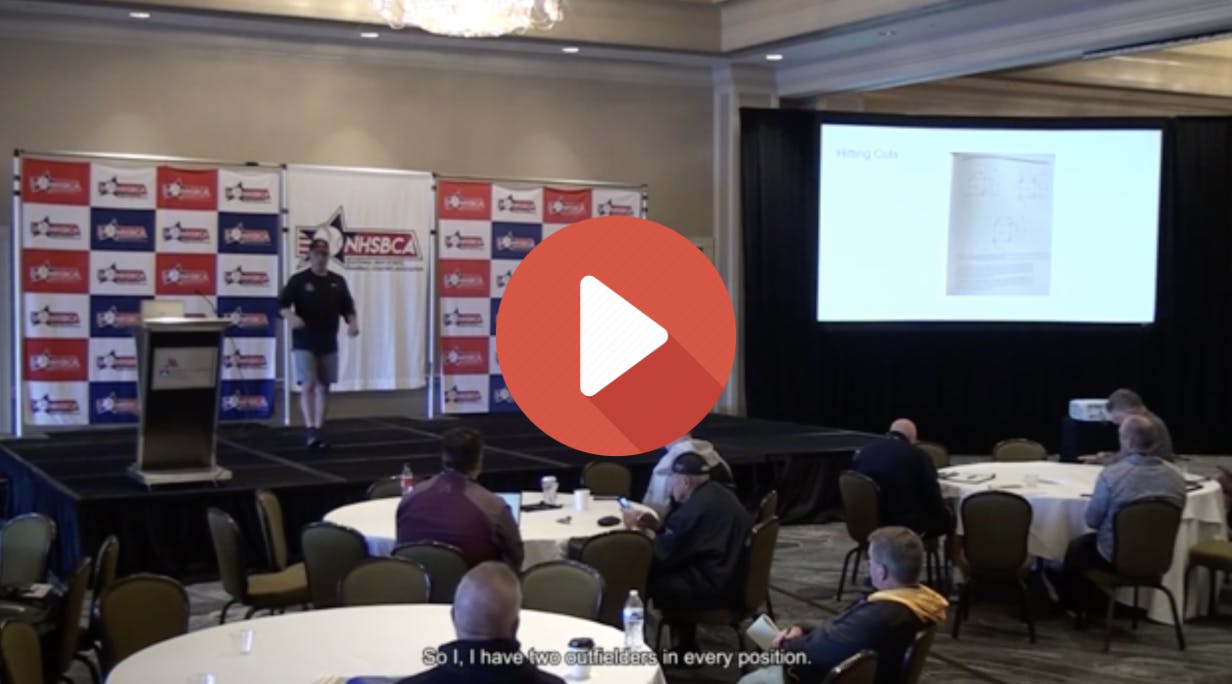
While there are plenty of effective outfield drills out there, few focus on developing the communication and movement patterns necessary to ensure safety and success for players of all ages and skill levels. But coach Todd Dulin, Head Coach at North Andover High School (Massachusetts), provides an in-depth, structured approach to mastering defensive excellence in baseball, specifically in the outfield with his ‘Outfield Play with Todd Dulin’ clinic. 

Whether you're an aspiring outfielder or a coach seeking expert drills and strategies, this course provides the knowledge and structure to elevate defensive skills and build a championship-caliber mentality.

We have pulled two drills from Coach Dulin’s clinic and included them below. 

The Rhythm Drill

null

One of Coach Dulin’s drills is called the Rhythm Drill, a fundamental exercise to develop smooth, controlled, and accurate outfield throws while preserving arm strength. 

The movement and footwork involved in fielding a grounder in the outfield and then executing a strong and accurate throw to a specific base may sound easy, but coaches know that it can often be much more difficult than initially conceived. 

This is why this simple rhythm drill is perfect, which starts with a coach having a bucket of balls, a fungo, and standing at home plate. The players will line up in two lines in the outfield, and the coach will just hit balls to each line. 

Each player will then take turns fielding the ground ball while ensuring they remain on the balls of their feet so they don’t get off balance. From there, they will stay in an athletic stance, execute a crop hop, and deliver a throw to the assigned base, which will have a screen behind it. 

By repeating this drill with a steady rhythm, outfielders enhance their throwing mechanics, reinforce good habits, and prepare for game-like situations with precision and efficiency. 

Another way to improve this drill is by hitting the ball between the two lines and forcing them to communicate on who is going to field the ball and which base they should throw to. 

The Sprinkler Drill

null

The next drill that Coach Dulin discusses in his clinic is what he calls the sprinker drill, which is a dynamic outfield exercise designed to improve tracking, catching on the move, and communication. 

The drill begins with all the outfielders along the right field like, and the coach has a bucket and a fungo. The player who’s first in line will then start jogging across the outfield while fielding multiple fly balls, progressively moving toward left field with each ball hit.

A great way to enhance communication with this drill is to make two different lines and hit the ball either between them or behind them, so that they have to run near the fence. This will force the two players in line to communicate about who is catching the ball and where the ball is while also tracking down the fly ball. 

This drill is especially effective early in the season, when players haven’t learned each other’s communication preferences and are still acclimating to tracking balls down on the fly. 

This drill is also fun and engaging, while also working as a conditioning exercise because of all the running that players will need to do.

NYSS Find Their Strengths

Monday, May 19, 2025

US Sports Martial Arts: Grappling v.s. Striking: Which is Better? And Muay Thai Chaos 😤 Aliff vs. Walter Goncalves | Full Fight


  • By Owen Reilly

The UFC was originally created to determine the most effective martial art in combat. Since then, the sport of Mixed Martial Arts (MMA) has evolved with nearly every fighter involved in the sport incorporating techniques of multiple fighting disciplines and styles. However, most fighters specialize in a specific martial art or prefer the techniques of one discipline to the other. For example, Khabib Nurmagomedov specializes in sambo and wrestling while someone such as Alex Pereira prefers to keep the fight standing and strike with his opponent. These two differing styles represent an age-old debate of whether striking or grappling is more effective both in the cage and in real life. In this blog, we will review the arguments for each style and determine which is more important when starting your MMA journey.

The Case for Grappling

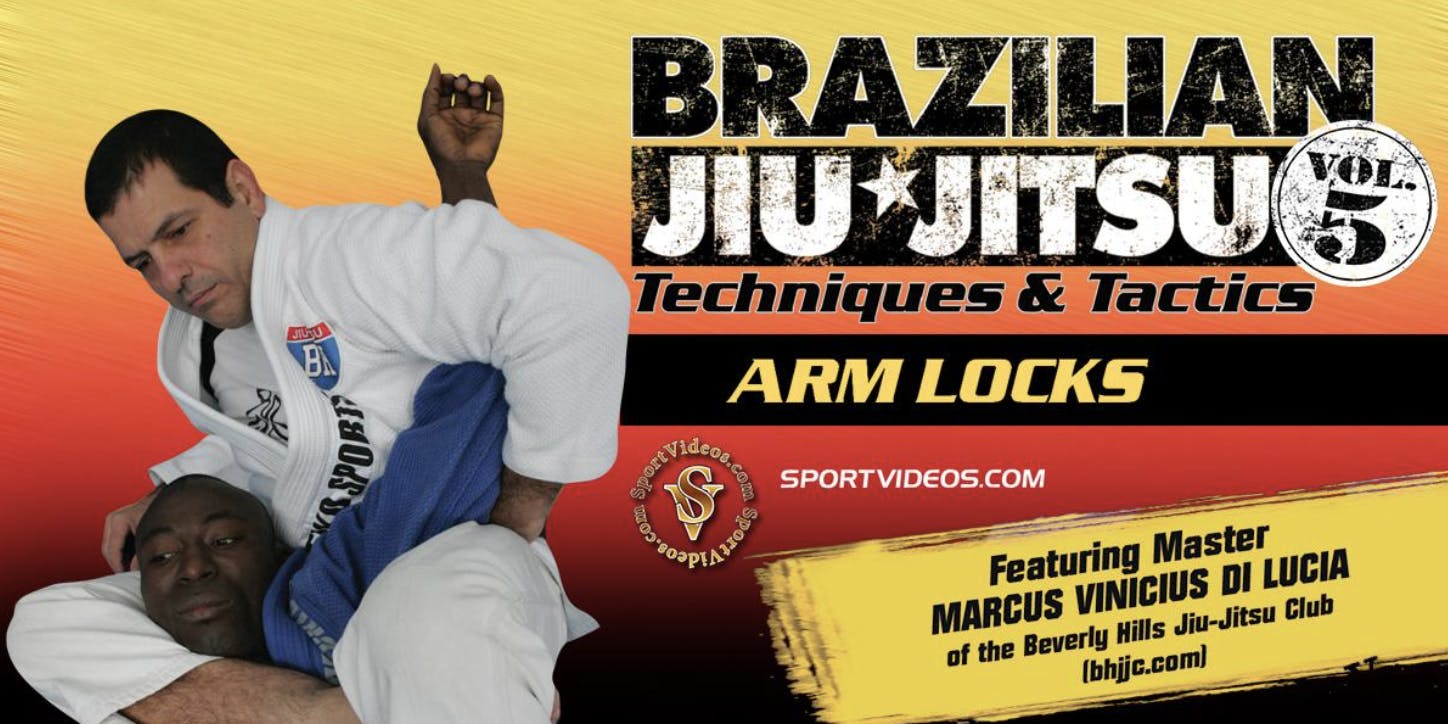
The term grappling encompasses multiple martial arts, including Jiu-jitsu, Judo, Wrestling, and Sambo, with each art focusing on taking down, controlling, and submitting or pinning your opponent. In MMA, a strong proficiency in one of these arts allows you to dictate the pace of the fight and choose where the fight takes place. Furthermore, the level of control, submission threats, and cardio that the grappling arts offer allow you to wear down your opponent through consistent pressure. Understanding how to properly close the distance, however, is a crucial skill that all grapplers must learn. Without it, grapplers will run the risk of getting knocked out when initiating takedowns or scrambles. Fighters utilizing a grappling-heavy style include Khabib Nurmagomedov, Islam Makhachev, Merab Dvalishvili, Colby Covington, and Kamaru Usman. For grappling classes taught by top coaches and fighters, check out the link below. 

null

The Case for Striking

The term striking also refers to numerous fighting styles including boxing, muay thai, kickboxing, karate, tae-kwon-doe, and karate with each discipline incorporating some form of punches, kicks, or knee and elbow strikes. The striking arts have a distinct advantage over the grappling arts in one major respect; the ability to end a fight decisively at nearly any moment. A singular well-placed strike can stop any opponent dead in their tracks. The unpredictability and the ability for a worse fighter to land a single strike and win the fights is an alluring thought that makes the striking arts incredibly appealing. The control of range that striking also teaches coupled with the fact that numerous strikes over time can wear down your opponent also make the striking arts effective. Learning takedown defense, however, is crucial to being an effective striker as you are unable to use the vast majority of striking techniques while on your back. Examples of strikers in MMA include Israel Adesanya, Alex Pereira, Anderson Silva, Sean O’Malley, and Connor McGregor. To look at online striking courses taught by some of the best in the world, click the link below.

null

Historically speaking, grapplers have tended to dominate the MMA landscape with the original UFC events featuring winners such as Royce Gracie and Ken Shamrock. Grappling has continued to dominate the MMA scene with the above-mentioned fighters reaching the pinnacle of the sport through their grappling abilities. Recently, however, fighters including Leon Edwards, Israel Adesanya, and Alex Pereira have proved that elite striking coupled with strong takedown defense can win fights against elite grapplers. Truthfully, to be successful at the professional level, being well-rounded is absolutely necessary. Relying on one specific style too much can expose holes in your game that opponents can exploit. But which is better? Especially at the amateur level, grappling still proves to be the most effective path to victory. When fighting a ‘pure’ striker, grappling offers a relatively easy path to victory assuming one can properly close the distance to clinch with or takedown the opponent. The unpredictability of striking makes grappling a safer and more secure route to neutralize your opponent. Strikers have more opportunities to end the fight faster but become vulnerable when put on their backs. As a grappler, you can negate a striker's game plan completely with a single takedown. Despite this, a striker with very strong takedown defense can be an absolute nightmare for a ‘pure’ grappler.

Sunday, May 18, 2025

The Rock Almighty: Modern Day Faith-based Parenting Style for Unruly Children and Faith In Action!


Listen on Apple Music
  • Author Taibat Fasina

Creating a modern, faith-based parenting approach for unruly children focuses on combining principles of love, discipline, grace, and responsibility. This approach acknowledges the unique challenges of raising children while incorporating faith values to guide and shape behavior. Here’s a holistic approach:

  1. Emphasize Love and Connection-

a. Unconditional Love: Reflect God’s love by showing unconditional affection and acceptance, regardless of behavior. Children need to know that their worth isn't based on their actions, but that their actions have consequences.

b. Bonding and Time: Spend quality time with your children. When children feel loved and understood, they are more likely to respond positively to guidance.

c. Active Listening: Engage in open conversations with your child, listening to their concerns, frustrations, and emotions. This fosters mutual respect and trust.

  1. Discipline Rooted in Grace-

a. Firm Yet Loving: In line with Scripture, discipline should always be firm yet full of grace. In Proverbs 3:11-12, it says, “Do not despise the Lord’s discipline, and do not resent his rebuke, because the Lord disciplines those he loves.” Children need structure, but it should come from a place of care.

b. Natural Consequences: Let children experience natural consequences where appropriate. If they don’t do their homework, they may face academic consequences; if they disrespect others, they may face social consequences. This helps them connect their actions to real-life outcomes.

c. Consistency: Be consistent in your expectations and discipline. If a boundary is set, it should be upheld with love, but without wavering.

  1. Teach Responsibility and Accountability-

a. Self-Control: Encourage children to take ownership of their behavior and decisions. Galatians 6:5 reminds us, "For each will have to bear his own load." Help your child understand the importance of managing their actions, emotions, and choices.

b. Apologize When Necessary: Model humility by apologizing when you’ve made a mistake. This demonstrates to your child that making amends is part of living out faith.

c. Empathy and Compassion: Teach children to consider how their actions affect others. Teach them that the foundation of faith is love and kindness (Matthew 7:12 – "So in everything, do to others what you would have them do to you.").

  1. Set Clear Boundaries with Flexibility-

a. Firm Boundaries: Set clear, loving boundaries that reflect your values and faith. For example, if a child is being disrespectful, calmly set the expectation that disrespect will not be tolerated.

b. Flexible Problem Solving: While the boundaries should be firm, allow for dialogue. Maybe a child is acting out due to a deeper issue. In those moments, be open to listening to why they feel or act a certain way, and work together to solve problems creatively.

c. Redirect Unruly Behavior: If a child is misbehaving, offer positive redirection. Instead of focusing solely on the punishment, guide them toward alternative actions, such as taking a break to calm down, or helping with a task.

  1. Incorporate Faith into Daily Life-

a. Scripture and Prayer: Use scripture to teach values and principles. Ephesians 6:4 encourages fathers to “bring them up in the training and instruction of the Lord.” Regular family prayers and scripture reading can become a way of teaching moral values while also strengthening the family bond.

b. Faith-Based Teaching Moments: Use everyday moments as opportunities to teach faith. For example, if your child is frustrated, talk about patience and how God helps us be patient. If they’re angry, teach about forgiveness.

c. Modeling the Fruit of the Spirit: Live out the values of love, joy, peace, patience, kindness, goodness, faithfulness, gentleness, and self-control (Galatians 5:22-23). Your actions will speak louder than words.

  1. Develop a Routine and Encourage Structure-

a. Routines Provide Stability: Having a consistent daily routine helps children feel secure and understand what is expected of them. For example, setting times for meals, homework, chores, and rest can bring order to a potentially chaotic situation.

b. Balance Freedom with Structure: Allow space for children to express themselves, but always within the framework of respect and responsibility. Too much unstructured time can lead to disobedience or boredom, which can lead to unruliness.

  1. Be Patient and Prayerful-

a. Patience with Growth: Remember that growth takes time. Children are learning and developing. Be patient, remembering that mistakes are part of the learning process.

b. Pray for Wisdom: James 1:5 says, "If any of you lacks wisdom, let him ask of God." Parenting can be incredibly challenging, but prayer for guidance and wisdom can help you make better decisions.

c. Pray with Your Child: Include your child in prayer, especially when they are facing challenges. This can help them feel supported and reminded of God’s presence in their lives.

  1. Use Positive Reinforcement-

a. Praise Good Behavior: Focus on encouraging positive behavior. Recognize and celebrate when your child makes good choices, listens, or helps others. Positive reinforcement encourages them to continue those behaviors.

b. Offer Opportunities for Growth: Give your children chances to take on age-appropriate responsibilities. Let them help with chores, contribute to decisions, or even serve in the community. This helps them develop a sense of responsibility and accomplishment.

  1. Create a Safe and Nurturing Environment-

a. Safe Space for Expression: Children need to know they have a safe space to express their feelings and struggles. Be open to hearing about their challenges without judgment, while offering guidance rooted in faith.

b. Foster Respectful Relationships: Encourage your children to respect you, each other, and authority figures. Emphasize that respect for others is a reflection of their respect for God.

c. Incorporating these elements into your parenting style can help you raise children who are not only well-behaved but also grow spiritually, emotionally, and socially. Remember, the goal is to be both a loving guide and a faithful example for your children to follow. Let them experience God’s love through your actions, and be patient as they learn to apply faith-based principles in their own lives.

Taibat Fasina is a dynamic content writer with a passion for storytelling that spans across multiple mediums. With a keen eye for detail and a knack for crafting compelling narratives, she excels in writing, translation, and transcription.

Saturday, May 17, 2025

US Sports Volleyball: Master the Perfect Volleyball Approach – Jump Higher & Hit Harder and Savvy/Van Winkle vs. Toni/DeBerg Semi Final Highlights Xiamen


  • By Sam DeJoseph

The Three-Step Approach: 

The three-step approach is perfect for any volleyball player to increase their hitting ability. It not only allows players to jump higher but also hit harder,  more accurately, and consistently. It is the framework for any good hitter's skillset! 

First Step: 

Purpose: This step generates forward momentum and sets up your approach direction. 

Execution: 

• To start, make sure you’re in a good athletic stance, your knees should be slightly bent, and your weight is on the balls of your feet, ready to move forward.

• Take a strong, controlled step forward with your dominant foot (right foot for right-handed hitters, left for lefties); this step should allow you to get going in the direction of the ball. 

• Ensure that your eyes stay locked on the ball and your arms are relaxed out in front of your body to prepare for the next explosive movement in the second step. 

Key Tip: This step is not based on speed. The main goal is to gather yourself and prepare for the following two steps, which will need to be very explosive!


Second Step: 

Purpose: This step is where you will gain speed and power to explode into the jump. 

Execution: 

• Your non-dominant foot (left foot for right-handers, right foot for lefties)  moves forward and slightly out. This should be a big, loaded step with your knees staying bent. 

• Increase the speed and momentum of your step, leaning slightly forward to prepare for your takeoff. 

• Swing your arms back; this will help you load energy for a powerful arm swing into the jump. Your arms swinging back and up is one of the most important parts of any approach! 

Key Tip: This step should feel explosive and dynamic—like you're building up for an unstoppable launch! 

Third Step: 

Purpose: This is the final step; it should be a strong step that shifts your momentum forward, but also upward. 

Execution: 

• Anchor your final step in front of yourself  

• Bend your knees and push through the ground with maximum force. • Swing your arms forcefully, helping with lift-off. 

• Keep your core tight, eyes on the ball, and prepare to attack with full power!

Key Tip: Think of yourself as a rocket—you’ve built the speed; now explode upward with everything you've got! 

The Jump: 

The jump is the culmination of your approach, using all the momentum you have built up, swing your arms up, and use your explosive approach to jump to your maximum height! 

If you want to learn more about how to master your approach and use it to up your game to new heights, click the link above and learn from Coach Santiago  Restrepo! 

By following these tips, we guarantee that it will make you a much more explosive jumper, but they will also allow you to hit the ball much harder.

NYSS FB Be A Role Model
Want to help kids find sports they love? Sign up to be a
 coach or volunteer in a local youth sports program. Learn more ways to 
support youth sports in the National Youth Sports Strategy: https://bit.ly/2lIHPUc

Friday, May 16, 2025

US Sports Softball: How to Perfect Pitch-Calling For Your Softball Team and WCWS predictions from the 2025 college softball bracket


  • By Grant Young

Calling pitches in softball can be one of the most challenging parts of being a softball pitching coach, regardless of which level you’re coaching at. 

There are various factors as to why pitch-calling presents a unique challenge. The pitching coach must take into account the batter's strengths and weaknesses, the game situation, and the team's overall strategy—all of which must be communicated to the pitcher and the catcher, who are often the ones who are making the final decisions on which pitch to throw.

Furthermore, the pitcher and catcher need to be in sync, which can be difficult in noisy or hectic game environments. Lastly, maintaining control and accuracy while keeping the batters guessing is crucial, and achieving this balance can be quite demanding.

There are some obvious times when calling a fastball makes the most sense, especially when you want to surprise the batter or when you need to bring the heat to challenge a strong hitter. It can also be useful in situations where you are ahead in the count and want to maintain control. Additionally, using a fastball early in the game can help establish dominance and set the tone for the rest of the match.

Yet, if you as a pitching coach believe calling a fastball in a situation is a no-brainer, the opposing hitter is likely thinking the same thing. This is why it’s crucial to understand when to break your typical pitch-calling patterns. And Amy Hunt can help you learn when and how to do so effectively. 

Coach Hunt has spent recent years working as a part-time Assistant Coach for Messiah College softball.

She was formerly an assistant coach with the team in 1998, where Messiah went to their first NCAA Final 6. Amy then continued her education, as she was a graduate assistant for the Marietta College softball team in Ohio.  She moved on to coach at Catoctin High School where she was the assistant coach for 1 year and head Varsity Coach for 6 years.

Coach Hunt has made a career out of trying to perfect pitch-calling. Her ‘Championship Pitch Calling System for Pitching, Catching and Coaching’ course is a great resource for any prospective pitch-callers at any level of softball. 

Why do STATS matter? 

Coach Hunt explains that being able to read and understand certain statistics makes a world of difference when trying to call pitches. 

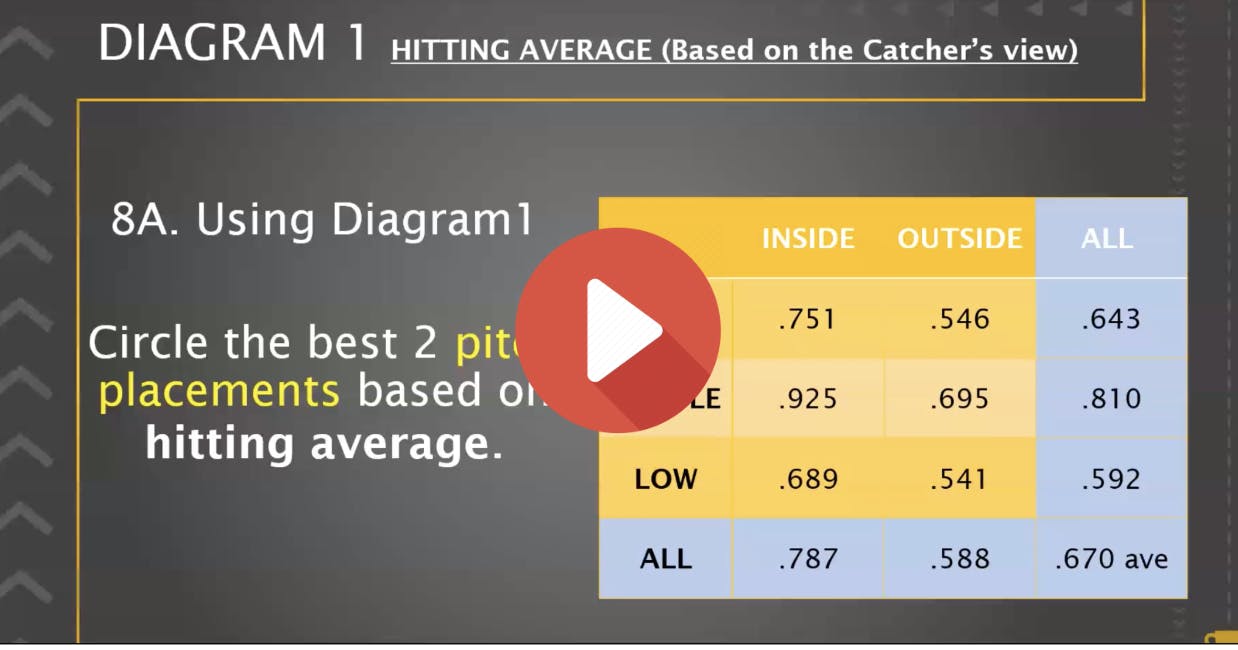
One of the most important statistics to know is what a hitter’s hitting average is within the nine segments of the strike zone. Because every hitter is going to have a slightly different stance, goals at the plate, and preferred areas, having (and then using) information about how which pitch locations they hit will at and which they don’t can make a major difference in success on the mound. 

Coach Hunt makes it clear that a hitting average isn’t the same thing as a batting average, which is the more commonly used statistic. The difference between these is that, while a batting average measures a batter's performance by dividing the number of hits by the number of at-bats, a hitting average is simply the number of times they make contact with a ball in a certain area. 

This is crucial because it doesn’t take uncontrollable factors into account (like if a player hits the ball weakly but still gets a hit) like the batting average does. It will give an accurate indication of a player’s ability to make contact at the various segments of the strike zone. While collecting hitting average stats might sound difficult, it’s actually simpler to calculate than the batting average. A coach can just watch a recent hitter’s at-bats and chart what pitches they’re making contact with. 

Pitch Location - Pitch placement is CRITICAL!

null

Of course, any pitching coach or pitcher knows that the worst place to position a pitch would be in the middle of the strike zone. And it’s typical knowledge that throwing the ball on the outside corner is usually a great option.

But not enough thought is put into whether a pitch should be thrown at the top or bottom of the strike zone. Typically, a pitcher will always try to aim for low in the strike zone. And while that’s a good base strategy to have, the ability to throw a pitch for a strike at the top of the strike zone can spell the difference between a good and great pitcher. 

Even if a pitcher is just able to throw an occasional fastball at the top of the strike zone (or even above the strike zone, in a two-strike scenario with less than three balls), hitters love swinging (and missing) at pitches in this location. It will also adjust their eye level so they don’t get too comfortable with/can sit on a pitch that’s lower in the strike zone. 

Learning about Batter Weaknesses

As we mentioned previously, charting each batter’s hitting average will give you a good indication of where they like to hit the ball. But another integral part of this charting strategy is that it will likely give you an insight into what an opposing team’s coach is teaching their hitters, as it pertains to their hitting approach. 

If you notice that a team very rarely swings at non-fastballs low in the strike zone or on the outside corner, that is likely because their coach is instructing them to take those pitches. You will then be able to exploit that by focusing on throwing off-speed pitches either low or away, which will force the hitters to make adjustments.

NYSS Twitter Be a Role Model
Want to help kids #GetActive through youth sports? 
Learn how parents, coaches, and volunteers can get involved in 
@HealthGov’s National #YouthSports Strategy: https://bit.ly/2lIHPUc