Now Streaming On US Sports Radio!

US Sports Net Today!


Live Play-by-Play, Updates, Highlights and More! on US Sports Network!
[Chrome Users-You may have to click on the play button twice to listen]
US Sports Network Powered By Gorilla Sports!


US Sports Radio
The Las Vegas Raiders Play Here
Fitness and Sports Performance Info You Can Use!
The Scoreboard Mall
The Rock Almighty Shaker Of Heaven And Earth!
The Coolest Links In The Universe!

Saturday, September 6, 2025

US Sports Partner Spotlight: Concealed Carry


American Gun Law
The most comprehensive educational and preparatory legal program for American Gun Owners. Gun owners have reason to be concerned with changing and confusing laws that ensnare and trap them. This course is anchored by over 40 High Def video interviews with one of the nation's top attorneys and several downloadable resources, workbooks, and guides to help the gun owner prepare their legal defense while also better understanding the laws that affect them.
http://bit.ly/4mQsmeh
Barrel Block
BarrelBlok was designed for use in semi-automatic pistols so the user could realistically train while maintaining the full mechanical functionality of the firearm. There are several features that were engineered into BarrelBlok to provide the safest, most realistic training platform possible!
http://bit.ly/4lZqq1N
Guardian Nation
A premier membership program for American self-defense shooters. Members receive a quarterly box of gear, discounts on products, access to training, live events, and more.
https://shorturl.at/mZp4J

US Sports Radio affiliate partner
http://www.USSportsRadio.net

US Sports Track and Field: Two Valuable Hammer Throw Training Tips and European Throwing Cup Nicosia 2025 Highlights


  • By Grant Young

The journey from being a good hammer thrower to a great one often hinges on subtle coaching nuances and slight shifts in hammer throw workouts that may not always be immediately visible. 

While an athlete might have the physical prowess and a fundamental understanding of the sport, it is often the less obvious elements introduced by a knowledgeable coach that can unlock the athlete's full potential. These small coaching details contribute to refining skills and enhancing performance in ways that can be transformative. 

The impact of tailored feedback during training sessions cannot be understated; it allows athletes to discover and fine-tune their unique throwing styles. Coaches help cultivate an environment where athletes can develop confidence in their abilities and learn to tackle the mental aspects of competition, which can significantly differentiate a good performance from a great one. 

The relationship between coach and athlete plays a pivotal role in nurturing the right mindset. A great coach knows how to inspire their athlete, fostering resilience and a sense of purpose that can elevate competition outcomes. As athletes learn to embrace challenges and visualize success, they often find themselves approaching competitions with a new level of composure and determination. 

The evolution from good to great in hammer throwing illustrates how small but intentional guidance from a coach can shift an athlete's trajectory. These understated yet critical contributions create a ripple effect, influencing not just technique but the overall approach to both training and competition, leading to extraordinary results.

With this in mind, we have pulled two vital hammer throw tips from two proven track and field coaches that could end up becoming key in your quest to unlock the potential that your hammer throwers are destined for. 

Paddy McGrath - Swings

Patrick McGrath is a 1995 graduate of Manhattan College and a former track and field Olympian and current assistant coach at Manhattan College and founder of The New York Hammer Squad. He oversaw the trio of Nina Bjorkman, Lasma Padedze and Alexandra Preckajlo that accounted for two golds, three silvers, one bronze and 54 total points at the 2021 MAAC Outdoor Women's Track & Field Championship.

Following the season, he helped Rudy Winkler to the USA Championship in the hammer throw and a seventh place finish at the 2020 Tokyo Olympics.

With experience at the international, collegiate and high school levels, McGrath has mentored NCAA, Senior National, Junior, and Youth champions. Ten of his athletes have won high school national titles, and four have claimed New York State championships. McGrath also coached Track and Field News' 2013 High School Boys Athlete of the Year. In 2019, three of his Manhattan throwers qualified for the NCAA Outdoor Track and Field East Regionals. 

In his ‘Athlete Development: How Rudy Winkler Went From Beginner to American Record’ clinic, Coach McGrath details how a consistent dedication to the technical work is needed to be great, and that starts with the swing. 

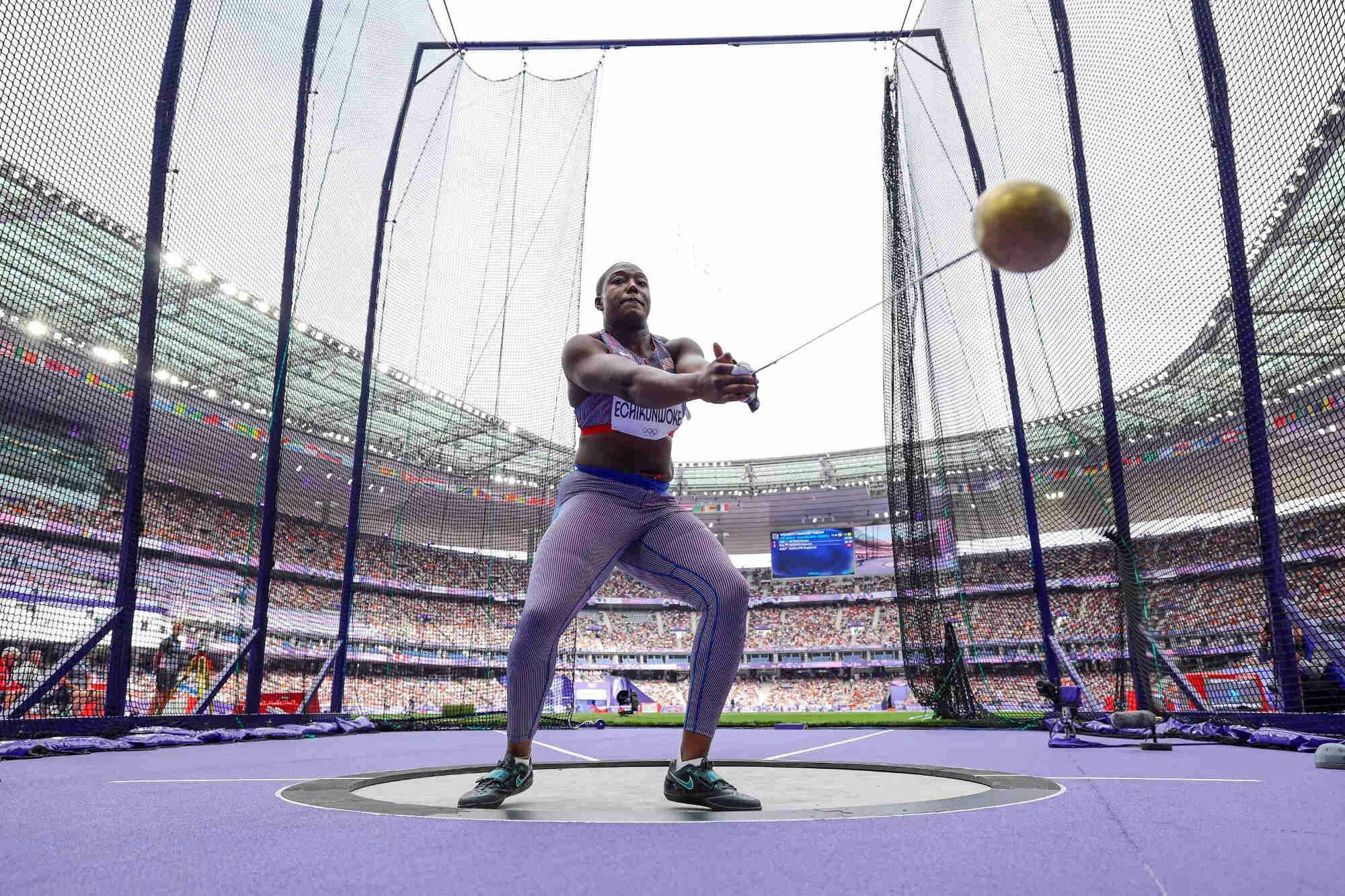
Coach McGrath noted how he likes to see the ball in front of the thrower as they prepare their swing. For a right-handed thrower, their weight should be on the left while they’re singing on the right side. 

A term that he loves using with his athletes is “brush the hair” when discussing how close he wants the hammer swing to be to their head. Of course, they mustn’t get too close where they run a risk of whacking their head with the hammer. 

Another training strategy that he likes athletes to use is starting the swing with three fingers, moving down to two fingers, and then ultimately finishing with only swinging while using their pinky finger. This is so the athlete learns to let the ball do its own and create and sustain its own momentum, which is crucial for conserving energy. 

Nathan Ott - Catch

null

Nathan Ott begins his third season guiding Penn State’s throws group in 2024-25. During his coaching career, Ott has coached All-Americans in each and every one of the throws events. In his first two season with the Nittany Lions, Ott has mentored a pair of First Team All-Americans and has seen three school records toppled.

 During the summer of 2023, Ott returned to the World Athletics Championships, this time with a contingent of four professional hammer throwers under his guidance. Brooke Andersen (U.S.A.), Nayoka Clunis (Jamaica), Beatrice Llano (Norway), and Stamatia Scarvelis (Greece) traveled to Budapest with Ott as their coach. Clunis became the first Jamaican hammer thrower ever to make the World Championship final in the event.

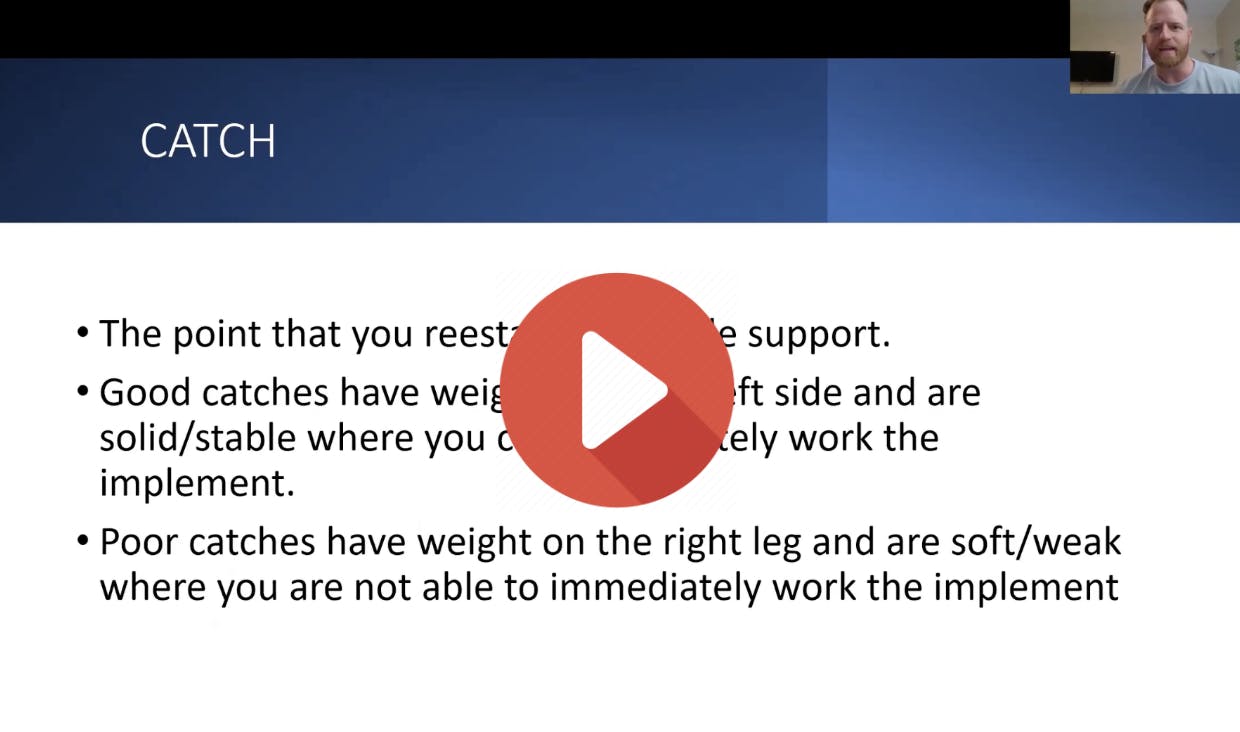
In his ‘Hammer Training: Tales of Connection and Engine Work’ clinic, Coach Ott discusses how his “catch” term is a core part of solidifying a hammer throw’s technique. 

Coach Ott explains that the catch is the point where an athlete reestablishes double support in their throw. 

He goes on to note that good catches have weight firmly on the left side (if the athlete is a right-handed thrower). The thrower can’t be collapsing on the right side or aggressively dropping, instead being stable once the right foot touches. 

Because of this good connection, the athlete will immediately become capable of working on an effective implementation which will lead to a good throw. 

A poor catch is when the weight collapses into the right leg, where the athlete isn’t immediately able to explode out of that position. The ball should always be back and the athlete should keep connected with it. 

NYSS FB Be A Role Model

Friday, September 5, 2025

US Sports Football: No. 2 St. John Bosco (CA) vs. No. 4 St. Frances Academy (MD) | MaxPreps Game of the Week

 Presented on US Sports by CoachTube:

Recruiting High School Players Today 

US Sports Tennis: New Tennis Injury Findings Linked to Neutral & Closed Stances and Insane Alcaraz Defence; Medjedovic Tweener Lob & More! Top 20 Shots


  • By Oscar Wegner

null

Recent finding and reports from chiropractic doctors specializing in tennis medicine has revealed the damaging effects of using neutral and closed stances versus open stance. The results being discovered in these reports have been astounding! 

Here is one doctor's opinion on the subject in an interview with Oscar Wegner, Founder of Modern Tennis Methodology:

"From a chiropractic perspective, the neutral stance is an inferior way of hitting groundstrokes.

For a right-handed player, when he braces to hit a forehand by placing his right leg behind his left leg while shifting his body weight from his back leg to his front bent knee, the fatigue of repetition or an extreme stretch is likely to subluxate (slip slightly out of joint) the right sacro-iliac joint causing a series of normal but painful bio-mechanical compensations.

In a typical situation, one can expect the right ilium to shift posterior, the right hamstring to tighten, the fifth lumbar vertebrae to rotate, and the paravertebral and gluteal muscles on the right side to spasm.

In due time, the player may expect a right hamstring pull, lower back pain, and possible involvement of the lumbo-sacral plexus on the left side of the pelvis with radiating nerve pain into the left leg.

Additionally, the continual transference of weight to a bent front knee, especially when placing the knee into a deep bend or when the front foot is not directly in line with the force vectors generated by the forehand swing, is likely to cause knee pain and eventual knee injury.

Again, imagine doing this for about 100 times in the course of an hour, or 100 times in an hour of tennis. No wonder so few adults are still playing tennis. Tennis is a wonderful game and should provide a lifetime of fun when played with bio-mechanical correctness. My most serious advice is: listen to Oscar." 

–Dr. Carl Barniak, Chiropractor

null

Learn tennis the way it's meant to be played! INJURY-FREE.

Oscar's Modern Tennis Methodology is the same, exact techniques used for decades by some of the best players ever.

Now available streaming, on-demand for the first time on CoachTube! Over 14 hours of tennis drills, techniques and everything players need to play better and safer than they ever have!

Watch these consecutive 11 video clips taken from Oscar's course "MTM Volume III: Tennis Into The Future " Chapter 2: Part 2 of Modern Footwork as he discusses with Dr. Bruce Harris why open stance and natural bio-mechanics are so important!

How Movement Affects the Body  

SPECIAL OFFER:

Own Oscar's complete Modern Tennis Methodology collection today 33% off!off! This offer includes over 14 hours of incredible tennis coaching content streaming, on-demand to all your devices.

Buy NOW for $79

Send comments tennisoscar@aol.com

NYSS Twitter Focus on Fun

Thursday, September 4, 2025

US Sports Partner Spotlight: The Wellness Company


Wellness You Can Trust
The Results You Can Feel
Shop now @ http://bit.ly/46omIKA

US Sports Radio affiliate partner
http://www.USSportsRadio.net

US Sports Lacrosse: Understanding Men’s Lacrosse: A Beginner’s Guide to the Sport and Top 10 Highlights from PLL Semifinals

  • Author Chris Robinson

For athletes new to the sport, men’s lacrosse can be thought of as a blend of soccer, basketball, and hockey. It is a fast-paced stick-and-ball sport originating from a game played by Native American tribes for spiritual, ceremonial, and conflict-resolution purposes. It is known as the “fastest game on two feet.”

Men’s lacrosse and women’s lacrosse have very different rules and differ by some of the equipment used to play the game. For example, men’s lacrosse players wear helmets and shoulder pads, while women’s lacrosse players do not. This article will explain how men’s lacrosse is played, key positions, and the basic rules.

Basic Rules

The scoring mechanism of men’s lacrosse is similar to soccer, where the object of the game is to get the ball in your opponent’s net. Teams can advance the ball down the field by cradling (carrying the ball in the net of their stick), passing, catching, and dodging opponents.

Starting Play: Games begin with a face-off where the ball is placed between two opposing players at midfield who vie to gain control.

Ball Movement: Players can run with the ball by cradling it in their stick, passing to teammates, or shooting at the goal.

Scoring: A goal scores one point and occurs when the ball completely crosses the goal line within the frame of the goal.

Body Checking: Players can body check their opponent when the opponent has possession or is within five yards of a loose ball. Hits to the body must be legal which means no hits to the head, back, or below the waist.

Stick Checking: Hitting an opponents stick is allowed in order to dislodge the ball, but players are not allowed to recklessly hit their opponent with their stick or make contact to the helmet with their stick as that is a penalty.

Game Duration

A standard men’s lacrosse game consists of four quarters, each 12-15 minutes long (depending on the level of play), with a half-time break after the first two quarters for recovery and strategy adjustments.

Offside Rules

Player Limits: No more than six players (including the goalie) can be on their defensive half of the field, and no more than six offensive players are permitted beyond the midfield line. This rule is designed to prevent teams from overloading one side of the field and to maintain a balance of play.

Key Rules and Penalties

Personal Fouls: These include slashing, tripping, illegal body checking, and cross-checking. Such actions can lead to time penalties (1 minute, 2 minutes, etc.), where the offending player must sit out, and the team plays short-handed.

Technical Fouls: Lesser infractions, such as holding or offside, result in a change of possession or a 30-second penalty if the team fouled against has the ball.

ISNation: Sports App

Why These Rules?

The structure and rules of men’s lacrosse aim to maintain a fast-paced, strategic game that balances offensive opportunities and defensive challenges. The physicality allowed reflects the sport’s origins and emphasis on agility and coordination, while the protective measures like the crease around the goal ensure player safety, particularly for goalkeepers.

Men’s lacrosse is a dynamic and physically demanding sport that requires not only athletic ability but also strategic thinking and teamwork. It’s a game where speed, skill, and physicality come together beautifully, providing excitement and fun for both players and spectators.

Men’s Lacrosse FAQs

Field Setup and Equipment

A men’s lacrosse field is 110 yards long and 60 yards wide. Similar to soccer and basketball, the field is divided into two halves by a midfield line.

Each half contains a crease and goal; the crease is a circular area around the goal. The goals are 6 feet by 6 feet, positioned 15 yards from the end line.

A hard rubber ball, about 7.75 inches in circumference, is used to play the game and can be white or orange in color depending on the league.

Attackmen and midfielders use short sticks, 40-42 inches in length while defenders use long sticks that measure between 52-72 inches. Goalies use a special stick with a larger head to defend the goal and clear the ball when a save is made.

Players and Positions

Each team has ten players on the field:

Three Attackmen: Positioned on the offensive end of the field, their main role is to set up the offense and score goals.

Three Midfielders (Middies): Similar to soccer, they cover the entire field, aiding both in offense and defense. Midfielders are key in transition, contributing heavily at the face-off and in the riding and clearing game.

Three Defensemen: Positioned near their goal, tasked with stopping the opposing attackmen, supporting their defensive teammates and protecting the goalie.

One Goalie: Just like with soccer or hockey, they are the last line of defense, responsible for stopping the ball from going into the goal and directing the defense.

NYSS Twitter Be a Role Model


Wednesday, September 3, 2025

US Sports Partner Spotlight: Real Life Self Defense


For ordinary men and women who just want to know how to handle
a situation if the worst ever happens to them… or their family
US Sports Affiliate partner

The Rock Almighty On US Sports Radio


The Rock Almighty.
Minnesota Mass Murder. Where Was God?
Right there!
Minneapolis Shooting 8th Grader Describes Keeping Others Safe
Now streaming on US Sports Radio


The CFL On US Sports Radio

The CFL
2025 Recap Toronto @ Hamilton
Now streaming on US Sports Radio

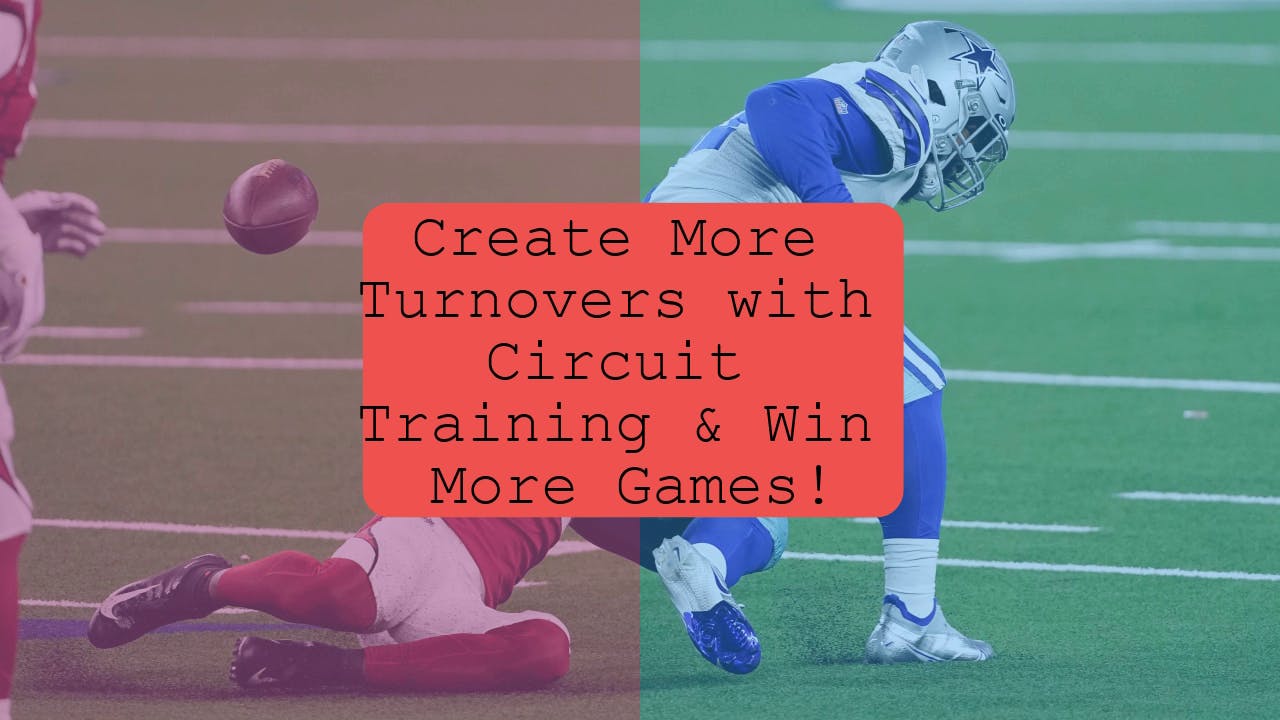
US Sports Football: Create More Turnovers with Circuit Training & Win More Games! And Notre Dame vs. Miami Game Highlights


  • By Keith Grabowski

It’s one of the simplest to understand stats…

Teams that win the turnover battle win 78% of the time. 

Understanding a number and translating that to performance is the challenge. 

Spending time training skills that have the ability to change the outcome of a game is smart coaching. So what’s the best way to do that?

Former Kansas DC DJ Eliot told me once that “player development is a race against time.”  We have to find ways to be more efficient and get reps on skills that matter most.

For the turnover skills and techniques, circuit training is an efficient way to get a lot done in a small amount of time.  

What may seem insignificant in terms of the amount done on a single day can add up exponentially and the cumulative effect of those reps will have an impact.

Two coaches doing that well shared their circuits in their clinic talks.

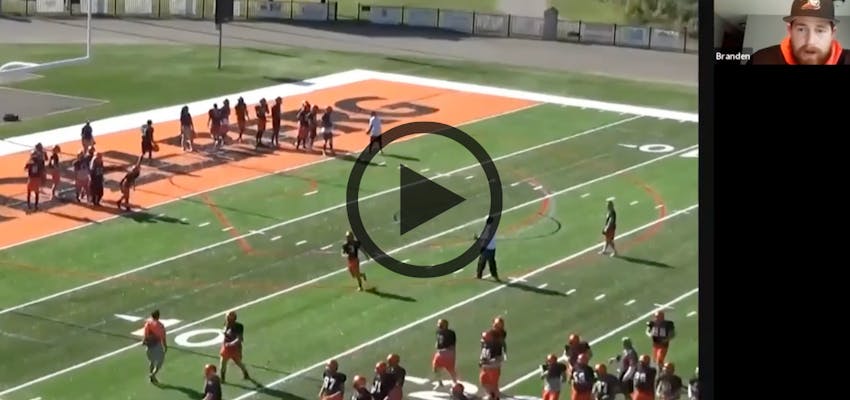
Heidelberg ranked as high as #11 in the country in turnover margin.  Defensive Coordinator Branden Jakubcin loves how turnovers can change the momentum of a game. He explains it here (click on images for video):

‘Berg spends time training those in their turnover circuit which includes drills for Level 1-2-3 of the defense:

Rip/Punch

Hammer Strip

Crash Pad Rip/Punch

Solo Fit Strip

2nd Man in-Punch and Rip

Scoop or Cradle

Scoop and Score

Downhill High/Low

Tip Drill

Here is an example of their Scoop and Score Drill

null

LSU defensive coordinator Daronte Jones reverse engineered the 6-points of contact to determine exactly how to attack the ball and get it out. This is something that they share with their players and chart daily. He shares their approach here:

Like Coach Jakubcin, Coach Jones utilizes circuits to train takeaways.  The “Rip” Drill  is part of one of his circuits and it goes back to teaching how to get the ball away from that carrier who is utilizing the 6 points of contact, in this case, the high and tight or two hands on the ball:

Coach Jones and Coach Jakubcin have spent a lot of time designing their circuits so that they can create the turnovers needed to help their teams win.

As you plan for camp and the season, think about what you can do to learn from their examples and apply circuit drills to train the fundamentals of taking the ball away.  Like the pictures Coach Jake showed, you will have a lot more smiling faces on game day, and more in the WIN column.

P.S. Get ready for camp with this Turnover Circuit Combo for just $15 (67% off) for Coach Jake’s and Coach Jones’s courses together. 

There are enough drills here to create multiple circuits which you can cycle through to keep the interest levels high.  The combo is available for a limited time, but the results of training your players will show up this fall.

NYSS Stay In The Game