Now Streaming On US Sports Radio!

US Sports Net Today!


Live Play-by-Play, Updates, Highlights and More! on US Sports Network!
[Chrome Users-You may have to click on the play button twice to listen]
US Sports Network Powered By Gorilla Sports!


US Sports Radio
The Las Vegas Raiders Play Here
Fitness and Sports Performance Info You Can Use!
The Scoreboard Mall
The Rock Almighty Shaker Of Heaven And Earth!
The Coolest Links In The Universe!
Showing posts with label track and field coach NCAA track and field Track and field recruiting video USA track and field track and field athlete. Show all posts

Wednesday, November 19, 2025

US Sports Track and Field: Three Hurdle Drills All Track Coaches Should Know and You will not believe how close these finishes got 👀 Tokyo 25


The Paris 2024 Olympics have made track and field top of mind for not just American citizens watching the games on TV, but especially young athletes who find themselves intrigued by the record-breaking feats they’re witnessing. 

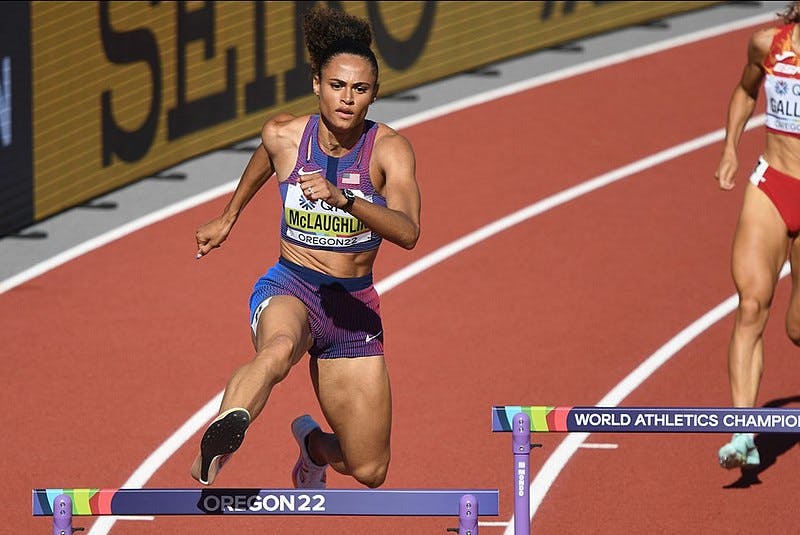
One of Team USA’s most famous athletes at the Olympics is Sydney McLaughlin-Levrone. She is a 25-year-old American hurdler and sprinter who competed in the 400-meter hurdles at the 2024 Olympics. She is the 2020 Tokyo Olympic champion with the Games record and the 2022 World champion. She currently holds a world record time of 50.65 seconds, which was set at the U.S. Olympic Trials on June 30, 2024. But many are expecting her to set a new world record when she competes in Paris. 

While McLaughlin-Levrone is now the world’s fastest female hurdler, she got to this point by dedicating herself to her craft for years, even decades. She surely honed her hurdling skills by using many of the same drills that Chris Parno teaches his college athletes and Olympic hopefuls. 

Coach Parno is the Associate Head Track and Field Coach at Minnesota State University. Parno leads the men's and women's sprint/hurdle groups and serves as the recruiting coordinator. While being led by Parno, the maverick sprinters and hurdlers have experienced unprecedented success, re-wrote the record books, and established MSU as a sprints and hurdles powerhouse among Division II. This includes Coach Parno coaching 11 Individual/relay NCAA National Champions and 8 Individual/relay NCAA National Runner-ups in his 13 seasons at MSU. 

Coach Parno’s ‘Hurdle Drills’ course details all of the main drills he has used to turn Minnesota State into a national powerhouse. They will help track coaches cover all the bases when it comes to getting their athletes prepared for their next hurdle event—and could even help turn a select few of these athletes into Team USA’s next Olympics champion. 

Cut Step Drill

null

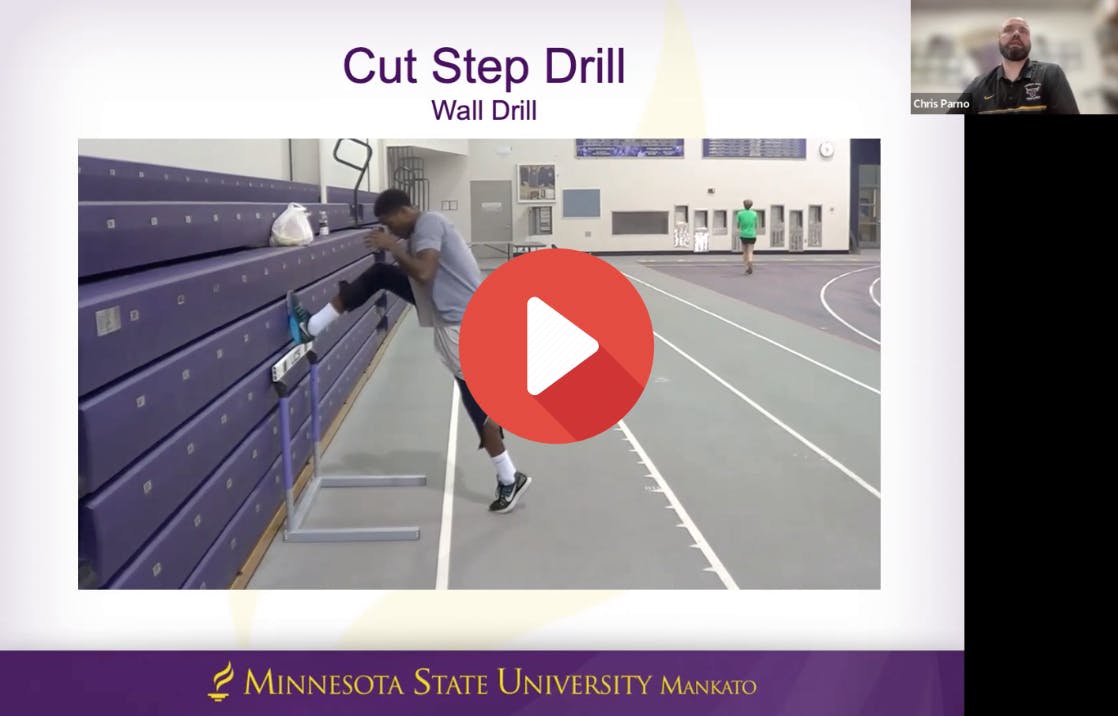
One of Coach Parno’s favorite drills for hurdlers is what he calls the Cut Step Drill. 

The cut step is the last, shortened step a runner makes before they make their jump. Therefore, working to perfect the cut step can be the difference between winning one’s race and coming up a few milliseconds short. 

The cut step drill will start by placing a hurdle against a wall or some other flat surface. The runner will position themselves a few steps away from the wall and then begin by taking a couple of steps toward the hurdle. Once they reach their cut step, the runner will get their drive foot down beneath their hips before projecting into the hurdle. 

This drill doesn’t require the runner to make any actual hurdles. Rather, their simulating the jump will end with their lead foot being placed against the wall just above the hurdle, and not having ever left the ground. 

“Cutting” that last step before the hurdle a bit short allows the runner to project into the hurdle. The runner wants to start feeling the hip projection as they lead into their hurdle, which will help propel them forward when making their jump without losing momentum. 

One Step Leads and Trails

One dynamic drill that Coach Parno recommends for any hurdle athlete is what he calls the One Step Leads and Trails drill. 

This drill is going to start with three hurdles being placed about 3-5 feet in between one another (although that can change depending on what level you’re coaching at/whatever your need is). 

The hurdler will then start with the runner approaching the side of the first hurdle (meaning they aren’t jumping over the entire hurdle) and getting their lead leg only over the hurdle.

Once they land, they’ll have to return right back into their hurdling position after a quick contact with the ground and get into their golden position take-off before sending their lead leg over the second hurdle. Then they’ll do the same thing with the third and final hurdle. 

The goal for this drill is to get the rhythm down of these golden position take-offs and get repeated attacks into each hurdle in order to build repetitions. Therefore, the hurdle doesn’t need to be at its full height. 

The second half of this drill is the trails portion, where the runner will be doing the same thing as before but with their trail foot going over the hurdle, rather than their lead foot. 

Another important part of this drill is that the coach makes sure the runner’s lead arm is coming down and around as they make their jump, as per the proper technique. 

6 Step Starts

A runner’s ability to get off the starting blocks can either spell success or despair for a runner during a race. And that’s why Coach Parno’s ‘6 Step Starts’ drill is a must for not just hurdle coaches, but coaches for all other track events as well. 

The drill starts with the coach putting a piece of tape on the track where the hurdler’s sixth step should land. Then the hurdle will head off the blocks and by their sixth step, they should have already launched into the first hurdle. 

This drill is particularly effective for getting runners to push off the blocks because if they haven’t reached that piece of tape by their sixth step it’s clear proof that they’re not excelling at the start of the race as efficiently as they could be. 

Without putting the tape marks down, it takes more guesswork from a coach to figure out how their runners are starting off the blocks. 

Saturday, November 1, 2025

US Sports Track And Field: How to Teach the Glide Shot Put and He WON Worlds with a Broken Freakin' Elbow


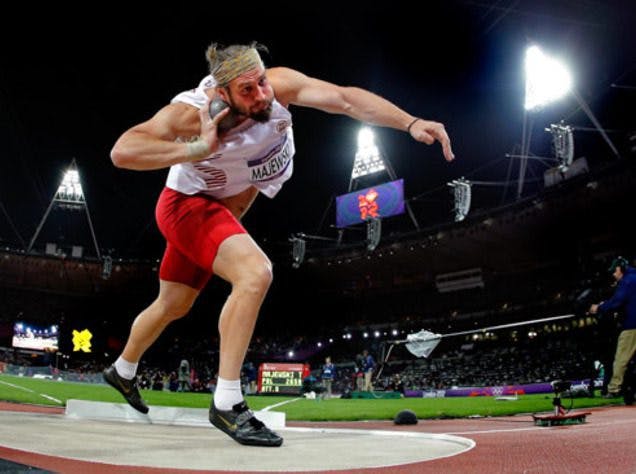
There are two prevailing techniques for the shot put: the spin and the glide.

For those who are unaware, let’s briefly discuss the fundamental differences between these two techniques. A thrower who utilizes the glide technique will typically have a much wider base when establishing their foot positioning, and will also have a significantly deeper torso position than the spinner. 

A thrower who employs the spin technique, however, will be a bit more upright during their standing throw. 

While the throw’s initiation will come from the left side with both techniques (given the thrower is right-handed), the thrower’s left arm travels differently in each movement. And this is where a thrower’s build, athleticism, and natural abilities should help decide which technique is best for that athlete. 

The glide technique is simpler to learn and execute, and places less physical demands on the athlete compared to the spin. Gliding typically allows for greater stability and balance during the throw, which is crucial for young athletes still developing their strength and coordination. 

And there are few better coaches of the glide technique for developing athletes than René Sack.

Coach Sack has been the German national coach for the women’s discus since 2016. Before that, he was also a national junior coach for the discus throw and hammer throw. He has coached athletes at Halle Olympic Training Center for more than a decade, including athletes such as World Championships discus medalist Nadine Müller.

As an athlete, René competed in the shot put with a best of 19.84 meters, placed second at the German championships, and represented Germany at the World University Games and several European age group championships.

Coach Sack’s ‘Glide Shot Put’ course by ITCCCA reveals all the keys that he used as a world-class athlete and as a coach to master the glide shot put. We have pulled some of his best lessons so that you can use them as a blueprint for teaching the glide shot put to your own developing athletes. 

Technical Progression

null

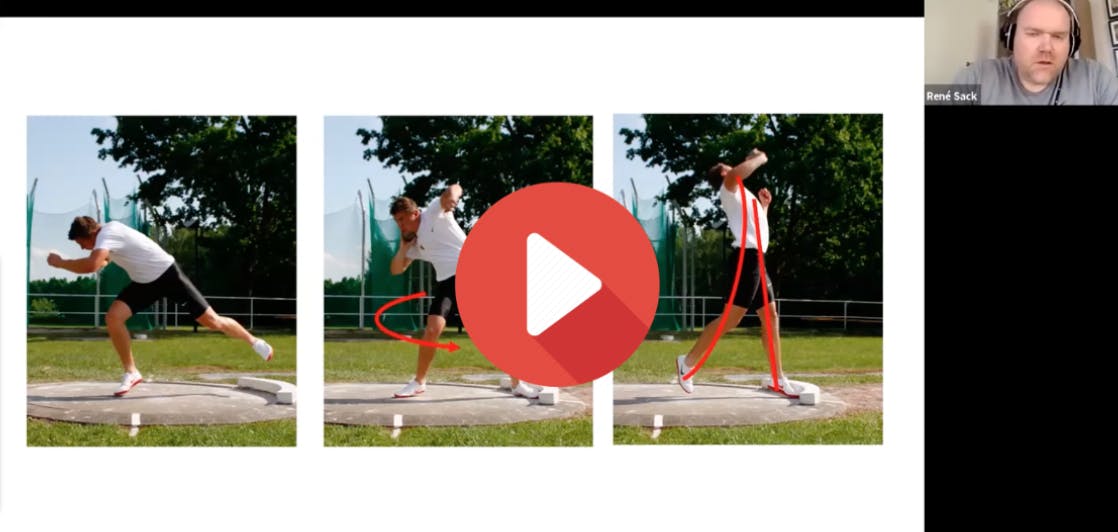
Coach Sack likes to think of the glide shot put’s technical progression training as a pyramid. At the bottom of the pyramid’s base are the basic and special throws.

These are all of the medicine ball throws, kettlebell throws, and the many variations of those types of throws (such as doing them standing, sitting, and with various rotational elements). The goal for these is to make your athletes get a basic feel for various aspects of the throw, as well as provide core and strength stability training

Coach Sack says the next rung of the pyramid should be implement-handling/standing throw training, which will break down the glide technique into different segments that will give the athlete a better idea of what they should be feeling in each phase of the movement. 

The next rung up in the training pyramid will be to add throws with pre-acceleration, which will help to build on rhythm and help the athlete get a good feel for what their base should feel like as they through their throw. 

And at the top of the pyramid is the competition technique, which simulates what the complete technique will be when the actual competition is taking place. 

Implementing a training regimen that includes all four rungs of this pyramid, and that goes in this gradual progression from basic exercises and throws to full-on competition throws is not only the safest but the most effective way to help develop your athlete’s glide shot put technique.

Where To Put

The next glide shot put aspect that Coach Sack broaches is where to position the actual shot on one’s body during the throw. 

Coach Sack notes that the positioning between the glide and the spin throw is quite different. For the spin throw, most American coaches direct their athletes to hold the shot near the back of their neck. 

If we were to envision the neck as a clock, with the adam’s apple at six o’clock and the back of one’s back at twelve o’clock, Coach Sack notes that most spin coaches would have their athletes holding at about ten o’clock.

But the glide technique is vastly different. Coach Sack suggests that athletes should be holding the shot at about seven o’clock on their neck, in a position where it sits above the athlete’s clavicle bone and tucked beneath their chin.

This is because if the right leg is in the right position during the glide shot’s execution, the chest will open up, which will naturally cause the arm (and shot) to separate from the body. And if the shot is being held too far back then this might cause the arm to enter some uncomfortable positions and take away from the throw’s power.  

In addition, holding the shot at ten or eleven o’clock will force the arm to remain flexed and tight throughout the throw, rather than the throw starting out relaxed at the throw’s beginning.

Lifting Drill

Coach Sack believes that the most effective powerlifting exercise for glide shot put throwers is the power clean. 

For those who don’t know, the power clean is a highly technical exercise that involves catching a barbell in a partial squat, or "power position", above parallel to the ground. It’s also an Olympic weightlifting movement often used to develop whole-body explosive strength and power, and using it consistently brings benefits such as boosting explosive power development, enhancing body composition, and improving overall coordination.

Many aspects of the power clean relate to the actual glide throw, in terms of which muscles are being used at what phases of the lift. This is why the power clean should be an essential part of the workout regimen of any athlete who uses the glide technique (or even the spin technique). 


Friday, October 17, 2025

US Sports Track & Field: How Distance Running Coaches Can Get the Most Out of Their Athletes and Habtom Samuel, New Mexico Cross Country Grind At Altitude


  • By Grant Young
  •  

When it comes to coaching distance runners, there’s one obvious training method: make the runners run; the farther, the better. 

But it shouldn’t be that simple if coaches truly want to maximize their athletes’ potential. Regardless of what level your athletes are at, you would be short-changing their progress if their daily training regimen only consisted of distance running. Not only would this contribute to these athletes feeling burnt out, but there are plenty of other training techniques that have been proven to help runners become the best version of themselves. 

And one of the key figures driving this movement toward improved distance runner training is Jay Johnson.

Jay Johnson has coached collegiate, professional, and adult runners for two decades. Coach Johnson started his career as the head track and cross country coach at Pratt Community College in Pratt, Kansas, before returning to CU to serve as an assistant cross country coach, middle-distance coach, and recruiting coordinator. After eight years as a collegiate coach, Johnson transitioned to coaching post-collegiate athletes, three of whom won USATF titles, the most notable being Brent Vaughn, who won the USATF 2011 Cross Country championship. 

Coach Johnson is deeply involved with high school running. His popular YouTube channel has close to 2,300,000 views, with runners of all ages using this resource to learn exercises and routines needed to gain the strength and mobility necessary to remain injury-free.  

Coach Johnson’s ‘Consistency Is Key: Training Principles for Distance Coaches’ course has proven to be an indispensable training device for many professional, collegiate, high school, and youth track and field coaches

We have pulled some of Coach Johnson’s best insights from his course and distilled them into easily digestible bits that will give you a taste of the training wisdom he can offer when it comes to making your distance runners the best they can be.

What To Train - Introduction

While there’s a lot that should go into long-distance running training, there’s no doubt that actually running long distances should be a central part of a team or individual’s regimen. 

But the important part here that Coach Johnson stresses is that it isn’t good enough just to tell your runners to go run a random set of miles each day for practice. Rather, there needs to be structure (and a purpose) to each training session, even if it’s just distance running. 

And the purpose should be to build up the runner’s anaerobic base (or, as Coach Johnson calls it, their engine). And there are lots of different ways to do this that aren’t just a typical long-distance run every day.

One example of this is what Coach Johnson calls a “critical velocity run”. While this might sound like a complex concept, what it essentially means is a timed run where the runner’s goal is to run at the same pace throughout.

In order to achieve this, the runner would need to be checking their pace at set intervals (say, every five minutes), and try to maintain a running pace there she wouldn’t lose any time every five minutes. 

This is going to take time for the runner to perfect. But if this becomes a weekly part of the long-distance training routine then it can become a huge asset in building up a runner’s anaerobic endurance. 

Run Race Pace (or faster)

“This is the second biggest mistake I see athletes and coaches make. Kids have to be ready to run race pace. Training a touch faster is important, but also, you need to have a progression of strides.” - Coach Johnson

The first mistake that Coach Johnson alluded to in that quote is when high school athletes are not running strides most days. And he notes that the second biggest mistake made is not practicing race pace enough. 

While an athlete building their engine and strengthening their aerobic endurance should be a crucial component to one’s distance training, the lungs aren’t the only part of the body that needs to build stamina. 

 A runner’s legs also must be trained up. And there’s no better way to get one’s legs acclimated to running at race pace than running at race pace. 

Of course, this will take time to build up, and runners should not try to be running at race pace at their race distance on day one of training. But Coach Johnson notes that doesn’t mean a 400 or 800m runner can’t run 50 meters at race pace in the first week of practice just to get that race-like feel, and increase the distance from there. 

Remember To Sleep

“Sleep is like a secret ingredient in the recipe of running success.”

We’ve all been told countless times how important sleep is for our health and overall well-being. And Coach Johnson asserts that this is even more paramount for a distance runner.

Coach Johnson suggests that a distance runner (or any athlete, for that matter) should be getting at least 8 hours of sleep every night. In order to ensure this happens, he believes the best course of action is to work backward. 

First, a runner should figure out what they must wake up in the morning. From there, the athlete should figure out what’s (at least) eight hours before that wake-up time and plan to be in bed, trying to sleep, at that point. 

It might sound like a long shot that a coach can convince their athletes to go to sleep at 9 PM on a weeknight. But Coach Johnson claims that if any of those kids are willing and receptive to doing so, then those are almost certainly going to be your future champions and record-breakers.


Wednesday, October 1, 2025

US Sports Track and Field: 3 Pole Vault Check Points From Legendary Kansas Coach Tom Hays and Men's Top 10 Tokyo Performances World Athletics Championships


  • By Grant Young

For nearly four decades, Tom Hays has been the quiet architect behind the University of Kansas's remarkable pole vault coaching dynasty. His journey from promising athlete to legendary coach embodies the perfect marriage of technical precision and psychological insight that defines elite coaching.

Hays's approach begins with fundamentals. Early in his career, he recognized that the pole vault isn't merely about raw athleticism but requires a methodical building of skills. He developed a progressive teaching system that breaks down the complex movement into learnable segments—grip positioning, approach rhythm, plant technique, swing mechanics, and finally, the commitment to inversion.

What distinguishes Hays is his embrace of both science and artistry. In the 1990s, when biomechanical analysis was still emerging, he was already filming his vaulters, analyzing frame-by-frame movements to identify inefficiencies invisible to the naked eye. Yet he balances this analytical rigor with an intuitive understanding of how each athlete learns differently.

"The pole vault is physics in motion," Hays often tells his athletes, "but the vaulter is human." This philosophy informs his individualized coaching style. For some athletes, he focuses on technical cues; for others, he cultivates the psychological fortitude needed to hurl oneself nearly twenty feet into the air.

His training facilities at Kansas have evolved from basic pits to high-tech laboratories featuring specialty equipment and computer modeling. But Hays maintains that the most valuable coaching tool remains attentive observation—watching how an athlete responds to instruction, adapts to challenges, and demonstrates readiness for progression.

The results speak volumes: dozens of All-Americans, multiple national champions, and Olympic qualifiers, along with his securing the nation’s No. 1 men’s pole vault recruit for three consecutive years at one point in his career, ensuring continued excellence in Kansas’ jumps program. More impressively, many of his former athletes have become successful coaches themselves, spreading his methodology throughout the sport.

Coach Hays’ ‘Tom Hays - The Art of Coaching the Pole Vault’ clinic explains the art of coaching this challenging sport and offers insights into athlete evaluation, coaching technique improvement, and simplifying complex movements. He emphasizes the importance of self-evaluation, clear communication, and eliminating unnecessary elements.

We have pulled some lessons from Coach Hays’ clinic and included them for you below.

3 Check Points to Look For

null

At one point in his clinic, Coach Hays discusses three check points to look for what an athlete is executing their pole vault. 

Check point number one is that if the athlete is right-handed, when they land on their right foot in the step before takeoff, the hand is going to be somewhere around the runner’s forehead. 

Most athletes have a tendency to have their hand closer to neck height, which is about eight inches away from where they should be and which will make them late in their plant. 

Thankfully, this is a very easy thing to spot when watching film as it will be extremely apparent. But there are other nuances, such as the speed and rhythm are also important to diagnose and get right.

The second check point is when the runner lands on their takeoff foot, their top arm is extended close to straight. While many runners have a completely straight arm (which is okay and which Coach Hays teaches his athletes), Coach Hays explains that it’s also all right to have a slight bend if that’s what the athlete feels most comfortable doing. 

The top arm should be up over the runner’s head in a high position, regardless of how bent the arm is. 

The third and final check point is that the lead knee (or the drive knee) is before the takeoff foot leg before there’s pressure or bending in the pull phase. Coach Hays then discusses how, while some people don’t drive their knee correctly at this point, their hips are rising enough where it does the same mechanical work instead. 

 “The more pole speed you have, the more potential fly-away speed you’ll have,” Coach Hays said. He then quoted a coach who said, “Energy in, energy out.” In other words, the more energy and speed you can put into the takeoff, the more energy you’re going to get out of the pole. 

Coaching Athleticism

null

When it comes to coaching the pole vault, Coach Hays says that it’s important for an athlete to only have one voice they need to listen to, instead of multiple coaches telling them what to do. In order to ensure this, a coach will want to be very direct and specific about what they want their athlete to be working on on any given day.

He also said that stress can be a good thing when it comes to an athlete learning. However, it’s important to understand the difference between good stress and bad stress. Good stress is competition between peers or opponents, or working hard in the weight room or on the track. Bad stress can be external pressures that a coach puts on their athlete. 

He also discusses that if a coach puts a camera on their athletes while training so that they know there will be film of them, they’ll be more inclined to focus on their mechanics and develop good habits. This is another good type of stress. 

Finally, a tired athlete doesn’t learn very fast, so fitness needs to always be a focal point. And Coach Hays adds that rhythm (or a lack of rhythm) always overcomes effort. 

NYSS Stay In The Game

Saturday, September 6, 2025

US Sports Track and Field: Two Valuable Hammer Throw Training Tips and European Throwing Cup Nicosia 2025 Highlights


  • By Grant Young

The journey from being a good hammer thrower to a great one often hinges on subtle coaching nuances and slight shifts in hammer throw workouts that may not always be immediately visible. 

While an athlete might have the physical prowess and a fundamental understanding of the sport, it is often the less obvious elements introduced by a knowledgeable coach that can unlock the athlete's full potential. These small coaching details contribute to refining skills and enhancing performance in ways that can be transformative. 

The impact of tailored feedback during training sessions cannot be understated; it allows athletes to discover and fine-tune their unique throwing styles. Coaches help cultivate an environment where athletes can develop confidence in their abilities and learn to tackle the mental aspects of competition, which can significantly differentiate a good performance from a great one. 

The relationship between coach and athlete plays a pivotal role in nurturing the right mindset. A great coach knows how to inspire their athlete, fostering resilience and a sense of purpose that can elevate competition outcomes. As athletes learn to embrace challenges and visualize success, they often find themselves approaching competitions with a new level of composure and determination. 

The evolution from good to great in hammer throwing illustrates how small but intentional guidance from a coach can shift an athlete's trajectory. These understated yet critical contributions create a ripple effect, influencing not just technique but the overall approach to both training and competition, leading to extraordinary results.

With this in mind, we have pulled two vital hammer throw tips from two proven track and field coaches that could end up becoming key in your quest to unlock the potential that your hammer throwers are destined for. 

Paddy McGrath - Swings

Patrick McGrath is a 1995 graduate of Manhattan College and a former track and field Olympian and current assistant coach at Manhattan College and founder of The New York Hammer Squad. He oversaw the trio of Nina Bjorkman, Lasma Padedze and Alexandra Preckajlo that accounted for two golds, three silvers, one bronze and 54 total points at the 2021 MAAC Outdoor Women's Track & Field Championship.

Following the season, he helped Rudy Winkler to the USA Championship in the hammer throw and a seventh place finish at the 2020 Tokyo Olympics.

With experience at the international, collegiate and high school levels, McGrath has mentored NCAA, Senior National, Junior, and Youth champions. Ten of his athletes have won high school national titles, and four have claimed New York State championships. McGrath also coached Track and Field News' 2013 High School Boys Athlete of the Year. In 2019, three of his Manhattan throwers qualified for the NCAA Outdoor Track and Field East Regionals. 

In his ‘Athlete Development: How Rudy Winkler Went From Beginner to American Record’ clinic, Coach McGrath details how a consistent dedication to the technical work is needed to be great, and that starts with the swing. 

Coach McGrath noted how he likes to see the ball in front of the thrower as they prepare their swing. For a right-handed thrower, their weight should be on the left while they’re singing on the right side. 

A term that he loves using with his athletes is “brush the hair” when discussing how close he wants the hammer swing to be to their head. Of course, they mustn’t get too close where they run a risk of whacking their head with the hammer. 

Another training strategy that he likes athletes to use is starting the swing with three fingers, moving down to two fingers, and then ultimately finishing with only swinging while using their pinky finger. This is so the athlete learns to let the ball do its own and create and sustain its own momentum, which is crucial for conserving energy. 

Nathan Ott - Catch

null

Nathan Ott begins his third season guiding Penn State’s throws group in 2024-25. During his coaching career, Ott has coached All-Americans in each and every one of the throws events. In his first two season with the Nittany Lions, Ott has mentored a pair of First Team All-Americans and has seen three school records toppled.

 During the summer of 2023, Ott returned to the World Athletics Championships, this time with a contingent of four professional hammer throwers under his guidance. Brooke Andersen (U.S.A.), Nayoka Clunis (Jamaica), Beatrice Llano (Norway), and Stamatia Scarvelis (Greece) traveled to Budapest with Ott as their coach. Clunis became the first Jamaican hammer thrower ever to make the World Championship final in the event.

In his ‘Hammer Training: Tales of Connection and Engine Work’ clinic, Coach Ott discusses how his “catch” term is a core part of solidifying a hammer throw’s technique. 

Coach Ott explains that the catch is the point where an athlete reestablishes double support in their throw. 

He goes on to note that good catches have weight firmly on the left side (if the athlete is a right-handed thrower). The thrower can’t be collapsing on the right side or aggressively dropping, instead being stable once the right foot touches. 

Because of this good connection, the athlete will immediately become capable of working on an effective implementation which will lead to a good throw. 

A poor catch is when the weight collapses into the right leg, where the athlete isn’t immediately able to explode out of that position. The ball should always be back and the athlete should keep connected with it. 

NYSS FB Be A Role Model

Saturday, August 23, 2025

US Sports Track and Field: How to Coach Weightlifting For Increased Speed and Acceleration and The Women's 400mH did not disappoint! Diamond League


  • By Grant Young

Regardless of the sport they play, strength training and conditioning is an absolute must for any high-level athlete’s training regimen.

And while most coaches and players know their way around a weight room — at least at a barebone, simplistic level — increasing functional strength safely from weightlifting is a nuanced subject that takes years of study to master. 

But when one considers the increased risk of injury that can come from weightlifting improperly, which can impede an entire season’s worth of hard work, it’s best that coaches receive their weight room knowledge from experts. 

Especially because these experts have dedicated their lives to finding the most effective weightlifting regimens to increase explosion, speed, acceleration, and every other aspect of athleticism. Luckily for coaches, these gurus want to share the insights they’ve gleaned with the rest of the sports world, to maximize every athlete's potential. 

We've compiled some of the best online courses about how to increase speed and acceleration in the weight room; all while minimizing risk of injury.

JT Ayers - Lifting for Speed Made Easy

Coach JT Ayers is a three-time Orange County Track Coach of the Year (2013, 2016, 2019) and has been coaching Track and Field for 14 years. Since 2014, his athletes have broken 35 grade level and 8 school records, 3 All-Time Orange County Records, and the team has been ranked #1 in Orange County in 4 different years (2015, 2016, 2018, 2020).

Coach Kula has 22 years of experience in the athletic development of athletes at all levels from youth to professional. He has worked with Division 1 athletes from over 25 universities across the country including notable local athletes Christian McCaffrey (San Francisco 49ers running back), Anna Hall (US Record Heptathlon/Pentathlon holder in 2019), MaryBeth Sant (NCAA #1 ranked 100m sprinter in 2013 (Oregon/CSU), among many other professional athletes.

Coach Ayers and Coach Kula’s ‘Lifting for Sprre Made Easy’ course is an approachable and effective way for any coach to learn the necessary steps in making their athletes faster through the weight room. 

In their course, Coach Ayers and Coach Kula discuss the three components of speed: 

1. How often you contact the ground

2. How much muscular force you can deliver during ground contact

3. How much ground contact time is available to deliver that force

That might sound difficult to decipher at first. Thankfully, the coaches explain an in-season workout plan that will allow you to train and improve upon all three of these aspects, all with minimal risk of producing injury.

But before that, Coach Ayers discusses about a common misconception of many coaches: that their athletes should not be lifting weights during the season.

This is inaccurate. Athletes should certainly be lifting weights and aiming to improve (or at least maintain) their strength during the season, or else everything they did in the offseason would be for naught. But the important part is that they’re lifting weights thoughtfully, not lifting as heavy as possible every day, and utilizing a balanced training program that accounts for rest and recovery.

Here’s a weekly in-season workout plan that Coach Ayers would suggest for a track athlete: 

Monday - Run, Weight room (warm-up, deadlift, hurdle hops)

Tuesday - Run, Pre-Meet

Wednesday - Dual Meet

Thursday - Recovery, Weight room

Friday - Run, Pre-Meet

Saturday - Invitational Meet

Sunday - Rest, Recovery

As you can see, this is a balanced weekly schedule that will not have a track athlete too burnt out on any specific aspect of their program, and will also minimize physical overuse and injury.

Amanda Rego - Stronger Core for Faster Running

null

Amando Rego has 5+ years of coaching experience at the NCAA level, experience with coaching at the professional level, as well as the USATF Junior Olympic youth level. As a runner, Coach Rego was a 7x All-American & NCAA Runner-Up for Florida State and has run a 4:26 indoor mile. 

In her ‘Stronger Core For Faster Running’ course, Coach Rego details why core workouts are more than about obtaining washboard abs for athletes. 

Coach Rego has five reasons why core workouts are a must for every athlete to train in the weight room:

1. Improve dynamic postural control

2. Necessary to have a strong core before you move to strengthen the extremities

3. Improve running economy

4. Prevent injuries

5. It’s the key component of the kinetic chain

The core is, well, just that; our body's core. Its foundation. Without a strong core, athletes not only put themselves at risk of increased injury everywhere else across their bodies but also aren’t maximizing the strength of other body parts. Every athletic movement utilizes the core, so it’s crucial not to neglect this part of your body during weight training sessions. 

It’s also important to diversify your core workouts. While crunches and planks are great, they need to be complemented by other exercises that target separate areas of the core (such as the obliques). 

DeShawn Fontleroy - Hip Mobility & Hip Stability

Coach DeShawn Fontleroy specializes in problems of training — including the role of strength training, sprinting, and explosive plyometrics in the athlete’s physical preparation. Coach Lontleroy has helped professional, collegiate, and high school athletes develop explosive power and jumping ability.

Increasing speed and acceleration isn’t all about weightlifting. It’s also about flexibility. In his 'Hip Mobility and Hip Stability’ course, Coach Fontleroy explains why hip mobility is paramount to maximizing one’s speed. 

“Hip stability is your ability to maintain your center of gravity and produce strength and coordination in the hips and trunk,” Coach Lontleroy explains. Some ways that he recommends increasing hip mobility and stability is by foam rolling over one’s hips before the weight room session, by the body weight Romanian deadlift exercise, and by trying a barbell hip bridge exercise. 

These tools and techniques can all be utilized together, helping your athletes achieve their maximum speed and acceleration injury-free so that they can chase their goals. 

NYSS FB Be A Role Model