Regardless of the sport they play, strength training and conditioning is an absolute must for any high-level athlete’s training regimen.
And
while most coaches and players know their way around a weight room — at
least at a barebone, simplistic level — increasing functional strength
safely from weightlifting is a nuanced subject that takes years of study
to master.
But when one considers the increased risk of
injury that can come from weightlifting improperly, which can impede an
entire season’s worth of hard work, it’s best that coaches receive their
weight room knowledge from experts.
Especially because
these experts have dedicated their lives to finding the most effective
weightlifting regimens to increase explosion, speed, acceleration, and
every other aspect of athleticism. Luckily for coaches, these gurus want
to share the insights they’ve gleaned with the rest of the sports
world, to maximize every athlete's potential.
We've
compiled some of the best online courses about how to increase speed and
acceleration in the weight room; all while minimizing risk of injury.
JT Ayers - Lifting for Speed Made Easy
Coach JT Ayers is a three-time Orange County
Track Coach of the Year (2013, 2016, 2019) and has been coaching Track
and Field for 14 years. Since 2014, his athletes have broken 35 grade
level and 8 school records, 3 All-Time Orange County Records, and the
team has been ranked #1 in Orange County in 4 different years (2015,
2016, 2018, 2020).
Coach Kula has 22 years of experience in
the athletic development of athletes at all levels from youth to
professional. He has worked with Division 1 athletes from over 25
universities across the country including notable local athletes
Christian McCaffrey (San Francisco 49ers running back), Anna Hall (US
Record Heptathlon/Pentathlon holder in 2019), MaryBeth Sant (NCAA #1
ranked 100m sprinter in 2013 (Oregon/CSU), among many other professional
athletes.
Coach Ayers and Coach Kula’s ‘Lifting for Sprre
Made Easy’ course is an approachable and effective way for any coach to
learn the necessary steps in making their athletes faster through the
weight room.
In their course, Coach Ayers and Coach Kula discuss the three components of speed:
1. How often you contact the ground
2. How much muscular force you can deliver during ground contact
3. How much ground contact time is available to deliver that force
That
might sound difficult to decipher at first. Thankfully, the coaches
explain an in-season workout plan that will allow you to train and
improve upon all three of these aspects, all with minimal risk of
producing injury.
But before that, Coach Ayers discusses
about a common misconception of many coaches: that their athletes should
not be lifting weights during the season.
This is inaccurate. Athletes
should certainly be lifting weights and aiming to improve (or at least
maintain) their strength during the season, or else everything they did
in the offseason would be for naught. But the important part is
that they’re lifting weights thoughtfully, not lifting as heavy as
possible every day, and utilizing a balanced training program that
accounts for rest and recovery.
Here’s a weekly in-season workout plan that Coach Ayers would suggest for a track athlete:
Monday - Run, Weight room (warm-up, deadlift, hurdle hops)
Tuesday - Run, Pre-Meet
Wednesday - Dual Meet
Thursday - Recovery, Weight room
Friday - Run, Pre-Meet
Saturday - Invitational Meet
Sunday - Rest, Recovery
As you can see, this is a balanced weekly schedule that will not have a track athlete too burnt out on any specific aspect of their program, and will also minimize physical overuse and injury.
Amanda Rego - Stronger Core for Faster Running
Amando Rego has 5+ years of coaching experience
at the NCAA level, experience with coaching at the professional level,
as well as the USATF Junior Olympic youth level. As a runner, Coach Rego
was a 7x All-American & NCAA Runner-Up for Florida State and has
run a 4:26 indoor mile.
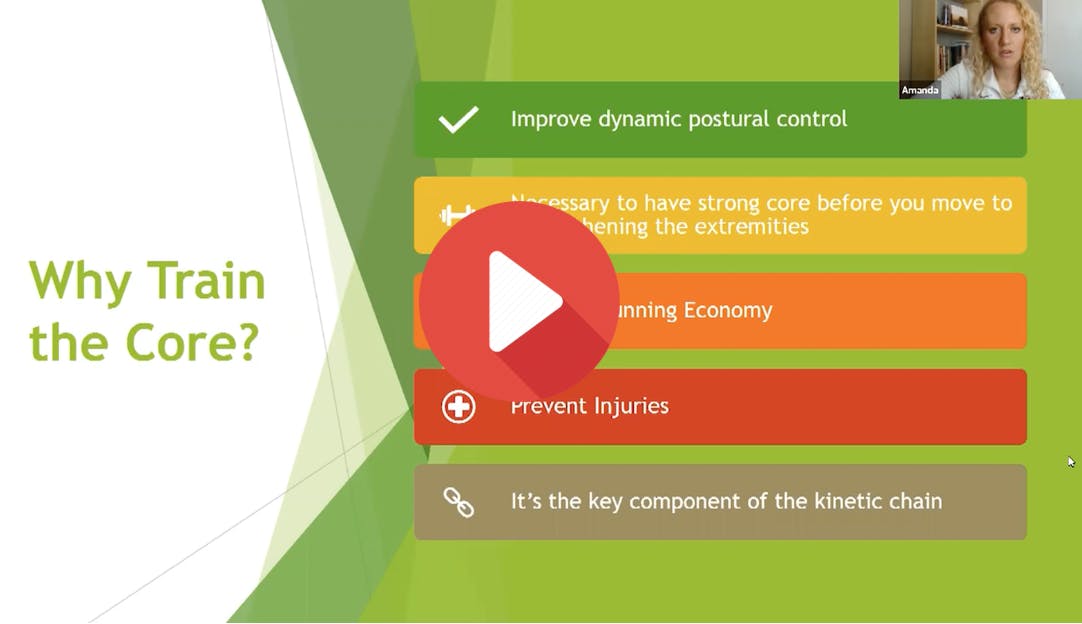
In her ‘Stronger Core For Faster Running’ course, Coach Rego details why core workouts are more than about obtaining washboard abs for athletes.
Coach Rego has five reasons why core workouts are a must for every athlete to train in the weight room:
1. Improve dynamic postural control
2. Necessary to have a strong core before you move to strengthen the extremities
3. Improve running economy
4. Prevent injuries
5. It’s the key component of the kinetic chain
The core is, well, just that; our body's core. Its foundation. Without
a strong core, athletes not only put themselves at risk of increased
injury everywhere else across their bodies but also aren’t maximizing
the strength of other body parts. Every athletic movement
utilizes the core, so it’s crucial not to neglect this part of your body
during weight training sessions.
It’s also important to
diversify your core workouts. While crunches and planks are great, they
need to be complemented by other exercises that target separate areas of
the core (such as the obliques).
DeShawn Fontleroy - Hip Mobility & Hip Stability
Coach DeShawn Fontleroy specializes in problems
of training — including the role of strength training, sprinting, and
explosive plyometrics in the athlete’s physical preparation. Coach
Lontleroy has helped professional, collegiate, and high school athletes
develop explosive power and jumping ability.
Increasing speed and acceleration isn’t all about weightlifting. It’s also about flexibility. In his 'Hip Mobility and Hip Stability’ course, Coach Fontleroy explains why hip mobility is paramount to maximizing one’s speed.
“Hip stability is your ability to maintain your center of gravity and produce strength and coordination in the hips and trunk,” Coach Lontleroy explains. Some ways that he recommends increasing hip mobility and stability is by foam
rolling over one’s hips before the weight room session, by the body
weight Romanian deadlift exercise, and by trying a barbell hip bridge
exercise.
These tools and techniques can all be
utilized together, helping your athletes achieve their maximum speed and
acceleration injury-free so that they can chase their goals.