Now Streaming On US Sports Radio!

US Sports Net Today!


Live Play-by-Play, Updates, Highlights and More! on US Sports Network!
[Chrome Users-You may have to click on the play button twice to listen]
US Sports Network Powered By Gorilla Sports!


US Sports Radio
The Las Vegas Raiders Play Here
Fitness and Sports Performance Info You Can Use!
The Scoreboard Mall
The Rock Almighty Shaker Of Heaven And Earth!
The Coolest Links In The Universe!

Wednesday, June 18, 2025

US Sports Softball: The 5 Biggest Mistakes Softball Coaches Make and Texas Tech Red Raiders vs. Texas Longhorns Game 3 Highlights


  • By Brandon Ogle

This can definitely be the case in softball as well. In this article, I’ll discuss some of the biggest mistakes that plenty of softball coaches seem to make time and time again.

Mistake #1: Instructing All Players The EXACT Same

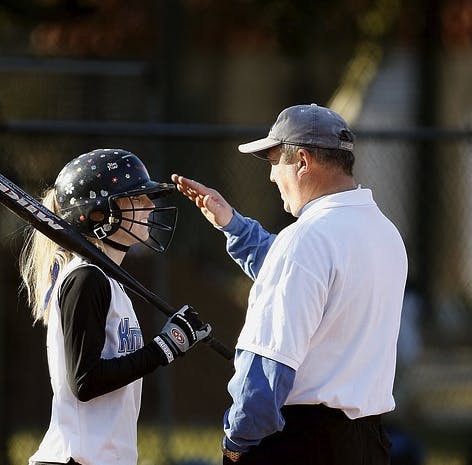
At the youth game, differences in skill sets might not be as distinct. However, trust me, they are there. The easy approach to coaching is running every player through the exact same drills. However, you have different types of players. Some are more speed focused, while others rely on the pop produced by their bat. With this said, coaches should be grouping players by skillsets for practice set-ups. The first half should focus on honing in on strengths and making those as pristine as possible. Then, with the second half of practice, focus on weaknesses. Look at the areas that are holding the player back from being a more complete player.

Mistake #2: Not Being the Coach

Not being the coach? Some of you might raise an eye at this one. With this said, what I’m stressing is the need to be the coach and sometimes this means discipline. I’m not talking about continuously yelling at your players, but rather using your position to train players. Occasionally, you’ll likely confront players that think they know more than the coach. Don’t let a negative attitude disrupt the rest of your team.

Mistake #3: It’s Not All About Winning

We live in a world where winning is sometimes viewed as always being the primary goal. Michael Jordan once said, “I've missed more than 9000 shots in my career. I've lost almost 300 games. 26 times, I've been trusted to take the game winning shot and missed. I've failed over and over and over again in my life. And that is why I succeed.” Don’t be the coach that creates a culture where players think an “L” is a complete failure and any season that doesn’t end with a trophy is a disappointment. Once you let the culture get away, all of a sudden softball goes from fun to a burden.

Mistake #4: Thinking All Kids Should Fall in Love With the Game

This mistake is mainly applicable to youth coaches. I always say that youth coaches should be more focused on development, as opposed to racking up the trophies. At the same time, you need to understand not every player on a youth team is going to be “all-in” on a particular sport. Don’t take this as an insult. Some kids are just there for the social part. Don’t think that you need to be more disciplined to get them to love the game. For these kids, it might be more about teaching them some life skills instead of perfecting their softball talents.

Mistake #5: I’m the Expert

As a coach, it is your job to teach players and develop their skills. However, don’t be the coach that is never accepting feedback from anyone. Going along with this, you don’t want to be the one that is always coming up with random historical philosophies that will ‘supposedly’ transform your team. At the end of the day, it’s critical to find a happy medium between being strict and having fun. After all, softball is supposed to be fun, right?

At the end of the day, no coach is perfect. We’re all going to make some mistakes. Just don’t keep falling victim to the same one. Just as it should be with your players, learn from your mistakes!

NYSS Stay In The Game 

Tuesday, June 17, 2025

US Sports Golf: History of Golf and 2025 U.S. Open Highlights: Final Round


  • Author Pete Buchanan

The popularity of golf is growing, with 68 million golfers worldwide to date. Since 2020, the number of 9- and 18-hole golfers has increased by 15% in three years. Countries like the USA, Japan, and Canada comprise the largest percentage of players, with the US alone seeing 20 million people participating in the sport.

USGA

Participation outside of golf is also rising, with off-course activities such as driving ranges and simulators driving participation. While golf is growing in popularity annually, many do not know its history, including when it was invented and key facts concerning its origins. This article outlines the history of golf in under five minutes of reading time.

When was Golf Invented?

The origins of golf are largely debated, but its history can be traced back to ancient empires, such as the Roman Empire and the Chinese Ming Dynasty. Specifically, the Roman stick-and-ball game of Paganica, which spread throughout Europe, and the Chinese game Chuiwan, played by traders throughout the continent, are likely descendants of golf.

After these old golfing variations spread throughout medieval Europe, the first forms of golf resembling modern-day interpretations were established near Edinburgh, Scotland. Historical records indicate that a stick or club was used to hit pebbles over dunes as a form of golf. It gained noteworthy popularity, so much so that it was banned in 1457 by the Scottish Parliament of King James II.

In 1502, this interpretation of golf gained royal permission and was endorsed by King James IV. The monarch’s predecessors – King Charles I and Mary Queen of Scots- later spread the sport throughout England and Europe.

In the following two hundred years, the first international golf tournament took place in 1682 in Lief, Scotland, with the first club formed in 1744 named the Gentlemen Golfers of Leith – formally instituting the sport we know today. The world’s first 18-hole course was established at St Andrews, Scotland, establishing a new standard for golf twenty years later in 1764; through the next century and beyond, golf went global, with the British Empire disseminating it from India to Hong Kong, giving the sport the international appeal we see today.

To learn more about golf, explore our video courses on the ISNation app, by veteran golf coach Pete Buchanan

5 Historical Facts About Golf

The history of golf is complicated, with historical scholars often disagreeing on its origin. Still, here are five commonly agreed-upon facts about golf you might not have known about:

While golf was banned in 1457 by King James II to favor other sports, such as Archery, the Scottish largely ignored the ban

King James IV of Scotland became the first golfing sovereign in 1502 when his parliament reinstated golf.

The term ‘caddie’ derives from Mary Queen of Scots’ French assistants, Cadets, who aided her in France while she studied and spread the sport.

Outside of Britain, the world’s oldest golf club, the Royal Calcutta Golf Club, was established in India in 1829.

In Europe, the first golf course was constructed in Pau, France, in 1856, and other clubs and golf courses were established throughout the continent in the 19th century.

Who is the Best Golfer of all Time?

While hotly debated, the best golfer of all time can be narrowed down to Tiger Woods or Jack Nicklaus—both masters of the sport with numerous wins and titles; these players are practically equal in their accomplishments and profound impact on golf. Nicklaus won 18 major championships (currently an unbeaten record), 73 PGA Tour wins, and was the youngest golfer to win a grand slam at 26.

Conversely, Woods holds the record for most PGA wins with 15 majors and 683 weeks at the top of his game as the best golfer in the world. Both players have lengthy accolades and accomplishments, making it difficult to determine the best golfer of all time. Woods is known for his mind-bending shots, while Nicklaus dominated the tour during the 1960s and 1970s, an era noted for its intense competitiveness. This distinction between the two greats is difficult to make.

What is the Farthest Drive in Golf History?

American PGA Tour golfer Max Homa executed the longest official golf drive in history in 2024. Performed at the seventh hole of the Plantation Course at Kapalua in Hawaii, Homa drove the ball 477 yards.

While this is officially the farthest drive in golf history on tour, other notable unofficial drives include Tiger Woods at 498 yards, Carl Cooper at 787 yards, and Mike Austin at 515 yards. The former saw the record wiped by the PGA, and the latter two are not officially included because they were conducted prior to the year 2000, before the ShotLink Era.

Nevertheless, Max Homa still holds the record for the longest official golf drive in history, with Davis Love III and Jeff Sluman narrowly behind at 476 and 473 yards on the PGA tour.

What Countries is Golf Most Popular?

The worldwide popularity of the sport has seen most traction and players in the following 3 countries, based on # of golf courses:

USA

Japan

UK

It is particularly notable that Japan ranks #2 despite having much less land to build courses on compared to the UK or Canada.

Golf Has a Rich, Royal History

This article has outlined the history of golf from its ancient conception to its expansion in Scotland, England, and, subsequently, the rest of the world. Tied to the British monarchs of old, modern-day golf is intrinsically linked to the royal heritage of the contemporary Western world.

If you’re a golfer looking to improve your mental game, check out the ISNation App for mind set courses and daily training.

NYSS Find Their Strengths

Monday, June 16, 2025

US Sports Hockey: Complete Youth Hockey Practice Plan and NHL Playoff Highlights Panthers vs. Oilers SCF Gm 5


  • By Jacob Crabtree

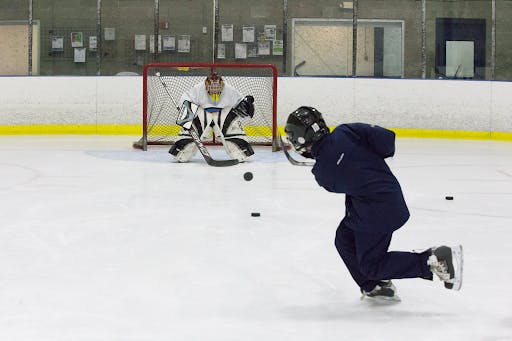
Young hockey players can be challenging to build practices around, which is exactly why we made the complete practice plan. This full practice plan will employ youth players with skills and abilities in every section of the ice, all while having fun, the most important part of the game! 

This plan has been fully developed to build your entire practice, starting from warm-up drills all the way up to small area games to finish off the practice. These may be basic, but none the else very essential when producing a practice. 

Here is the full youth practice plan for any team.

________________________________________________________________________________________________________________

Warm-up Drills:

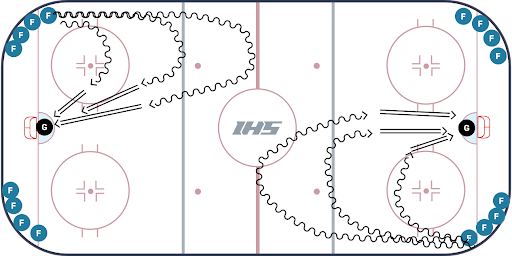
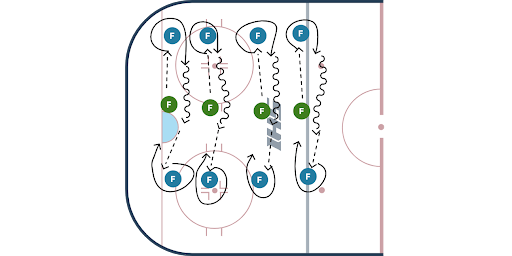
Drill 1: Canada Cup

null

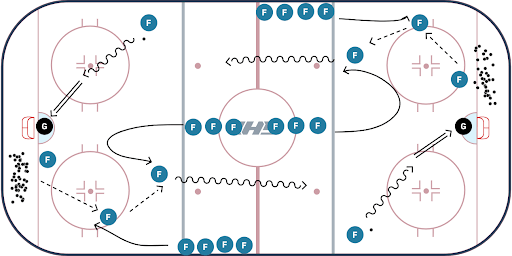
Canada Cup is a very well-known drill that wakes every player up including goalies for the rest of practice.

A line of players is diagonal to each other on the blue lines facing the offensive zone, and a line of players is positioned in the middle of the blue line also facing the net. On both ends of the ice.

One player on each side starts the drill by coming and taking a shot at the goalie.

Proceeds to pick up a puck behind the net and makes a pass to the player coming down from the blue line.

The player who receives the puck stays along the blue line, picks up his head aware of the other player swinging with speed, and makes a pass so the swinging player is skating out of the zone with pace.

The player who swung to get the puck takes the puck down to the other end, takes a shot on goal, then becomes the person who makes the pass to the player on the boards.

Creating a very simple and effective drill that engages all three players simultaneously, and most importantly goalies.

Drill 2: 3 Circle Loop

null

Another simple shooting drill that’s centered around getting goalies warmed up for the rest of practice.

Players can be positioned in all four corners of the ice, starting in opposite corners to prevent collisions.

Three players start skating with the puck, one goes around the top of the faceoff circle, another goes up to the blue line, and the third player goes up to the red line.

When the player gets to a respectable shooting range, the players take their shots and stand in front of the net, following their rebounds.

The three players then proceed to get back into line once the third player shoots, and the rebound is dead. Enforcing the other lines to go.

Very simple drill, but it teaches young players how to get their heads up when skating with the puck. So they can appropriately warm up the goalies, but also not hit their teammates in front of the net. 

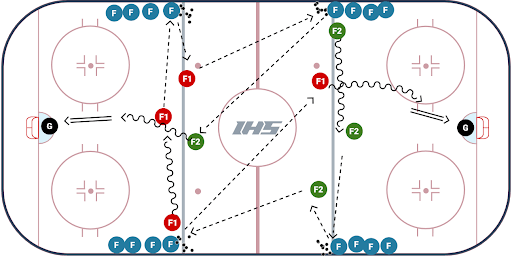
Drill 3: 4 Blue Line Cut

null

4 blue-line cut enables players to think quickly and make good passes to players so they can keep moving with speed through the zone.

One line of players is positioned at each blue line.

Diagonal lines to each other start the drill, where the first players in line come across the blue line and make a pass to the first person in line.

The first player in line gives the puck back to he/she who started the drill, and then that player makes another pass to the next line as they skate.

The player who started the drill then looks up to the line where they started and gets a pass from that line.

The last line to receive the pass makes a crisp pass to the streaking player who started the drill from their line. In that, wherever the player started the drill, the first person in line makes a breakaway pass to that player.

Once that player receives the puck they go in and take a shot on goal, and get back into line.

Good flow drill, teaching players how to lead each other when they’re on breakaways, rather than passing in each other's skates.

________________________________________________________________________________________________________________

Station Drills:

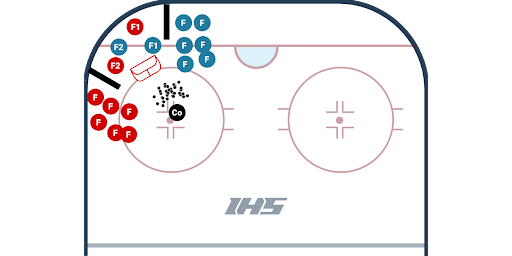
Drill 1: 2 v 2 Corner Battle

null

This battle drill employs players with the ability to move and create space in a small area.

A net is positioned in one corner of the offensive zone, and players are lined up on both sides of the net. Borders are set up on the boards to prevent the puck from getting out of the zone and limiting room for players to move.

Two players from either team are in the zone, making a 2 on 2 battle for possession.

The players within the zone try to create scoring chances and pass to their teammates while also trying to be physical with the other team when playing defense.

To make the drill more competitive coach could also make it one on one, and players can pass to their lines to activate more players.

Very effective drill in teaching young players how to move quickly in limited space to get open and protect the puck.

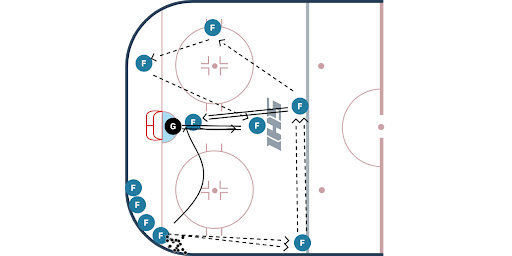
Drill 2: Stationary Power Play + Net Drive

null

This drill is very simple but demonstrates to young players how the power play should be set up, and how to complete good passes to teammates.

A line of players is set up in one corner. A defenseman is positioned on the blue line same side as the line in the corner, another defenseman is within a respectable distance of the near-side defenseman, another player on the hash marks along the far-side boards and one more down below the goal line.

The drill starts as the first player in line makes a pass to the defenseman at the blue line. Then proceeds to drive the net, timing when the far-side defenseman is going to shoot. The near-side defenseman makes a pass to the far-side defenseman and takes a shot on the net looking for a tip from the player who drove the net.

Once the puck and rebound are dead, the player who went to the front of the net then goes up the slot.

The next player in line makes a pass to the defenseman on the near side but continues to stay in line. Then that defenseman makes a crisp pass to the far-side defenseman, who makes a pass to the person near the boards on the hash marks, collects, and makes a pass to the player down low.

The player down low gathers the puck and makes a good catchable pass to the player in the slot.

He/she takes a quick shot, follows the rebound, and takes the place of the player down low. 

The player who was down low moves up to the hash marks, the player from the boards rolls up to the far-side defenseman, and the far-side defenseman moves to the near side. The near-side defenseman goes back into line. 

A drill that has a little bit of everything, but most importantly breaks the powerplay down to simple movements that can be employed in game-like situations.


Drill 3: Passing Figure 8’s

null

Another passing central drill, but teaches players how to make tight turns and quick passes.

Coach sets up several groups of three and positions them all somewhat close together.

One player is between the other two players who are spaced out, about a faceoff dot to faceoff dot distance away

The player in the middle has a puck and starts skating towards one player, makes a pass to that player does a tight turn around them, gets the puck back, and does the same exercise with the other partner.

Players can be creative and pass among the stationary players or have a certain number before the player turns.

Creating a figure eight with consistent passes between partners.

Once the coach blows the whistle, one of the two players who have not been in the middle switches places, and so on once all three have been in the middle.

________________________________________________________________________________________________________________

Small Area Games

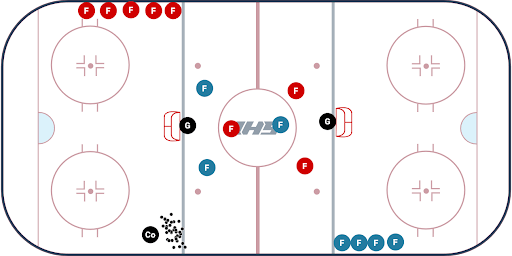
Drill 1: Center Ice 2 v 1 Possession

null

A line of players is on opposite sides of the blue line, determining the teams.

Nets are set up at the blue lines.

Technically there are three players on each team, but one of the players has a different role than the other two teammates.

How the drill is set up is that one defenseman from each team is restricted to staying within the circle at center ice on a distinct side of the red line.

Where that defenseman is trying to take away passing lanes from the two players on his/her side and try to get the puck over to the offensive players.

The coach can dump as many pucks in as they wish, and one goal is equal to the offensive players scoring a goal on the goalie.

A very fun drill, that can get competitive, but most importantly teaches players how to create passing lanes and build teamwork.

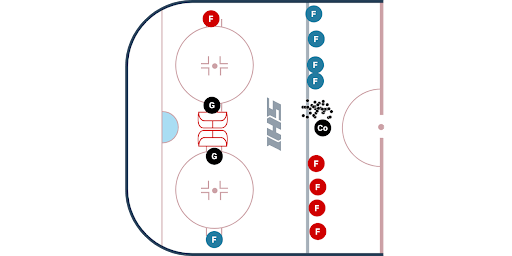
Drill 2: Back-to-Back Nets + Point Man

null

Nets are positioned in the middle of the offensive zone, back to back.

Two teams are lined up on either side of the blue line.

One player from either team is positioned as the point man in front of their offensive net.

The coach dumps a puck in, and two or three players from both teams go, depending on whether the coach wants to do 2-v-2 or 3-v-3.

Players battle for possession and have to pass to the point man in order to initiate an offensive attack.

The point man can either take a shot looking for his/her teammates in front or look to make passes to other teammates. Players can use their point man as much as they like.

Another fun drill teaching young players to pick up their heads and create scoring chances for their teams, and also teaches point guys not to miss the net when shooting     

Drill 3: Coaches Poker

Teams are on both benches, with one coach per bench.

A coach dumps a puck into center ice, but coaches on both benches tell their players how many are going to go.

Hopefully guessing to have more players than the other team, coaches can pick between 1-5 players.

So it could range from 5 on 5 to 5 on 1, you never know what the other team is going to do, which makes it fun.

A very fun drill that’s quickly paced and familiarizes players to take advantage of having a man advantage or playing defense with fewer players than the other team.

NYSS Every Kid In the Game

Sunday, June 15, 2025

The Rock Almighty; Fear Not!


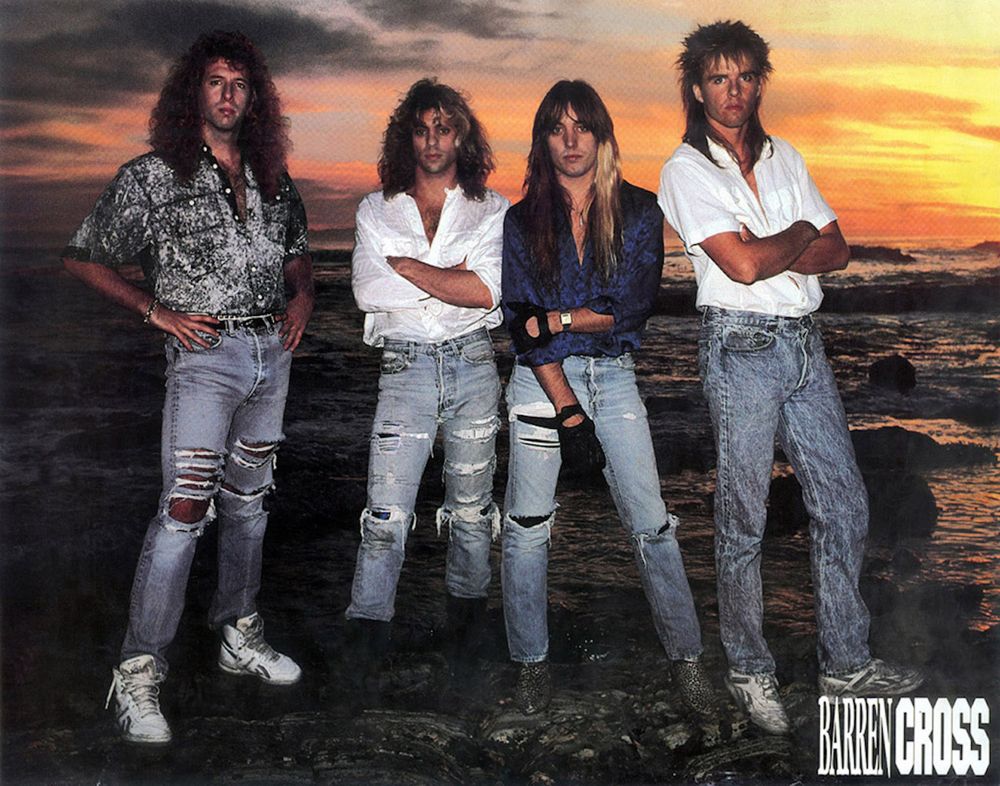
  MICHAEL DRIVE - BARREN CROSS
                 Corniglia, Italy - Cinque Terre. Photo by Charles F. Stanley.
                          

Knowing God as Our Father

In the Lord's Prayer, Jesus taught us to talk to God as our Father—because we are His children.


Matthew 6:9-14

The Lord’s Prayer shows us something unique about God. In Jesus’ day, calling God “Father” (Matt. 6:9) was a radical and marvelous concept: The Israelites understood a national link between people and deity, but Jesus’ words made that connection a personal one.

How amazing that the Creator wants a relationship with us. By trusting Jesus as Savior, we’re welcomed into God’s family, though we can never be completely holy or perfect like Him. The bond is based on His great love and acceptance, not our abilities.

In today’s passage, the Lord’s Prayer teaches us to develop transparency and intimacy in our relationship with God—which is what a father/child connection should be. The pattern Jesus demonstrated directs us to share needs, confess sin, and admit weakness. Like the good Father He is, God responds to our petitions with love and wisdom” (Matthew 7:7; Matthew 21:22). He also makes His presence known during our quiet times, offering comfort and the assurance that He is always near.

Jesus’ prayer recognizes the Father’s holiness and sovereignty as well as His desire to be personally involved in our life. If you hunger to know God as a Father, follow the pattern of the Lord’s Prayer. As you open yourself to Him, He will draw close to you.

Bible in One Year: Psalms 23-28

National Youth Sports Strategy

Saturday, June 14, 2025

D.C. Divas Football: Vs Philadelphia Phantomz - Hall Of Fame Game


US Sports Soccer: World Cup Soccer with Mia Hamm and Portland Timbers vs. San Jose Earthquakes Highlights


World Cup Soccer with Mia Hamm

Description

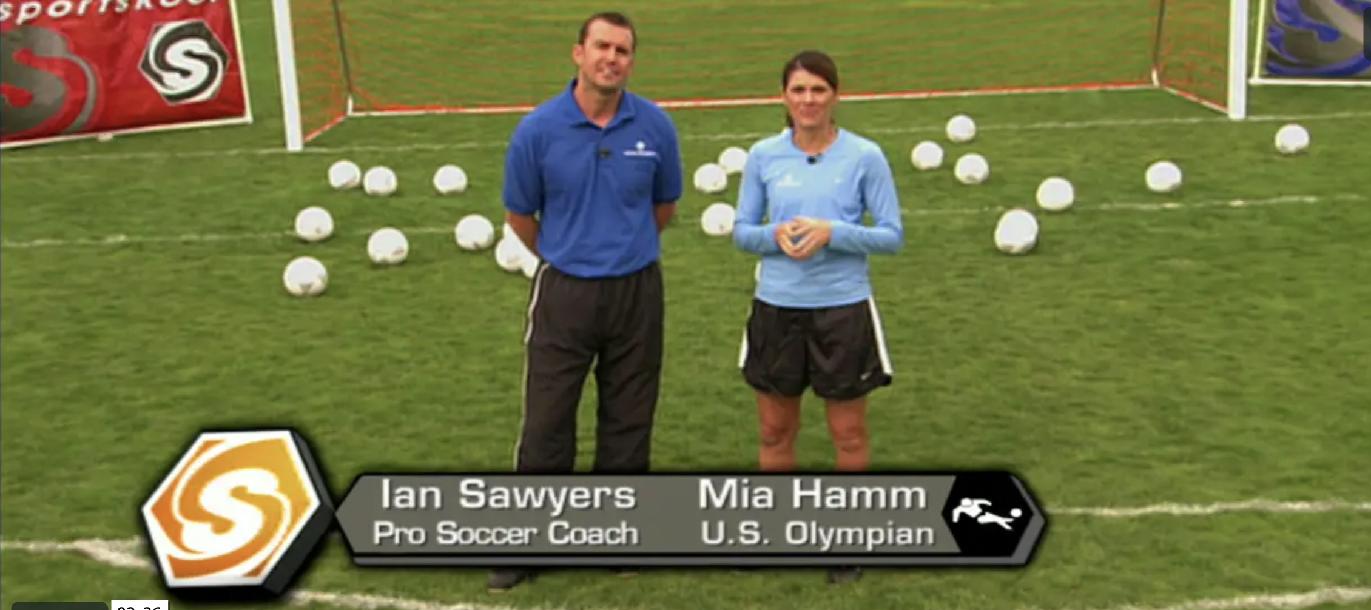
In her illustrious and record-breaking career, Mia Hamm won four college championships, two world cups, three Olympic medals, and scored more goals in international competition than any other player in the world, male or female. Now she's adding one more thing to her resume: your personal soccer coach!

World Cup Soccer with Mia Hamm provides you with the fundamentals necessary to build a foundation for achieving your athletic goals and will put you on your way to being a better all around player. In addition, this instructional video course also features a tutorial with professional soccer coach Ian Sawyers on how to be a successful soccer coach.

As the record crowd of more than 90,000 fans at Pasadena's Rose Bowl - the most to see a women's sporting event in the United States - erupted with the winning goal in the 1999 World Cup, women's soccer ascended to a new level. The sport, mainstreamed with the success of the U. S. Women's National Team earlier in the 1990s, became a national phenomenon with the victory. Mia Hamm, who played in every celebrated win, was a driving force behind women's soccer and the national team. An iconic figure in sports, Hamm is widely considered the best female soccer player in history. Hamm played 17 years for the U.S., and her 158 goals in international competition are a record for females and males. As a 15-year-old, Hamm became the youngest player ever on the national team. At 19 in 1991, she became the youngest American woman to win a World Cup when the U.S. captured the inaugural women's tournament in China. With the two more World Cup wins and Olympic gold medals in 1996 and 2004, Hamm and the U.S. team helped soccer earn a spot on America's sports radar. Born March 17, 1972 in Selma, Alabama U.S.A. Soccer's female athlete of the year five years in a row (1994-1998) All-American selection and Atlantic Coast Conference Player of the Year her last three seasons at North Carolina Helped take Tar Heels to four consecutive NCAA women's championships Graduated in 1993 with all-time ACC records in goals (103), assists (72) and points (278) Retired shortly after the 2004 Olympics in Athens Carried the U.S. flag at the closing ceremonies of the 2004 Olympics Won silver medal at the 2000 Olympics in Sydney Finished third at the 1995 World Cup in Sweden; named tournament MVP In 1999, Nike named the biggest building on its corporate campus after Hamm In March 2004, Hamm and former U.S. teammate Michelle Akers were the only two women and Americans named to the FIFA 100, a list of the 125 greatest living soccer players selected by Pele. 

NYSS FB Be A Role Model

Friday, June 13, 2025

US Sports Track & Field: Three Lessons Every Distance Running Coach Should Know and Boys 2 Mile - Brooks PR Invitational 2025


  • By Grant Young

Teaching distance runners the proper physical and mental techniques they need to maximize success is a fundamental aspect of being a distance running coach. 

It's essential to focus on developing proper running form and technique to help runners maximize their efficiency and reduce the risk of injury. This includes aspects such as posture, foot strike, cadence, and breathing techniques. 

In addition to physical techniques, coaching distance runners also involves addressing the mental aspects of running. This includes strategies for building mental toughness, managing race-day nerves, and staying motivated during challenging workouts.

By providing comprehensive guidance on both the physical and mental aspects of distance running, coaches can help athletes reach their goals and maximize their success in the sport.

Of course, knowing what’s worth teaching your runners and what should get left out from your daily lessons is easier said than done. But if you’re unsure about how to construct your fundamental running coach's blueprint, heed the tried and true wisdom of Diljeet Taylor. 

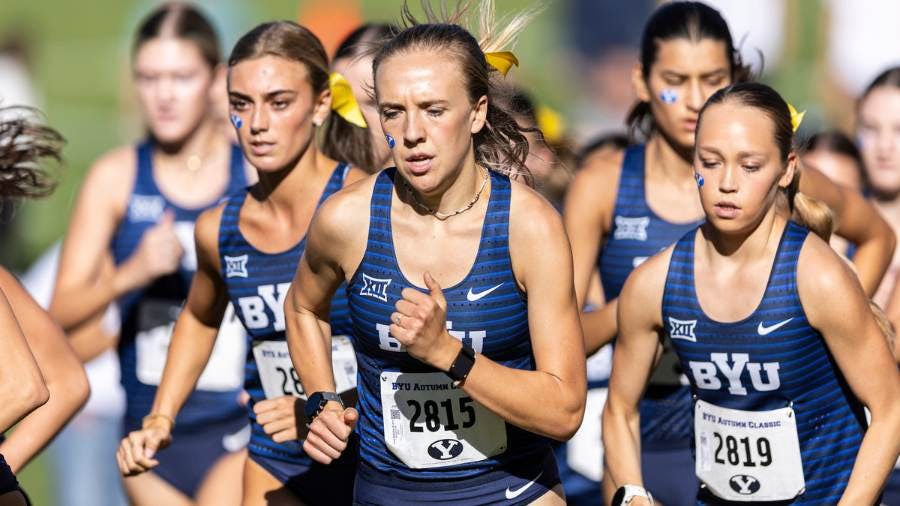
Coach Taylor is currently the women’s cross-country head coach at Brigham Young University (BYU), a role she has held since 2016. Since arriving at BYU, Coach Taylor led BYU to an NCAA Division I Women's Cross Country National Championship (2020-21), coached 1 Individual Cross Country Champion (Whittni Orton - 2021), led BYU to two national runner-up finishes (2019 & 2021), guided BYU athletes to 16 All-America honors, and produced one Big 12 Conference Championship (2023) and five West Coast Conference Championships (2018, 2019, 2020-21, 2021, 2022). 

Before coming to BYU, Taylor coached at Cal State Stanislaus from 2007 to 2016. During her time at Cal State Stanislaus, Taylor guided All-American Courtney Anderson to an NCAA Division II championship in the 1,500-meter run in 2014. From 2013 to 2016, the distance and cross country programs accumulated 16 All-America honors, including consecutive runner-up finishes in the indoor championships by the distance medley relay team.

Coach Taylor’s ‘Distance Running: The Basics’ course will give you all the information you need to help build your cross-country team from the ground up and give your athletes the physical and mental knowledge they need to blossom into the best versions of themselves. 

Training

Coach Taylor explains that distance runners require a yearly training cycle so that they never get too out of shape. 

Because creating an entire annual plan at once doesn’t make sense considering how much can change within that timeframe, Coach Taylor suggests that coaches segment their seasons into three phases: a macrocycle, a mesocycle, and a microcycle. 

The macrocycle is a topical blueprint of a plan that you are roughly drafting for your athletes to follow. As previously mentioned, there can’t be any expectation that this macrocycle will go exactly how you write it out. But having a rough guideline for yourself and your athletes to follow is beneficial for ensuring that you stay on track (literally and figuratively) as the season progresses. 

The mesocycle should be written about three weeks to a month in advance. Coach Taylor notes that she writes out all of her practice plans about three weeks in advance. She does this because this is typically far enough out that she can thoughtfully plan out where she wants her runners to be in terms of physical preparedness while being close enough to real-time that she’ll have an accurate idea of what they will need in a few weeks. In addition, her not writing out her practice plans last minute ensures that she’s prepared for any last-minute changes that life forces upon her and her team. 

And finally, the microcycle is a daily practice plan that Coach Taylor suggests constructing during the actual week you’re currently in. These will be precise practice plans that shouldn’t change much.

Training Programs

null

When it comes to training programs for 800-meter runners, Coach Taylor says that coaches should come up with a combination of both speed and strength, because runners need both in order to be successful from that distance. 

The workouts should usually be at a higher intensity and have a longer recovery. 

A great staple workout for 800-meter runners is eight 200-meter runs at a high intensity with two minutes rest and then six 200-meter runs with two minutes rest. 

Coach Taylor notes how important it is for runners to know what their pace is without needing to look at their watch every few seconds. And the best way for them to figure this out is by doing repetitive interval training like what was just listed. 

For runners that focus on one-mile or two-mile races, their focus during training should be aerobic workouts that emphasize strength, where the volume is just as important as the intensity. This can encompass either 800-meter or 1000-meter repeats. 

Strength Training

Strength training is another crucial component of a distance runner’s training regiment. Coach Taylor explains how she has her runners do strength training twice a week, typically after their recovery runs during practice. 

The biggest focus in these exercises is core work. Since core strength and stability are paramount to a distance runner’s success, workouts that activate the core muscles should take priority. 

There’s also no need for distance runners to be lifting overly heavy. Instead, they can focus on simple bodyweight exercises like pushups, body weight squats, lunges, and other exercises like those. 

Also doing hurdle drills on the track after recovery runs is a great way to lengthen muscles and increase core stability.

NYSS Twitter Focus on Fun

Thursday, June 12, 2025

The Rock Almighty: What Would Jesus Do With Illegal Immigration?


Maui, Hawaii. Photo by Charles F. Stanley.

A Balanced Prayer

Remembering the mercy, grace, and power of God gives us confidence to ask for all we need.

2 Chronicles 20:5-12

We can learn valuable lessons from the prayers in the Old Testament. When Jehoshaphat petitioned for divine help, he struck a balance between asking the Lord to meet his needs and proclaiming God’s greatness. Likewise, our requests should be made with recognition of who God is. Otherwise, the focus of our prayers can become need, weakness, failure, or fear.

Jehoshaphat cried out to God about his terrible predicament, but he also exalted the Lord, acknowledging the great things He had done for the people of Israel. That’s why knowing the Word of God is so important (2 Timothy 3:16-17). When we read about how the Lord has worked in the lives of others, we better understand His awesome power. Then we can look to the men and women of the Old Testament as an example and begin to pray in a similar way. God’s wonder-working power is still available to us today, and He wants His children to access it.

By proclaiming, “Power and might are in Your hand so that no one can stand against You” (2 Chron. 20:6), Jehoshaphat was praising God and at the same time reminding himself of the Lord’s greatness. As you pray today, speak to God of His mercy, talk to Him about His grace, and recall His mighty power.

Bible in One Year: Psalms 8-14

NYSS Twitter Be a Role Model