Now Streaming On US Sports Radio!

US Sports Net Today!


Live Play-by-Play, Updates, Highlights and More! on US Sports Network!
[Chrome Users-You may have to click on the play button twice to listen]
US Sports Network Powered By Gorilla Sports!


US Sports Radio
The Las Vegas Raiders Play Here
Fitness and Sports Performance Info You Can Use!
The Scoreboard Mall
The Rock Almighty Shaker Of Heaven And Earth!
The Coolest Links In The Universe!
Showing posts with label Soccer coach world cup soccer Mia Hamm Soccer training soccer coaching clinic soccer position Messi. Show all posts

Thursday, October 2, 2025

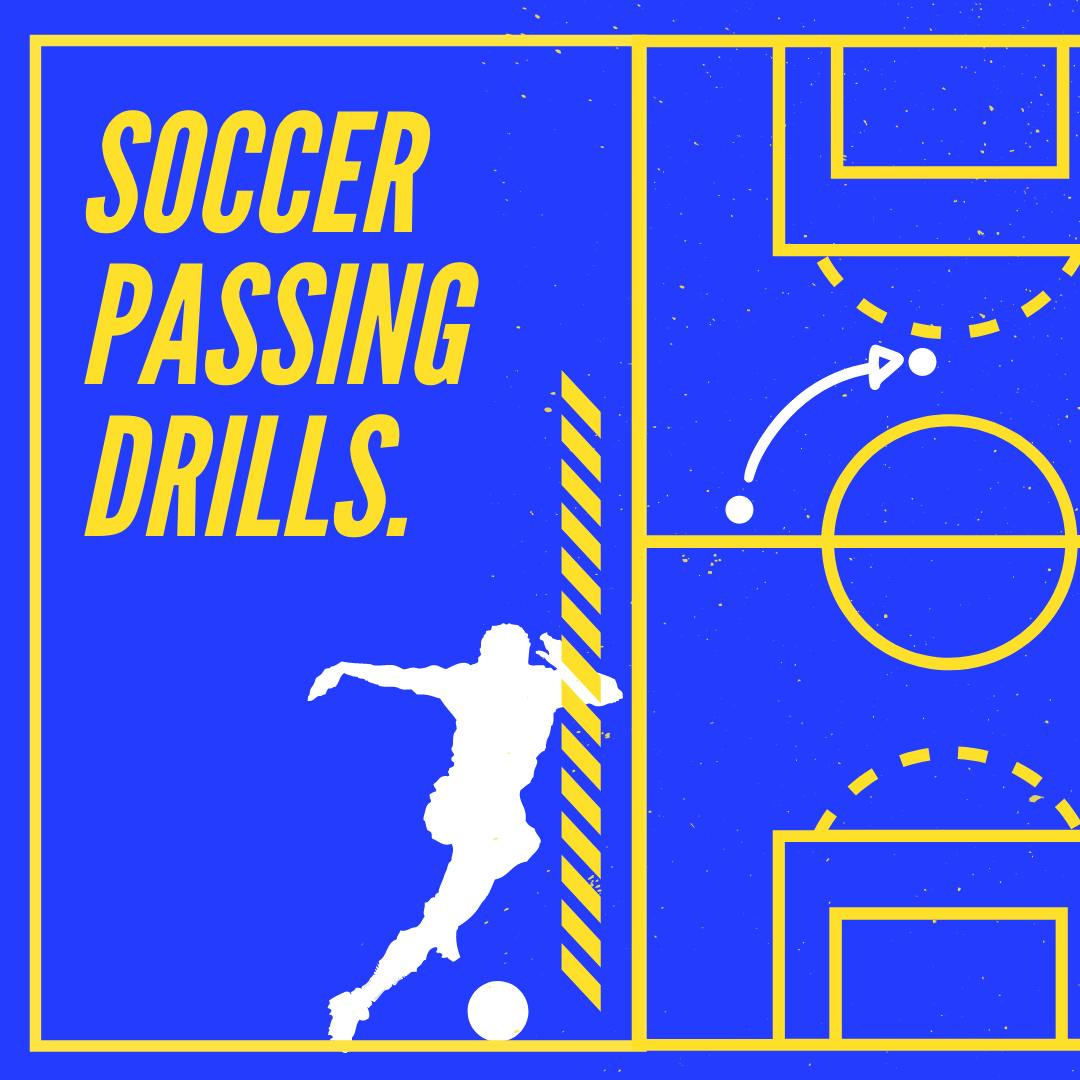
US Sports Soccer: Top 3 Soccer Passing Drills and LA Galaxy vs. Toluca FC Full Match Highlights


  • By Maggie Fintel

There are plenty of components when it comes to playing a game of soccer. From dribbling to shooting, continuously practicing these skills can enhance your performance on and off the field. Some of these can improve individual performance, but passing can grow both individual and team skills as a whole.

Passing/possession drills can improve the team’s communication skills, attentiveness, first touch, and even their connection on and off the field. Being able to pass the ball accurately and precisely can affect the team’s performance and quality during practice and games.  If you watch professional soccer teams on television, you can see how the passing just flows so swiftly between the players. These players know precisely how and where to pass to their teammates, but they have also had plenty of practice and developed a connection within their team. Building a strong bond with your team, being focused, and lots of practice can help build strong passing skills during the game.

Coaches must implement passing drills during practices. There are plenty of drills to choose from, depending on your team’s strengths and weaknesses, and a range of variations within each exercise. With the continuous passing practice, each player will develop a new and vital skill as well as building upon that necessary team bond.

There is a multitude of different passing drills to have your team work on. Here are three soccer passing drills that you, your team, and your coach can work on during practices to perfect passing:
null

Before You Start

Equipment:                                                                                   

- 4 cones  

- 1 soccer ball (or more for variation)

- 4 players (or more for variation) 

The Set-Up:  

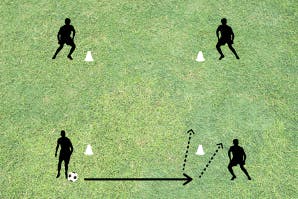
- place the four cones in a  10x10 grid, each player on each cone to start.


How It Works

- Begin with one player at each cone

- One player starts with the soccer ball at their cone.

- The player with the ball will pass it towards the cone either to the left or right of them (determines which direction you desire to start with. In the diagram above, the player is passing to the right).

- The receiver is able to use either the inside or outside of their foot while receiving the ball from the passer.

- The receiver may go behind or in front of the cone, shown as the dotted lines in the diagram above. The cone represents the “mock defender” in which the player is trying to move around.

- The receiver, once taking their first touch behind or in front of the cone, then passes the ball to the next receiver, repeating this process around the square.


Switch It Up

- Number of soccer balls. Adding more soccer balls can create a quick drill to challenge your players’ attention and communication skills

- Number of players on each cone. Decreasing the number of players creates a faster-paced drill or increasing to build a better team connection

- Call out a change in direction during the drill. This can help the players work both left and right feet and test their reaction skills

More Tips

- Get the players to communicate! This is a great drill to work on the team’s communication skills. The players can say “Ball!” “Here!” “Left foot!” “Right foot!” and more.
null

Before You Start

Equipment:  

- 3 cones  

  - two players 

   - one soccer ball

 The Set-Up:

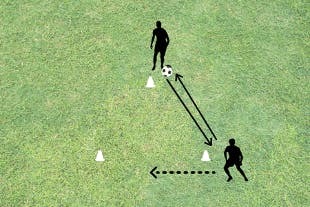
- Place 3 cones in a pyramid shape, with two players on separate cones

How It Works

- One player is at the top of the pyramid with the soccer ball; the other is on either the left or right bottom cone (whichever one you wish to start with)

- The top player will pass the ball towards the player when at the cone.

- The receiver will take a touch, then pass the ball back to the top player.

- After passing the ball back to the top player, the bottom player will then sprint to the next cone to receive the ball once again.

- Repeat these steps until the time is up (approximately 1-2 minutes), switch roles from the top stagnant player to the moving bottom player.


Switch It Up

- Number of touches. Switch from a two-touch pass to a one-touch pass for quicker, more controlled movement

- Number of players. Instead of sprinting back and forth between cones, there can be three players on the drill to pass in a triangle structure


More Tips

- Make sure the receiver takes a light and controls the first touch. Do not want the ball flying around towards the opponent

- Communicate. Let the passer know which foot you would like to receive the ball on (“Left!” or “Right!”)
null

Before You Start

Equipment:                                                                         

- 8 cones

- 12 pennies (8 one color, 4 a different color) 

- 12 players

The Set-Up:    

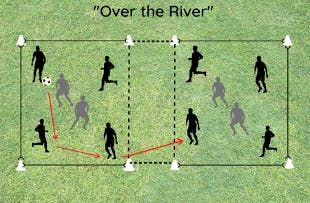
- Make a large 20x30 rectangle

 - Create a 2x10 boundary in the center of rectangle 

- 4 attacking players and 2 defensive in each box                                                                                                 


How It Works

Soccer ball starts in either box with the offensive team (team with four players in each box). The defensive team has two players in each box, the rest of the team sits out for the round.

The offensive team must complete at least three passes within their box without the defenders taking the ball.

After connecting three complete passes, the offensive team’s objective is then to pass the ball to the other box without letting the defensive team take the ball.

The defenders are trying to take the ball away from the offensive team. If the defenders take the ball three times within the same box, the positions must switch (offense becomes defense, defense becomes offense).

The only way to switch roles is for the defense to steal the ball away from the offense.


Switch It Up

- Limit the number of touches. Limit to one-touch passing for a high-intensity game

- Adjust grid size. Make the grid smaller and tighter for quick passing or larger to work on long passes and time awareness

- Make the offensive team “loft” or “chip” the ball over the middle-dotted line area towards the other box after completing the three passes. This works on lofting skills and first touch out of the air.


Additional Videos on Soccer Passing:

Winning Soccer Vol. 5: Passing, Receiving, and Heading

Paul Riley's Soccer Moves, Skills, and Drills

Soccer Drills & Tips Video Library

World Cup Soccer with Mia Hamm

Passing is the route of all things great in soccer, so there will be aspects of passing in every drill that you do. When your players start to grasp the fundamentals of passing, you can start to progress into more tactical methods of passing. This includes positioning and areas that you want to exploit.

If you are interested in the more tactical side of passing, Coach Kadioui's course, Football (Soccer) Play Styles - Possession is a superb course.
NYSS Twitter Be a Role Model

Tuesday, September 9, 2025

US Sports Soccer. World Cup: Alvaro Fidalgo on His Future with Mexico and the FIFA 2026 and Sporting Kansas City vs. Austin FC Highlights


  • Author Haris Alvi

World Cup Tickets: Spanish midfielder Álvaro Fidalgo, a standout performer for Club América, has recently opened up about the increasing conjecture regarding his potential role in the Mexican national squad ahead of the FIFA World Cup 2026. Fidalgo, who has acquired the Mexican population, is now theoretically capable of representing El Tri, but he has highlighted that a national team call-up is not something he is taking for granted.

FIFA World Cup 2026 Tickets | Buy FIFA 2026 Tickets

His future, both at the club and globally, remains unstipulated as the FIFA World Cup 2026 looms large on the horizon. As expectation continues to shape for the FIFA World Cup 2026, which will mark an important moment with matches presented diagonally across the United States, Canada, and Mexico, many enfranchised companies are being considered as part of expanded national squad schedules.

Fidalgo’s Focus on the Present as Mexico Eyes World Cup

The event will kick off at the fabled Estadio Azteca, and for Mexico, playing on home soil brings both great chance and huge pressure. Amid these circumstances, Álvaro Fidalgo’s name has surfaced among the possible accompaniments to the national troop pool. However, the Spaniard remains humble and measured in his method, making it clear that his chief focus is on the current second rather than on hypothetical states connected to the FIFA World Cup 2026.

Are you excited to support your favorite team at the FIFA 2026? eticketing.Co offers exclusive access to Mexico FIFA World Cup Tickets, allowing you to follow your team throughout the tournament. Our trusted platform connects you with the best deals on Iran FIFA World Cup Tickets, ensuring you never miss a moment of the action.

Fidalgo recently spoke queries nearby his future in a candid manner, admitting that his present situation is shaped not only by his footballing services but also by bond dynamics and training choices. He revealed that his existing contract with Club América is set to expire in the coming year, and no extension has been agreed upon. This raises questions about his long-term presence in Liga MX and his potential obtainability for the Mexican national squad as it prepares for the FIFA World Cup 2026.

FIFA World Cup 2026 Tickets | Buy FIFA 2026 Tickets

Fidalgo Reflects on Uncertainty and the Road to the FIFA 2026

Speaking openly, Fidalgo specified, I don’t know how these upcoming months will unfold. I have a one-year agreement, and it’s a complicated topic. There’s a director who may not fancy me, and I can’t predict what will happen to me in the short or long term. His words underline the uncertainty that can shape a player’s course, especially when the stakes are as high as receiving a spot in the FIFA World Cup 2026 squad.

Despite the gossip about the FIFA World Cup 2026 and Fidalgo’s suitability, the midfielder has chosen not to make assumptions or declare himself a candidate. Instead, he has remained absorbed in delivering his best presentations with Club América. In what has been one of his most creative seasons to date, Fidalgo has continued to validate his value on the pitch through technical skill, originality, and tactical intelligence.

Experience the excitement of FIFA 2026 live by securing your spot today! Buy World Cup Tickets through our streamlined online platform, where you can easily Buy World Cup Tickets at unbeatable prices. Do not miss your chance to be part of the action. Buy FIFA 2026 Tickets now and join fans from around the globe for the world's record-breaking football event.

These qualities have made him a fan favorite and a reliable contributor in Liga MX, but he remains cautious about reflecting his international predictions. He remarked, Honestly, if you ask me if I have predictable myself for this, the answer is no. I prefer to focus on the contemporary and what is happening now. Thinking about a potential call-up seems disrespectful to other Mexican players who are also excelling in my location.

Fidalgo Praises Mexico’s Midfield Talent Ahead of FIFA 2026

Fidalgo’s humility and respect for the Mexican football attitude were further evident when he was aware of the depth of talent in the national squad’s midfield. As Mexico prepares for the FIFA World Cup 2026, knowing the right blend of skill and form will be crucial. Fidalgo praised several domestic talents, including Erik Lira, Edson Álvarez, Luis Romo, Carlos Rodríguez, and rising star Elías Montiel. Of Montiel, he said he is a very, very good actor, showing his respect for the initial group of Mexican footballers.

Football enthusiasts around the globe are eagerly anticipating the chance to secure FIFA World Cup tickets. To experience the excitement firsthand, purchase your FIFA World Cup Final Tickets through our online platform, eticketing. Do not miss the opportunity to be part of one of football's most thrilling tournaments.

FIFA World Cup 2026 Tickets | Buy FIFA 2026 Tickets

This gesture copies Fidalgo’s consciousness that, while he may be capable of playing for Mexico, the rivalry for places in the FIFA World Cup 2026 group is fierce and filled with deserving applicants. As one of the co-host states for the FIFA World Cup 2026, Mexico will be looking to make a deep run in the competition, chiefly with the added stimulus of playing key competitions on home soil.

This unique variety of the FIFA World Cup 2026 will feature an expanded preparation with more teams, more matches, and more chances for players to make history. The choice of accepted players like Fidalgo contributing to the squad adds a fascinating layer to team selection. These companies often bring a varied set of participations and a dissimilar strategic outlook, which can be helpful in stressful settings during the FIFA World Cup 2026.

World Cup Tickets: Balancing Loyalty and New Talent in Mexico’s FIFA 2026 Squad

Fidalgo’s situation highlights the wider challenges national team coaches face as they build their squadrons for the FIFA World Cup 2026. Balancing loyalty to long-serving national squad players with the need to integrate fresh talent and naturalized citizens is never easy. With head coach Javier Aguirre potentially having different preferences, Fidalgo recognizes that assortment is not something he can regulate.

Experience the thrill of the FIFA World Cup with exclusive FIFA World Cup Hospitality Tickets from eticketing.co. Enjoy VIP treatment, premium seating, and unmatched comfort. Whether you’re looking for Football World Cup Hospitality Tickets, eticketing offers the ultimate hospitality packages for an unforgettable experience. Book now and secure your hospitality tickets for the world’s biggest football event.

FIFA World Cup 2026 Tickets | Buy FIFA 2026 Tickets

The midfielder has made it clear that he is willing to donate if called upon, but won’t be agitated for a spot. His expert attitude adds credibility to his acts and sets an example for how players should handle FIFA World Cup 2026 speculation. For fans and analysts alike, Álvaro Fidalgo remains a convincing figure in the FIFA World Cup 2026 conversation. His recitals in Liga MX continue to catch the eye, and his eligibility adds valuable suppleness to Mexico’s midfield options.

Yet, as Fidalgo has emphasized recurrently, the road to the FIFA World Cup 2026 is long, and nothing is guaranteed. Injuries, tactical vicissitudes, and competition can all shift the landscape between now and 2026. As the FIFA World Cup 2026 draws near, the stories of companies like Álvaro Fidalgo will continue to shape the description. Whether or not he ultimately wears the Mexican jersey in the world’s principal period.

FIFA 2026 Tickets: Alvaro Fidalgo’s Consistency and Growth Ahead of the World Cup

His journey reflects the evolving nature of global football and the unique dynamics of a dual-national picture. The FIFA World Cup 2026 will be a competition unlike any other, and as preparations intensify, every match, every training session, and every decision will count. Fidalgo knows this better than anyone and is making the only way he knows how by giving everything on the pitch today while letting the future unfold on its terms.

The FIFA World Cup 2026 promises to be more than a display of elite talent; it will be a tribute to diversity and shared ideas. Álvaro Fidalgo’s expedition fits perfectly within that narrative. Through discipline, humility, and staunch consistency, he has emerged as a possible wildcard for the final squad. Regardless of selection, his inclusion in the FIFA World Cup 2026 discussion is a testament to his growth and the expanding likelihoods within the world’s biggest football stage.

For fans eager to attend FIFA 2026 matches, a wide array of FIFA World Cup 2026 tickets is available at eticketing.co. Our platform partners exclusively with reputable sellers on the secondary market, ensuring access to top-notch ticket listings from across the web. Explore our Football World Cup 2026 selection to find the best deals available today!

fans can effortlessly book Tickets for thrilling FIFA World Cup 2026 matches at discounted prices. Don't miss the chance to witness the world's greatest Football World Cup 2026 event live.

https://blog.eticketing.co/world-cup-tickets-alvaro-fidalgo-on-his-future-with-mexico-and-the-fifa-2026/

NYSS Find Their Strengths

Monday, August 11, 2025

US Sports Soccer: Understanding an ACL Tear and LA Galaxy vs. Seattle Sounders FC Match Highlights


  • Author Stacey Simpson

The Anterior Cruciate Ligament (ACL) is the most commonly torn of the four main ligaments of the knee. The other three being Posterior Cruciate Ligament (PCL), Lateral Collateral Ligament (LCL), and Medial Collateral Ligament (MCL). The word “cruciate” in these ligaments comes from the way that the ACL and PCL form a “cross” on the inside of the knee joint, working together to provide stability for the knee. These four ligaments are primarily responsible for providing stability and support to the joint during physical activities. The ACL primarily prevents excessive movement forward and rotation of the knee.

An ACL tear is a common, yet serious injury that can significantly impact an individual’s activity level, with a huge financial and time of recovery burden that can affect quality of life. This article delves into the intricacies of an ACL tear, its causes, symptoms, and the journey toward recovery.

Anatomy of the ACL

Positioned in the center of the knee, the ACL connects the femur (thigh bone) to the tibia (shin bone), preventing the tibia from sliding out in front of the femur (hyperextension) and providing rotational stability to the knee.

This ligament is pivotal to stabilize the knee during dynamic activities that require sudden changes in direction, jumping, or halting motions.

Therefore, ACL injuries can happen in virtually any sport, but are commonly associated with the following sports:

Basketball, Soccer, Lacrosse: Quick pivots, jumps, rapid directional changes, sudden stops, and collisions, make players more susceptible to ACL injuries

Football: The contact nature of football and similar lateral/cutting motion required, puts players at a high risk

Skiing: The fixed nature of ski boots can place a lot of strain on the knees during falls or sudden movements

How an ACL Tear Occurs

An ACL tear often occurs during activities that put stress on the knee. The primary mechanisms leading to a tear include:

Pivoting Movements: When the foot is firmly planted and the knee turns sharply, the ACL can tear if the movement is beyond the ligament’s tensile strength.

Sudden Stops: Abruptly halting motion can force the knee beyond its normal range, overstressing the ACL.

Direct Impact: A direct blow to the knee, often seen in contact sports, can result in an ACL rupture.

Improper Landings: Landing from a jump with the knee hyperextended or bending inward, can cause the ACL to give way.

You can also check this detailed explanation of the anatomy of a knee joint to better understand how the ACL functions:

Other Causes of ACL Tears

In addition to the sports-related causes of ACL tears, it’s crucial to recognize that these injuries can also occur in various other circumstances. It’s important to note that there are both contact and non-contact causes for these injuries. This distinction is significant because up to 70-80 percent of all ACL tears occur without direct contact with an opponent.

Approximately 50 percent of non-contact tears are potentially preventable, so the focus on injury prevention programs becomes paramount. These programs, when applied consistently, can not only help prevent ACL tears but also guard against other lower extremity injuries, such as ankle sprains. Their role in safeguarding athletes and individuals engaged in physical activities cannot be overstated, as they offer a proactive approach to maintaining knee health and overall physical well-being.

ACL Injury Rates and Gender Disparity: ACL injuries are most prevalent among individuals aged 15 to 45. While more ACL injuries occur in sports played by men because of shear numbers of athletes, women are at a higher risk of sustaining these injuries. Women are 2-7 times more likely to tear their ACL than their male counterparts at the same age. This difference is highlighted in high school sports, where the rate of ACL tears in basketball is about 5.5% for males and a striking 26.5% for females. In soccer, the disparity is even more pronounced, with 7.2% for males and a staggering 53.2% for females experiencing ACL injuries​​​​.

Sports with High ACL Injury Rates: Among various sports, girls’ soccer has the highestACL injury rate, followed by boys’ football. Basketball for boys also shows a significant rate of ACL injuries. Interestingly, the injury rates are higher during competition compared to practice, indicating the role of intense, competitive play in these injuries​​.

Factors Contributing to Higher Injury Risk in Females:

The higher percentage of ACL tears in female athletes can be attributed to several factors. For instance, females have a smaller ACL and narrower attachment, making it easier to tear. They also have a greater hip-to-knee angle, which affects the alignment and mechanics of the knee joint. Additionally, women generally have less optimal quadricep to hamstring ratio of strength which is crucial for knee stability. Also, hormonal differences between biological men and women play a role in making females more prone to an ACL injury.

Burden of ACL Tears:

The financial burden of ACL injuries is substantial, not only due to the immediate medical costs but also considering the long-term implications such as the potential need for surgery and rehabilitation. ACL injuries nationwide are estimated to cost 7.6 billion dollars per year. These injuries have far-reaching impacts, affecting the athlete’s performance, career longevity, and even their quality of life post-recovery. The management of ACL injuries, therefore, remains a crucial aspect of sports medicine, emphasizing prevention, early diagnosis, and effective treatment strategies.

The moment of injury is sometimes accompanied by a ‘popping’ sound, usually followed by immediate pain and swelling. Athletes may describe a sensation of the knee ‘giving out’ beneath them.

Symptoms of an ACL Tear

Symptoms vary with the degree of the tear. The ligament may be partially torn or fully ruptured. The severity of the symptoms also depends on other injuries connected with the ACL tear. For example, when the athlete tears the Medial Meniscus and Medial Collateral Ligament (MCL) along with a complete ACL rupture, it is called the “Unhappy Triad”.

Pain: The intensity can range from no pain to severe, often causing significant discomfort.

Swelling: Rapid onset of swelling is common, usually developing within the first 24 hours after the injury.

Instability: A feeling that the knee cannot support the body’s weight or may buckle under pressure. Sometimes, the athlete will hear and feel a “pop”.

Limited Movement: The knee’s range of motion may be reduced due to pain and swelling.

Altered Walking Pattern: The individual may be unable to bear weight on the affected leg, or have a feeling of instability in the affected leg, leading to limping.

Diagnosing an ACL Tear

An accurate diagnosis begins with a thorough medical history and physical examination, followed by imaging tests like MRI, which can provide detailed images of the knee’s internal structures. Do not attempt to self-diagnose ACL issues. Always seek professional medical advice.

The treatment of an ACL tear depends on several factors, including the severity of the injury, the patient’s age, activity level, and overall health.

Treatment strategies include:

Conservative Management: For less severe tears or patients with low physical demands, physical therapy focused on strengthening the muscles around the knee may suffice.

Surgery: Reconstructive surgery is often recommended for individuals who wish to return to an active lifestyle. This involves replacing the torn ligament with a graft taken from another tendon in the patient’s body or a donor.

Post-Treatment Rehabilitation

Recovery from an ACL injury, particularly after surgery, is a lengthy process that can take several months. A structured rehabilitation program is crucial for a successful return to previous levels of activity.

This program typically includes:

Pain and Swelling Management: Using ice, compression, and elevation to control swelling and pain.

Physical Therapy: Graduated exercises to restore the knee’s range of motion, strength, and stability. To help with swelling and pain management and facilitate brace management as well.

Bracing: In some cases, a knee brace may be used to provide extra support during the healing process.

Activity Modification: A gradual return to sports or physical activities, often under the guidance of a physical therapist or athletic trainer.

The best case to return to pre-injury level of activity or sport should be at least 9 months to one year post injury. Rushing this time frame often results in a retear or secondary injury. Return to sport testing should be comprehensive prior to the release to play the sport again. The athlete should be supervised with a very gradual return to sport schedule.

The Risk of ACL Reinjury is High for Those Under 25

The reinjury rates for ACL tears vary based on several factors, including age, activity level, and whether the individual has returned to sports post-reconstruction.

For individuals of all ages who underwent ACL reconstruction, about 7% experienced reinjury to the same ACL, and 8% injured the opposite side. However, younger individuals(under 25 years old) and those returning to sports face higher risks. In those under 25 years old, the rate of another ACL injury was 21%, with 11% involving the opposite knee. The reinjury rate for individuals returning to sports was 20%, with 12% affecting the opposite knee. The risk was even higher for individuals under 25 years old returning to high-risk sports, with a reinjury rate of 23% and 12% affecting the opposite knee​​.

Additionally, a study mentioned in Sports metrics reported that 30% of patients sustained non-contact re–injuries, tearing either their ACL graft or the ACL in the contralateral knee within 2 years of surgery. The rate of a contralateral ACL injury was significantly higher than the rate of ACL graft injury (20.5% vs. 9%)​​.

These statistics underscore the importance of careful rehabilitation and a cautious approach to returning to sports after ACL reconstruction, especially for younger athletes and those engaged in high-risk sports.

Prevention of Future Injuries

After an ACL tear, the risk of re-injury is a significant concern. Prevention strategies focus on:

Neuromuscular Training: These are exercises connecting the brain to the muscles in the lower body. Exercises to improve balance, proper landing techniques, and knee stability. Pre-season testing to measure baselines in mobility, strength, balance, and form. We can look for red flags and address deficiencies and in turn reduce the number of lower extremity injuries.

Strength Training: Building the muscles in the legs, hips, and core can provide better support to the knee.

Education: Understanding the mechanisms that lead to ACL injuries is vital for athletes, coaches, and fitness enthusiasts alike.

A gradual, calculated, and supervised return to sport is very important.

The Psychological Aspect

The journey to recovery is not solely physical. The psychological impact of an ACL tear can be profound, with individuals experiencing frustration, anxiety, or even depression due to the sudden change in their active lifestyle along with the longevity of return to sport. Mental health support, along with the physical rehabilitation process, is essential for a holistic recovery.

Final Thoughts

An ACL tear is a complex injury that requires a comprehensive approach to treatment and rehabilitation. Understanding the anatomy of the knee and the mechanism of the injury, recognizing the signs and symptoms of an ACL injury, and following a structured recovery program is paramount for a successful return to physical activities.

With proper management and preventive measures, individuals can not only recover from an ACL tear but also minimize the risk of future injuries, ensuring long-term knee health and stability.

Saturday, July 26, 2025

US Sports Soccer: Modern Ways To Find The Child's Natural Talents and San Diego FC vs. Nashville SC Highlights


 MLS: The Official App

  • Author Amy W.

It does a lot of good if parents can recognize the talents of their kids at a very tender age. This way, the parents can guide them right from their young age to help the kids to attain the height of their career as early as possible. For all you know, the little child of yours may be the next American Idol or the next United States’ president. The earlier the telltale traits are recognized by parents, the better it is to nurture your child to achieve his goals and fulfill his talents. Be that as it may, parents need knowledge on how to recognize the talents of their kids at an early age. And that is the essence of this piece - to enlighten the parent about how to identify hidden talents in their kids.

Accept the kid as he is

Many parents have dreams for their kids, but it is better to allow the kids to choose their own paths. The path chosen by the kid may differ from what you desire or expect as a parent. No matter how different the kid’s plans and opinion are about the future, you must be ready to accept him as he is and help him to nurture his positive dreams and goals. At times, it is not about what the society tells you or what you think that matters, but what the child wants to do or become. Do not compare your kid to another kid next door or your friends’ child. For all you know, the kid next door became what he has become because his parents allowed him to be himself instead of forcing their own perceived ideas on his poor, naïve and helpless mind.

Take time to observe

At times, the best way to identify the hidden talent in that kid is to watch him closely and allow events to unfold. Do not be too quick to sign him up for a football coaching class. Why not allow him to show traces of love for football first? Because you failed in your bid to win a gold medal at the Olympics does not mean you must force your daughter to get involved in sports and feature at the Olympics.

Instead of forcing the kid to tow your desired line, just sit back and be alert to possible signs of a career choice in him.

If your kid is always in the backyard kicking or playing with balls, or frequently drawing Craypas, this may indicate a possible interest in soccer. If your son loves to always bury his head in books or in the habit of building roads and castles with blocks, then you may have a building engineer on your hands. Do you find the child always counting objects, testing his math skills or finding patterns, then you may be grooming a mathematician or even another Albert Einstein right there in your home!

When you notice any of the behaviors above, you should buy supplies and materials that can help the child to groom his dreams and explore his interests further. You can go a step further by registering the child in an institution, class or organization that can help him to develop his dreams and goals in life. Membership of these organizations or attendance in such related classes can help determine if the child is interested in that particular area and also help him to get better at what he does.

Set him free

Allow your child to explore freely, and this can indicate what the child wants to do. Do not engage any trial and error method in discovering the interest of the child. Instead, set him free and let his behaviors determine what his talent is. Your kid will stumble upon his interests during exploration. Give the child ample downtime, and he can successfully develop a sense of wonder. It will leave him to decide for himself what he wants to do.

Do not expect too much

Not every child can start playing the violin like an expert from age four. Maybe the boy next door could pull off that stunt, it gives no excuse to expect the same from your kid. Research shows that kids only start reflecting developmentally on their future when they are in the middle school year. So expecting too much from your kid at a very tender age may yield no good fruit. Before the kid attains middle school years, allow him to explore all possible options, which will help him to make informed decisions about what he wants to do in the future. He can pick out his interest among the various activities you allowed him to engage in.

Foster a growth mindset

Your kids are more likely to try new things and take risks when they have a growth mindset. As a result, they can open themselves up to various possibilities of discovering that particular thing they are passionate about.

Conclusion

Parents should allow their kids to explore and discover their interests by themselves, but there are times the parent may have to give the child a push. A parent needs the discretion to know what to do at any particular time. The parent may have to give a push when the child seems to be giving up on a dream he had earlier developed a genuine passion for. Parents will be better guides for their kids if they are knowledgeable about what to do and when to do it.

If you are interested in coloring pages for children and adults then feel free to comment or contact us anytime you want.

NYSS FB Be A Role Model

Saturday, July 12, 2025

US Sports Soccer: Michael Emilio Rodriguez - Soccer Star in the Making and Messi FOUR STRAIGHT GAMES Scoring 2 Goals!


  • Author Mauricio Hernández

The Mexican soccer scene is abuzz with the emergence of a talented young attacker, Michael Emilio Rodriguez Macias, who has been making waves for his club Pachuca in the country's top professional league, Liga MX. At just 22 years old, Rodriguez Macias has already established himself as a key player for Pachuca, one of the most successful and storied clubs in Mexican soccer. In the 2023/2024 season, he has made an impressive 28 appearances across all competitions for his team.

Born and raised in Pachuca, the capital city of the state of Hidalgo, Rodriguez Macias joined the Pachuca youth academy at a young age and has steadily worked his way up through the ranks. His performances for the club's youth teams caught the eye of the first-team coaching staff, leading to his senior debut in 2021.

Despite his young age, Rodriguez Macias has already demonstrated a maturity and composure on the pitch that belies his years. His ability to create chances, link up with teammates, and find the back of the net has been crucial to Pachuca's str

With his impressive performances and growing reputation, it's no surprise that Rodriguez Macias has also caught the attention of the Mexican national team coaching staff. Many experts believe he could be a key part of El Tri's plans for the 2026 FIFA World Cup, which will be co-hosted by the United States, Canada, and Mexico. There are also rumors that in the future Michael Emilio would love to play in Miami, Florida alongside the legendary player Lionel Messi at Inter Miami CF.

As Michael Emilio Rodriguez Macias continues to shine for Pachuca, the future looks bright for this young Mexican talent. With his combination of skill, determination, and passion for the game, he is poised to become one of the next big stars of Mexican soccer.

Mauricio Hernandez is an aspiring sportswriter hailing from Mexico. Born and raised in the vibrant city of Guadalajara, Hernandez developed a deep passion for sports from a young age, particularly soccer.

NYSS FB Be A Role Model

Saturday, June 28, 2025

US Sports Soccer: Soccer Passing Drills Suitable for Beginners and Advanced Players and Colorado Rapids vs. LA Galaxy | Full Match Highlights


  • Author Val Texeira

Passing is a fundamental skill in soccer. Whether you’re playing in the midfield, defense, or even when striking, mastering passing techniques and drills is key to maintaining possession, controlling the game, and creating scoring opportunities. In this article, we outline some of the best passing drills for soccer that develop precision, ball control, and technique.

When progressing from beginner to more advanced soccer drills, it’s important to introduce fundamental skills first, then build on these skills with increasingly complex scenarios. The drills should target different aspects of technique, control, and decision-making, gradually enhancing a player’s understanding and execution of the game.

Basic Inside of the Foot Drill

How to do the drill

To begin the inside of the foot drill, stand 10-15 yards apart from your partner, ensuring both of you are in a relaxed stance with knees slightly bent.

A second pair lines up 10-15 yards to the side of you, so that the 4 of you make a square formation. One side acts as the “feeders” who are simply staying in place feeding you the ball. The other side executes the pass and then shuffles across each other to switch sides and receive a pass from the other side.

Both pairs start by passing the ball using the inside of your foot, which offers more control and accuracy.

Focus on hitting your partner’s feet directly. When receiving the ball, trap it with the inside of your foot by cushioning the ball’s impact, keeping it close and under control. This control is key to maintaining possession and avoiding turnovers during a game.

After trapping, look up, locate your partner, and return the pass using the same technique.

Shuffle to the other side at the same time as your teammate so that you cross each other without bumping into one another and repeat the pass.

Continue until the coach blows the whistle

Once you’re comfortable, progress to one-touch passing. In this variation, you skip the trapping step and instead redirect the ball immediately using the inside of your foot. This increases the speed of play, forcing you to make quicker decisions and improve your ball control under pressure.

Sole of the Foot Drill

In this passing drill for soccer, players focus on trapping and controlling the ball using the sole of their foot, a technique often necessary in wet or slippery conditions.

How to do the drill

As before, position yourself about 10-15 yards from your partner. A second pair lines up 10-15 yards to the side of you, so that the 4 of you make a square formation. One side acts as the “feeders” who are simply staying in place feeding you the ball. The other side executes the pass and then shuffles across each other to switch sides and receive a pass from the other side.

When the ball is passed to you, use the sole of your foot to stop it by stepping on the ball gently.

This technique locks the ball into place, preventing it from rolling away and giving you more time to make your next move. Once the ball is under control, roll it slightly in front of you, then pass it back to your partner using the inside of your foot.

Continue moving left or right between passes to stay agile and simulate game-like movement. This passing drill helps develop a smoother transition from trapping to passing, which is especially useful when playing in quick-paced, tight spaces.

For an additional challenge, try reducing the time between trapping and passing, improving your ability to handle fast, unexpected passes under pressure, much like in a real match.

Quad and Laces Drill

The quad and laces trap soccer passing drill helps improve your ability to control high balls using your quad (thigh) or laces, two key techniques for handling passes that arrive in the air.

How to do the drill

Begin by standing 10-15 yards from your partner, who will serve a high ball toward you. This is the same setup as the previous 2 drills above.

As the ball approaches, raise your quad to meet it and absorb the impact.

Let the ball drop softly using your laces for control as it lands to the ground. Curl your toes slightly upward, trapping the ball with a controlled touch that keeps it close.

The goal here is to cushion the ball’s fall without allowing it to bounce too far away. This is especially helpful when dealing with high balls from goal kicks or long passes.

After settling the ball, pass it back using the inside of your foot. Shuffle across to the other side and repeat.

This drill enhances your ability to adapt to different ball heights and types of delivery, helping you keep the ball under control in various game situations.

To watch any of these drills in action, and better understand their setup, check out my full video course titled “Ball Control” on the ISnation app.

Chest Trap and Pass Drill

This soccer passing drill focuses on using your chest to control high passes, a skill that’s often required in competitive matches.

How to do the drill

Start by positioning yourself 10-15 yards from your partner, who will serve the ball at chest height. This is the same setup as the previous 3 drills.

As the ball approaches, lean back slightly, allowing your chest to absorb the ball’s impact.

The key is to cushion the ball’s momentum and drop it down to your feet, avoiding any excessive bounce that could cause you to lose control. Once the ball is by your feet, quickly pass it back to your, using the inside of your foot.

Shuffle over to the other side and repeat until the coach blows the whistle.

This simulates receiving the ball under pressure from a defender, forcing you to control it, reposition yourself, and then make a pass.

By learning this technique, you can handle high balls more effectively and transition into passes or shots quickly, which is crucial for maintaining possession and creating scoring opportunities during games.

Game Situation Drill: Trapping and Shooting

Game Situation Drills combine various trapping techniques with shooting, helping players develop the ability to transition from control to attack.

How to do the drill

Start by having your partner pass the ball to you from 10-15 yards away.

Depending on how the ball is delivered, trap it using one of the soccer passing drills previously practiced in the drills above—inside of the foot, sole of the foot, quad, or chest.

Once you’ve trapped the ball, position it slightly in front of you to set up a shot. Focus on a clean, controlled first touch that prepares you for a precise shot on goal.

Alternate between different trapping methods to handle various types of passes, such as low ground balls or high crosses.

After trapping, take a shot using your laces for power or the inside of your foot for more accuracy, depending on the situation.

This drill replicates real-game scenarios where quick ball control and decisive shooting are essential for converting opportunities into goals. Practice varying the pace and angles of the pass to simulate different match situations and incorporating dribbling soccer drills.

Use These Drills in Your Regimen

These passing drills for soccer emphasize different aspects of passing and trapping, teaching players to control the ball with various parts of their body in different scenarios.

By practicing each drill, players will develop a more refined first touch, better passing accuracy, and more effective control under pressure, all of which are essential in real-game situations. As they progress through the drills, they will gain the ability to adapt quickly, making fast, controlled passes and setting themselves up for success on the pitch.

To watch this drills in action, and better understand their setup, check out my full video course titled “Ball Control” on the ISnation app.