
The Las Vegas Raiders
Keep Pounding the Rock, Playing Primetime Football and More
Now streaming on US Sports Radio


Golf Fun and Fundamentals for Kids featuring Coach Eric Eggleston.
Golf
is fun at any age! When kids start playing well and shooting lower
scores, the game becomes even more enjoyable. This entertaining and
informative video introduces children to the basics of golf.
Learn more @
https://tinyurl.com/GolfFunandFundementals
The Coolest Sports, Talk, Music, and Fun
News You Can Use
US Sports Radio
http://www.USSportsRadio.net

PART 5 GOD’S ABUNDANT LIFE
CHAPTER 4
WHAT MAJOR DECISION WOULD HELP A BELIEVER EXPERIENCE GOD’S ABUNDANT LIFE?
The answer is by attending a Spirit-filled church assembly. This begs the question.
How would a believer recognize a Spirit-filled church assembly?
It might sound like it’s a church environment where everyone knows each other, likes each other and enjoys volunteering for church functions. And might I say, I would hope these interactions would be such. But at the heart of it all, there should be something or someone that binds everyone and everything together.
With these thoughts in mind, let’s define what should characterize a Spirit-filled assembly. A Spirit-filled assembly is an assembly where the believers are being influenced and prompted by the Holy Spirit not only when they attend the worship services but every day of their life.
How do I know whether the church I’m attending or the one that I might attend is Spirit-filled?
This is the million-dollar question. I believe there are certain characteristics that will be evidenced when a believer attends a Spirit-filled church. Some of these you might recognize, and some of these you might not. Nonetheless, let’s take a look at them.
The Gospel of Christ Should Be Clearly Presented.
Romans 1:16 For I am not ashamed of the gospel of Christ: for it is the power of God unto salvation to every one that believeth; to the Jew first, and also to the Greek.
I can’t stress how important this is. There should be a time during the assembly gathering when the gospel of Christ is presented to unbelievers.
The presenting of the gospel in a church service would most likely be done by leadership who would declare to anyone that was an unbeliever their need to repent and believe in Jesus Christ. While we’ve already talked about this earlier in this study, it’s crucial to point out that at this moment, the new believer would receive the indwelling Spirit into their life along with eternal, abundant life and a number of other spiritual benefits.
The gospel message and the unbeliever’s response to it allow each new member to be able to experience God’s presence, be convicted of sin, have access to God the Father in prayer, receive at least one spiritual gift which signifies his/her place in the body of Christ, be provided with the proper motivation to serve God, and be enabled to grow spiritually.
And just to mention what the gospel is not. You cannot receive the indwelling Spirit by being baptized in water. Furthermore, belief in Christ solely as a teacher or prophet and not God incarnate, being one of the members of the Trinity, being deity will also negate salvation from taking place.
What else should we look for when we gather together with the saints for worship and praise?
2. Grace Teachings.
These are teachings that are given to us without human effort or ritual. They are contained in God’s Word, the Bible. I’ve given different names to the varied classifications of these doctrines.
Foundational Doctrines: These are doctrines upon which our faith stands. The names of some of these are the doctrine of the Trinity; the deity of Christ; the deity of God the Father; the deity of the Holy Spirit; the gospel of Christ; salvation; atonement; redemption; the blood of Christ; the forgiveness of sins; the resurrection of Christ; Christ is the only way to get to heaven; and eternal security.
Intellectual Doctrines: These give us further information about our faith. The names of some of them are the doctrine of Spiritual Blessings, of Baptisms, of the Seven Crowns, of a godly Mouth, of Divine Guidance, of Defense Mechanisms, of Complaining, of Spiritual Growth, of the Virgin Birth, of the Lord’s Supper, etc.
Remember that we can’t lose or undo any of the foundational doctrines. I know that this sounds like a strange statement. What I mean is that we can’t undo Christ’s atonement, His payment for our sins, the providing of forgiveness, His resurrection, salvation, or the indwelling Spirit by our behavior or lack of performing good works. Our standing with Christ is different from our walk with Him. One is permanent, while the other is conditional.
One of the intellectual doctrines that I consider paramount is what we’ll take a look at next.
3. Church Teachings That Include the Doctrine of Personal Sanctification.
You might be thinking, I know what you mean by this. You mean, find a church where the teachings are all about not committing certain sins. Most churches will have a preset doctrinal platform whose teachings present the foundational and intellectual doctrines along with what I would call Spiritual Growth doctrines.
What do I mean when I talk about spiritual growth? And how do we grow spiritually?
Romans 12:2 And be not conformed to this world: but be ye transformed by the renewing of your mind, that ye may prove what is that good, and acceptable, and perfect, will of God.
We grow not only by learning about the truths of our faith but also by the renewing of your mind. The Apostle Paul was instructing the Christians at Rome to be transformed by the renewing of your mind. The word transformed in Greek means inward transformation; to appear as new people with new habits; of a person changing his outward expression from that which he has to a different one, an expression which comes from and is representative of his inner being.36 So, what causes inward transformation in the believer?
It’s having our minds renewed that brings about inward transformation. The words renewing of your mind means the variation of new views and feelings; a complete change for the better of the believers’ mental processes; as the mind keeps on being made new by the spiritual input of God's Word, … his lifestyle keeps on being transformed37; as you spend time meditating on God's Word, memorizing it, and making it a part of your inner man, God will gradually make your mind more spiritual.38 Wow! Wow! And Wow!
After salvation, we still have a sin nature whose preoccupation is with thoughts that are contrary to all that has occurred in our lives before our conversion. These thoughts, words, and actions that have had a lifetime to develop need an intervention. They need to be replaced with a new perception, i.e., divine viewpoint.
Thinking anew. Responding different. If someone says bad things about us, we bless them by saying good things about them. If someone has done something against us, we pray that they would acknowledge their sinful ways and an opportunity would open up for the gospel to be shared with them. Thoughts of lust can be replaced with thoughts of not loving others for our own advantage.
As we begin to apply the Word of God, what we’re actually doing is developing the fruit of the Spirit. Before we know it, the Holy Spirit’s influences and promptings become more apparent to us. And the next thing you know, we’re engaged in prayer, giving financially, and volunteering to participate in this or that with the right motives.
So, be careful when the emphasis of the church is on doing, doing, and doing with little or no teaching on this doctrine. Be aware when messages are brought forth that says you will lose the Spirit, or you’re standing with God because of whatever it is they say will cause these things to be removed (e.g., sinful behavior, not attending church, not exhibiting good works, not being obedient to leadership commands). Be on guard for teachings that emphasize following the tenets of the Mosaic Law, the institution that was given to the Jews by Moses from God (observing the Sabbath; tithing; earning and maintaining salvation by obeying its many commands).
4. The Gifts of the Holy Spirit.
Every time I mention this topic, I would get a response from a fellow believer that I must be involved in a Pentecostal church. In my youth, I would attend a mainstream church with my parents, and I can honestly say that I never heard of the gifts of the Spirit. After my spiritual conversion, which took place in my mid-twenties, I attended a Spirit-filled non-denominational church that evidenced these gifts even though I wouldn’t describe it as being Pentecostal with the impression of there being an overemphasis placed on them. I would describe this church as being God-centered in the sense of teaching on the fulness of the doctrines of the Word, of emphasizing the work of the Holy Spirit, of experiencing God’s presence, and of evidencing godliness in everything we say and do.
1 Corinthians 12:7 But the manifestation of the Spirit is given to every man to profit withal.
What are the gifts of the Spirit? What is their purpose? How many are there, and what are their names and functions?
The gifts of the Holy Spirit are divine empowerments, extraordinary powers, and a favor that one receives without any merit of their own. Are the gifts of the Spirit natural talents? No. Talents are received at birth. They are natural endowments.
As for their purpose, I love this explanation. God gives to each member of the body of Christ at least one gift as shall manifest the work and nature of the Spirit’s operation on the mind, which gives each person some proof of the Spirit’s presence in order to promote harmony in the church.39
Some believe there are fifteen gifts. Their names can be found in the book of Romans 12:6-8 and 1 Corinthians 12:1, 7-10, 28. I’ll mention a few of them now just so we can have an awareness of what they’re all about.
8 For to one is given by the Spirit the word of wisdom; to another the word of knowledge by the same Spirit;
The word of wisdom can be described as insight into doctrinal truth. It could also refer to supernatural wisdom about how to solve a practical or spiritual problem.40
The word of knowledge is the revealing of a fact in existence (of the present or past) that can only be supernaturally revealed. In other words, this is not something that could be known naturally, but something one’s eyes have not [seen] and ears have not heard.41
9 To another faith by the same Spirit; to another the gifts of healing by the same Spirit;
Faith is a peculiar impulse, … that came upon the apostles when any difficult matter was to be performed, which inwardly assured them that God's power would assist them in the performance of it.42 Another way of describing this gift is to say that God brings about a supernatural change with no human effort involved. God does something on our behalf but independent of us. This gift can also operate in areas of divine protection and divine provision.43
Healing is the power to heal various kinds of illnesses or diseases. Healing can come through a prayer of faith and the laying on of hands by the elders (James 5:14-15) or by speaking a word from the Lord for specific healing (Acts 3:6). We can pray and lay hands on the sick as we respond to the prompting of the Holy Spirit (Acts 28:8).
10 To another the working of miracles; to another prophecy; to another discerning of spirits; to another divers kinds of tongues; to another the interpretation of tongues:
The working of miracles has to do with God entrusting a believer with strength or energy that we don’t normally have. Another way of saying this is a believer does a supernatural act by the divine energy of the Holy Spirit.44
Discerning of spirits is the divine ability to the presence and activity of a spirit that motivates a human being, whether good or bad.45 Their doctrine is subject to examination, and what they’re saying is considered as to whether it proceeded from the Spirit of God.
Prophecy is the anointed speaking forth of words of edification (to build up), exhortation (a call to encouragement), and comfort (consolation- includes the healing of distress, of sorrow, of persecution, and of suffering) for the church.46 Its exercise is not solely intellectually based. [It’s] calling forth words from the Spirit of God.47 [It’s also] designed to warn men and [women] of sin or shortcomings.48 Someone who has this gift might also predict future events if they were called to the leadership gift of prophet.
Divers kinds of tongues mean speaking in a foreign language that one has not learned, which is inspired by the Holy Spirit. If it’s not interpreted, then it speaks mysteries to God, and the speaking is unable to understand what is being said. While the believer conveying it might be edified, those in the periphery will be unaware of what God would like to proclaim.
Interpretation of tongues is used to explain the meaning of the words that were spoken in a foreign tongue into the known language of the hearers.
There you have it, the characteristics of a Spirit-filled church. The true gospel is proclaimed, the foundational and intellectual doctrines of the faith are being taught, learning how to grow spiritually is brought forth by leadership in their teachings and examples, and the operation of the gifts of the Spirit is promoted to be exercised decently and in order. In this church, God’s abundant life is ever flowing. Lives are being changed from glory to glory. Church is fun because God shows up. Hallelujah! Praise God! Thank you, Lord!
Just meditating on what was just said is exhilarating.
What I’d like us to discuss next is the kind of decisions we could make that might help us experience God’s abundant life on a daily basis. While I might have already given you some advice in this area, there’s more to discover.
But before you turn there, please read the following article that conveys the additional characteristics of a Spirit-filled church.
10 CHARACTERISTICS OF A SPIRIT-LED CHURCH
by Paul Chappell | Jun 16, 2014 | Christian Life, Ministry Leadership
[It’s] impossible to read the book of Acts without seeing the evident power of the Holy Spirit working through the first-century churches—not just in the miraculous sign gifts, but in the daily witness of the churches.
I’m convinced that the reason we [don’t] always see this power in our churches today is [that] we tend to focus more on programs and action items than we do on seeking God’s power. It has been said, “If you can fully explain the ministry of a church, something is wrong.”
What evidences do we see in the early church of the work of the Holy Spirit? The same [evidence] set forth in a Spirit-led church today:
Fear of the Lord
Worship has never been about bringing God down to our level but about worshiping God for who He is. When we have a sense of awe and godly fear in the presence of God, we carry an awareness of His presence through the week and live in obedience to Him.
And they continued stedfastly in the apostles’ doctrine and fellowship, and in breaking of bread, and in prayers. And fear came upon every soul…—Acts 2:42–43
In the fear of the LORD is strong confidence: and his children shall have a place of refuge.—Proverbs 14:26
Desire for the Holy Spirit’s Fullness
Although I regularly preach on the holy lifestyle God calls His children to live, in the past twenty-eight years of pastoral ministry, I’ve preached more on the Spirit-filled life than any other topic. Without a yieldedness to the Holy Spirit and a hunger for His power, no matter how free from worldliness our lives may be, they will be empty and shallow. Having a desire for the power of the Holy Spirit means we move from self-reliance to God-reliance in every facet of our lives.
And be not drunk with wine, wherein is excess; but be filled with the Spirit;—Ephesians 5:18
Fervent preaching
Biblical preaching that lifts up Christ and boldly declares the truths of His Word is the great need of the hour. As E.M. Bounds rightly said, “The power of Christ’s dispensation is a fiery pulpit. Not a learned pulpit, not a popular pulpit, not an eloquent pulpit, but a pulpit on fire with the Holy Ghost.”
Now when they saw the boldness of Peter and John, and perceived that they were unlearned and ignorant men, they marvelled; and they took knowledge of them, that they had been with Jesus.—Acts 4:13
Doctrinal teaching
Nothing is as important as the doctrines of the Word of God. The early Christians saved at Pentecost continued first in the [apostles’] doctrine. With the emphasis on doctrine—the clear teaching of God’s Word—they continued in fellowship and prayer. The doctrine of the [apostles] was the natural backdrop for teaching young Christians the lifestyle set forth by those doctrines. To reverse the pattern—teaching what we do before teaching what we believe—is to give people the fruit without helping them develop the root.
And they continued stedfastly in the apostles’ doctrine and fellowship, and in breaking of bread, and in prayers.—Acts 2:42
Fervent prayer
One of the overriding characteristics in the early church was prayer. Prayer was their source of power, comfort, courage, and hope, and it was the underlying force for their witness, faithfulness, and growth. A church without frequent times of fervent prayer is a church without power.
These all continued with one accord in prayer and supplication…—Acts 1:14
But we will give ourselves continually to prayer, and to the ministry of the word.—Acts 6:4
Peter therefore was kept in prison: but prayer was made without ceasing of the church unto God for him.—Acts 12:5
Rejoicing in hope; patient in tribulation; continuing instant in prayer;—Romans 12:12
Loving fellowship
We easily connect the two words fervent prayer in our minds. But what about fervent love? Indeed, the early church was a loving church—a church with an intense spirit of love for one another to bear burdens, sacrificially give, and gladly fellowship.
And above all things have fervent charity among yourselves: for charity shall cover the multitude of sins.—1 Peter 4:8
Sacrificial spirit
The natural outflow of love is sacrifice. As Amy Carmichael once said, “You can give without loving, but you cannot love without giving.”
And all that believed were together, and had all things common; And sold their possessions and goods, and parted them to all men, as every man had need.—Acts 2:44–45
Obedient witness
The early church not only witnessed in the power of the Holy Spirit, but they did so in spite of intense persecution. A Spirit-led church is a church that witnesses for Christ regularly, passionately, and faithfully—regardless of the obstacles.
And Saul was consenting unto his death. And at that time there was a great persecution against the church which was at Jerusalem; and they were all scattered abroad throughout the regions of Judaea and Samaria, except the apostles. And devout men carried Stephen to his burial, and made great lamentation over him. As for Saul, he made havock of the church, entering into every house, and haling men and women committed them to prison. Therefore they that were scattered abroad went every where preaching the word.—Acts 8:1–4
Gracious spirit
A Spirit-led church overflows with the grace of God. And that grace will never be more evident than it is in the relationships within the church. Whether it be the member to member, member to [pastor,] or pastor to member relationship, every relationship in the church should set forth the graciousness of Spirit-filled people. A bickering, quarreling church is not likely to see the supernatural power of God.
And with great power gave the apostles witness of the resurrection of the Lord Jesus: and great grace was upon them all.—Acts 4:33
From whence come wars and fightings among you? come they not hence, even of your lusts that war in your members? Ye lust, and have not: ye kill, and desire to have, and cannot obtain: ye fight and war, yet ye have not, because ye ask not.—James 4:1–2
Dedicated ministry
While the first characteristic we saw—the fear of the Lord—is an attitude of the heart, this characteristic—dedicated ministry—is the corresponding outward action. To serve the Lord is to obey His will by obeying His commands. And a Spirit-led church will be focused on obeying Christ’s command to preach the gospel in its community and around the world.
But ye shall receive power, after that the Holy Ghost is come upon you: and ye shall be witnesses unto me both in Jerusalem, and in all Judaea, and in Samaria, and unto the uttermost part of the earth.—Acts 1:8
Do these characteristics describe the church you pastor or attend? More importantly—because, after all, a church is comprised of people—do they describe your life?
I’m all for [carefully planned] programs to further a biblical vision of fulfilling the Great Commission. But programs without the power of God are empty and fruitless. As it has been wisely said, “Anything done in our own strength will fail [miserably] or succeed even more miserably.”
To see the power of God in our churches and spiritual fruit for our efforts, we need to return to a dependence on and yieldedness to the Holy Spirit of God.49
Amazon: https://amzn.to/2ITJ1wj
Website: http://bit.ly/1RQnYJ8
Endnotes
36 Weust.
37 Bible Knowledge Commentary/New Testament, 2000. BIBLESOFT. WEB. 09 February 2020 ˂http://www.biblesoft.com>.
38 The Bible Exposition.
39 Barnes.
40Jewish New Testament Commentary Pc Study Bible version 5, 1992. BIBLESOFT. WEB. 26 October 2021 ˂http://www.biblesoft.com>.
41Lester Sumrall. “The Gifts and Ministries of the Holy Spirit,” Lester Sumrall Evangelical Association, 1982. .
42Adam Clarke.
43Lester Sumrall.
44Lester Sumrall.
45Lester Sumrall.
46“Motivational Gifts – What are Spiritual Motivational Gifts?” 24 March 2012 ˂http://christianity.about.com/od/holyspirittopicalstudy/a/spiritualgifts_2.htm>.
47Lester Sumrall.
48Lester Sumrall.
49Paul Chappell. “10 CHARACTERISTICS OF A SPIRIT-LED CHURCH,” 15 December 2021 .
My name is James Rondinone.
I grew up in Massachusetts and began my own spiritual journey early on in life.
I attended Bible college, having completed a two-year Christian Leadership course of study, and graduated as valedictorian (summa cum laude).
I’ve written and published a number of spiritual books on various biblical topics.


When I said we are now to enter into frightening times, I am speaking about the United States and the dire national troubles that are going to befall the nation.
America’s Influence is in Decline
Just consider where America’s standing is in the world today: as a nation, America has been the leader among the nations of the world and there was a time when America was feared and respected by other nations, but over time that respect and leadership role of the United States has been eroding – causing other nations to not only lose respect for the United States, but are now threatening the United States. Even Niger – which was once a partner of the United States, has asked the US to leave its country, and also as this article is being written, Chad, another country in central Africa, has indicated that it wants the United States to leave the country – for possible cooperation with Russia instead of the United States. Truly America is in decline.
I have said before that there are those who will say the shameful exit or pull out from Afghanistan has served to bolster the aggressor nations such as China, Russia, and Iran to be even more defiant against America- because they see the lack of will on the part of America to fight; and there are those who will tell you that this weakness has emboldened Russia to attack Ukraine. And even as this article is being written, I read a news report stating that Putin warned that any Western air base hosting U.S.-made F-16 fighter jets that are slated for deployment in Ukraine would be a “legitimate target” for the Kremlin’s forces. It is clear, Putin sees America’s weakness and is feeding on it.
As of now, America has been attempting to protect three frontiers – Europe, Middle East and East Asia – of which is it becoming more questionable whether or not the United States would even have the will to use its military power to protect another country; For example, would the United States be willing to send its forces to fight and protect Taiwan from China? Considering how timid we have become - it should place a high degree of doubt in people’s mind that America would be willing to do any such thing; and as a result, it is quite realistic to consider China taking Taiwan with no military intervention from the United States; and if this were to happen this would be a most SIGNIFICANT BLOW to America’s credibility.
Our Foolish and Rebellious Ways are Bringing Down the Nation
Just look and consider the deplorable moral state of the United States today; we are wallowing in the cesspool of immorality and divisiveness; it seems that every form of evil is being perpetrated in the nation; we have uncontrollable violence and wickedness being carried out across the cities; there is lying stealing and murder on levels that are of epic proportion. Both Democrat and Republicans are at each other’s throat – with each Party seeking to blame the other - unable to come to agreements that are supposed to benefit the nation. For example, look at the overwhelming immigration problem; the nation is being overwhelmed with illegals coming from all over the word and is being spread abroad throughout the various cities – with some living on the streets because of housing problem; Is it not a foolish thing for leaders to allow illegals to overwhelm its cities – creating problems for the well-being and safety of the American people?
I recently read Newsweek report in April 2024 - which states that the Migrant’s monthly payment in New York City is higher than veteran’s compensation; the article states that a family of four migrants in New York City receives more monthly funding that a family of four which include a military veteran who receives disability compensation. The article went on to say: “Migrants coming to New York City are being given prepaid debit cards that in certain cases, like food assistance, dwarf the amounts provided to families of legal status. For example, the average family of four's monthly Supplemental Nutrition Assistance Program (SNAP) payment is $713, but migrant families of four $1400 a month.”
There is also the incident of illegals rushing at a portion of a border fence and overpowering Texas National Guard; one New York Times Reporter called it a “riot.” And one of the things that greatly disturb me personally, is that it is very disconcerting to hear is that there are thousands of little children that come with the illegals and are unaccounted for – meaning no one seem to know what happened to these innocent little ones; and it is even more disturbing to hear that some of these children may be used for sex trafficking and child labor; how heartbreaking it is to even think about something like this, and from what has been explained or expressed on a certain News Media, is that there has not been a deeply concentrated effort on the part of the United States government to find out where these children are; if this true, then it appears these children may have been left to their own fate - and such should be deeply troubling to our leaders to know this is happening; and even more so when our elected leaders consider this in light of the fact that they too have children or grandchildren of their own –to which they would never want any such fate to befall their children or grandchildren.
And just look at the News Media and see how deeply divided they are – especially in their reporting on politics. For example, MSNBC refused to air the speech of Mr. Trump when he won the Iowa Caucuses. Now, I am not taking any sides in politic, but one has to wonder why should a News program decide for itself that the American people should not have the right to listen to the person who wants to be the next president of the United State; does it not seem that this act on the part of MSNBC is akin to something that would occur in Russia – where certain news is censored? Is this not bordering on totalitarianism – when a small few can seek to decide what you should hear and not hear? I mentioned this to show how America is changing.
China a Danger Within
And what about China? A lot of Chinese nationals have been illegally coming into the United States; And while many of these people may be seeking a better life, who is to say or even deny that there may be others among them who come to do harm to the United States? The Chinese have a lot of Safe Houses across the United States and Christopher Wray – the FBI Director had warned about China attacking USA electrical grids and other infrastructures – causing havoc. The FBI Director also admitted that there has been too little public focus on Chinese Hackers targeting our natural gas and oil pipelines, our transportation systems and water treatment plants.
The Chinese have also been buying up the farmlands of the United States. South Dakota Governor Kristi Noem – testifying before a U.S House Agriculture hearing on Chinese ownership of U.S farmland in March of 2024, pointed out that we should be vigilant about the ownership of the farmland; She is quoted as saying: “Over the years, I have witnessed this hostile communist country work to systematically take over more of America’s vital food supply chain …”
Considering what the governor said, it would appear that China could possibly be selling the United States food from its own farmland. There is a prophecy in the Bible – where God warns the people of Israel that if they turned from him that “The stranger that is within thee shall get up above thee very high and thou shall come down very low. He shall lend to thee, and thou shalt not lend to him: he shall be the head and ye shall be the tail” (Deuteronomy 28:43,44). It is the United States that is in debt to China. The Bible says “… the borrower is servant to the lender” (Proverbs 22:7).
We Are Entering a Time of Serious Troubles
As a nation, we are already in serious trouble, but our troubles are to intensify – leading national troubles that will be of epic proportion or the likes of which we probably never could have imagined.
The book of Amos contains prophecies that are for our time just as it was for the time of Amos. Amos lived at time when the political and religious leader were at ease – having this false sense of security - never wanting to believe that anything bad was going to happen. Both the leaders and the people had blinded themselves to the deteriorating moral condition of the nation – as they were preoccupied or concerned with their high living and their indulgent lifestyle. Chapter 6: 4-6 (of Amos) speaks of the lifestyle of the leaders in Israel – saying, “That lie upon beds of ivory, and stretch themselves upon their couches, and eat the lambs out of the flock… That chant to the sound of the viol … That drink wine in bowls and anoint themselves with the chief ointments: but they are not grieved for the affliction of Joseph (meaning Israel.”
The leaders were living high and enjoying their life – treating themselves to the best that life could offer - while not showing any urgent concern for the nation and its moral deterioration. Amos 6 says, they “put far away the evil day …” This means they never thought evil would befall them or that the nation was in danger, but the ancient Assyrians did come up against Israel and destroyed the nations – taking them into captivity – even as it shall be in our time.
Notice what God says is soon to strike our people – the people of the United States: “And I also have given you cleanness of teeth in all your cities, and want of bread in all your places … And I have also withholden the rain from you … I have smitten you with blasting and mildew: when your gardens and your vineyards and our fig tree and your olive tree increased, the palmerworm devoured them … I have sent among you the pestilence after the manner of Egypt: your young men have I slain with the sword …” (Amos 4: 6, 7, 9.10).
These things that happened to ancient Israel are to happen to our people; and we are living in the time now when these prophecies are going to come upon the United States; we are going to be afflicted with drought, famine and disease epidemic; and not to mention the danger we face from terrorism; we are going to be in state of civil unrest – ultimately leading to the breakdown of our society; the current situation with college students protesting on college campuses around the United States and where hundreds of protesters blocked traffic in cities throughout the country in protest against Israel’s war in Gaza, are a sign of the soon coming terrible times of great national unrest to come upon this nation and tear the country apart; we are never going to recover.
In a prophecy for our time, the prophet Ezekiel declared what was to come upon the people of Israel: he said, “… pestilence and blood shall pass through thee …” (Ezekiel 5:17). Please keep in mind that these words of the prophet Ezekiel were written when Ezekiel was held in captivity by the Babylonians and when Israel (the Northern kingdom), over one hundred years before, had already been taken out of their own land by the Assyrians - where they ultimately entered into Europe – with many coming to the British Isles – and where many of the people ultimately left the British isles to become the people of the United States; this is a fascinating story of how God – by his GREAT HAND – guided a people to become the single greatest nation on earth today, and has also preserved the royal throne of David in England to this day – fulfilling his promise that David’s seed would be established forever and build up his royal throne to all generations (see Psalm 89: 3,4, 36,37). The Book – America in Prophecy, explains the amazing identity of both the British and American people in prophecy, and anyone interested can see the information at the end of this article and get the book - should anyone desire to do so. I would add that I would rather offer the book freely to anyone who may be interested in reading it, but unfortunately, I do not have the means to offer it free, and so, the book is available at Amazon.
Understanding the identity of both the American and British people in Bible prophecy truly opens the door for people to understand those bible prophecies that pertains to the time of the end – for without this knowledge of the identity of America in prophecy, a person can read these prophecies and not understand what is being talked about or who God is addressing in these prophecies. The Bible says God’s people are destroyed for lack of knowledge (Hosea 4:6). The Bible also says, “… as fishes are taken in an evil net, and as the birds that are caught in a snare; so are the sons of men snared in an evil time, when it suddenly falleth upon them” (Ecclesiastes 9:12). Jesus did say that like a snare “it shall come upon all them that dwell upon the face of the whole earth” (Luke 21:35). Because of a lack of knowledge and awareness, people, are going to be caught in a snare because they buried their head in the sand - ignoring what God says is coming upon our people; they ignore God’s prophecies.
The future is bleak for our nations – as we have rejected God and are wallowing in the cesspool off immorality and God is going to bring us down; we are going to be a nation in great distress and troubles of epic proportion; this is what is ahead of us; And considering where we are now, I wish to inject the thought that it is quite possible that the falling of the Baltimore Bridge could possibly be a sign that God’s hand is against our people – because this place in Baltimore is the very place where the inspiration for Francis Scott Key to write the star spangled Banner – which became our national anthem – originated; it could be a sign of our coming downfall; perhaps God, by this fall, is sending our people a sign of our coming national troubles and destruction. But most people are probably not likely to consider these things as they would like to go on believing that no evil is going to befall the nation and that we are just going to continue being a great nation.
But whether or not you believe that the people of the United States are the modern day descendants of the house of ancient Israel, I will say we have been a nation who clings to the Judeo Christian tenet and should have known to have the fear of God before us but we DO NOT, and God is going to hold this United States of America accountable – for God says, “Therefore thus will I do unto thee, O Israel: and because I will do this unto thee, prepare to meet thy God, O Israel” (Amos 4:12). There are tragic times to soon break forth upon the land -as we are headed into troubles of epic proportion.
If interested, feel free to go https://www.amazon.com/America-Prophecy-Israel-people-consider-ebook/dp/B0C4M8R77J
I am an old man who has, long ago, came to the realization that this professing Christian world – with all its Mega -Churches and various denominations do not proclaim the true teaching of the Bible -as they fail to correctly teach many vitally important doctrinal truths of the Bible.



Designing a great hockey practice plan isn’t just about filling the hour—it’s about using that time to maximize player development, build habits, and prepare for real-game situations.
In this guide, you’ll get:
- A complete breakdown of how to structure your practice
- Example drills for each time segment (from warm-up to game play)
- Two proven drills pulled from elite-level coaching clinics
- Links to video demonstrations of featured drills
_____________________________________________________________________________________________________________________
Why a Hockey Practice Plan Matters
As a coach, you have a limited window to teach, correct, and motivate. A well-built plan keeps players engaged and ensures you’re hitting the right development goals each day.
A simple 60-minute practice might look like this:
0–10 minutes: Dynamic Warm-up – Get players moving and focused
10–25 minutes: Skill Development – Build core puck and skating skills
25–40 minutes: Situational Drills – Reinforce breakout habits and reads
40–50 minutes: Small-Area Games – Build pressure, pace, and creativity
50–60 minutes: Special Teams/Scrimmage – End with energy and fun
_____________________________________________________________________________________________________________________
0–10 min: Dynamic Warm-Up
Drill 1: 3-Lane Warm-Up Skate
Objective: Activate key muscle groups and improve skating coordination
How it Works:
- Players skate in 3 lanes across the ice
- Each lane includes a different skating element (quick feet, crossovers, edge work, backward)
- Add pucks in later rounds to challenge puck control
Coaching Tips:
- Keep reps short and high energy
- Integrate communication (e.g., call for pucks, tap sticks, shout colors)
- Emphasize balance and edge control
_____________________________________________________________________________________________________________________
10–25 min: Skill Development
Goal: Build and refine technical skills in a focused, high-rep environment.
Work on: Skating, Shooting, Passing, Stickhandling, etc
Drill 2: Passing Progression Series (3 drills, 1 set-up)
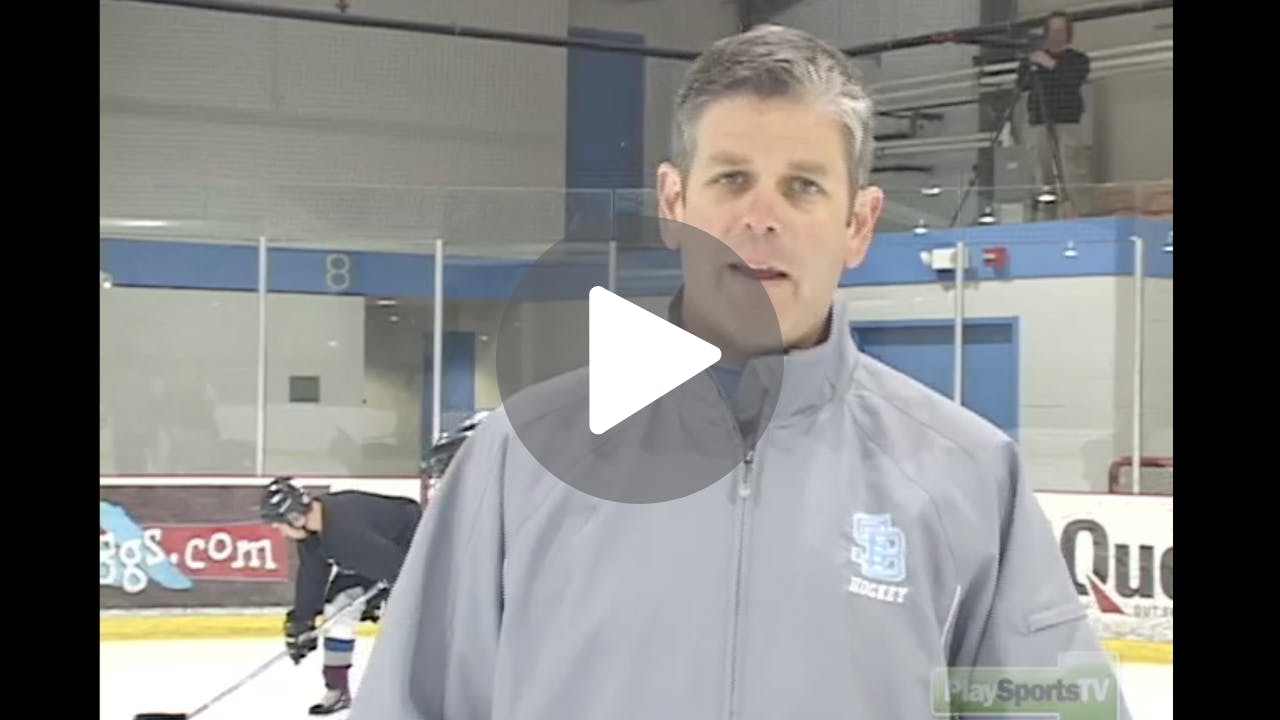
Objective: Improve passing accuracy and awareness in multiple game-like situations
How it Works: Three-part drill series
- Stationary Passing – Players pass while standing still
- Passing Under Pressure – Add light pressure to challenge quick decisions
- Passing on the Move – Players pass while skating forward and backward
Coaching Points:
- Emphasize crisp tape-to-tape passes
- Keep head up and communicate through each rep
- Smooth transitions between stages for realistic pace
_____________________________________________________________________________________________________________________
25–40 min: Situational Drills
Goal: Teach team concepts like breakouts, offensive entries, or D-zone coverage
Drill 3: 2-on-1 Continuous
Objective: Reinforce offensive decision-making under pressure
- Drill starts with a 2-on-1 attack
- Defender stays, two new attackers enter for a new 2-on-1
- Cycle continues
Variations:
- Limit passes
- Reward goals with an extra attacker
_____________________________________________________________________________________________________________________
40–50 min: Small-Area Games
Goal: Push tempo, compete, and develop under pressure
Drill 4: Corner Battles
Objective: Build compete level, puck protection, and angling
- 1v1 or 2v2 in a corner or below the goal line
- Play for 20–30 seconds max
- Winner earns possession, next players jump in
_____________________________________________________________________________________________________________________
50–60 min: Scrimmage or Special Teams
Goal: Reinforce power play and penalty kill systems, finish with energy, have fun!
Drill 5: Sled Dog Race Drill
Objective: Build explosive lower-body power and skating strength through resistance
How it Works:
- One player kneels on the ice
- A partner grabs their stick or jersey and pulls them to the far blue line
- Run it as a race or timed event for fun competition
Coaching Points:
- Emphasize strong posture and stride from the pulling player
- Reinforce lower-body drive and arm movement
- Use cones or designated lanes to stay organized
Drill 6: Controlled Scrimmage (Half-Ice with Constraints)
Add constraints like:
- Goals only off passes
- One-touch rule
- Only 2 passes allowed in the zone
Let players have fun but still build habits.


With Fundrise, you can invest in a portfolio of private market assets like real estate, private credit, and venture capital.
https://fundrise.com/r?i=p510y9
US Sports Radio affiliate partner
http://www.USSportsRadio.net


World Cup Tickets: Spanish midfielder Álvaro Fidalgo, a standout performer for Club América, has recently opened up about the increasing conjecture regarding his potential role in the Mexican national squad ahead of the FIFA World Cup 2026. Fidalgo, who has acquired the Mexican population, is now theoretically capable of representing El Tri, but he has highlighted that a national team call-up is not something he is taking for granted.
FIFA World Cup 2026 Tickets | Buy FIFA 2026 Tickets
His future, both at the club and globally, remains unstipulated as the FIFA World Cup 2026 looms large on the horizon. As expectation continues to shape for the FIFA World Cup 2026, which will mark an important moment with matches presented diagonally across the United States, Canada, and Mexico, many enfranchised companies are being considered as part of expanded national squad schedules.
Fidalgo’s Focus on the Present as Mexico Eyes World Cup
The event will kick off at the fabled Estadio Azteca, and for Mexico, playing on home soil brings both great chance and huge pressure. Amid these circumstances, Álvaro Fidalgo’s name has surfaced among the possible accompaniments to the national troop pool. However, the Spaniard remains humble and measured in his method, making it clear that his chief focus is on the current second rather than on hypothetical states connected to the FIFA World Cup 2026.
Are you excited to support your favorite team at the FIFA 2026? eticketing.Co offers exclusive access to Mexico FIFA World Cup Tickets, allowing you to follow your team throughout the tournament. Our trusted platform connects you with the best deals on Iran FIFA World Cup Tickets, ensuring you never miss a moment of the action.
Fidalgo recently spoke queries nearby his future in a candid manner, admitting that his present situation is shaped not only by his footballing services but also by bond dynamics and training choices. He revealed that his existing contract with Club América is set to expire in the coming year, and no extension has been agreed upon. This raises questions about his long-term presence in Liga MX and his potential obtainability for the Mexican national squad as it prepares for the FIFA World Cup 2026.
FIFA World Cup 2026 Tickets | Buy FIFA 2026 Tickets
Fidalgo Reflects on Uncertainty and the Road to the FIFA 2026
Speaking openly, Fidalgo specified, I don’t know how these upcoming months will unfold. I have a one-year agreement, and it’s a complicated topic. There’s a director who may not fancy me, and I can’t predict what will happen to me in the short or long term. His words underline the uncertainty that can shape a player’s course, especially when the stakes are as high as receiving a spot in the FIFA World Cup 2026 squad.
Despite the gossip about the FIFA World Cup 2026 and Fidalgo’s suitability, the midfielder has chosen not to make assumptions or declare himself a candidate. Instead, he has remained absorbed in delivering his best presentations with Club América. In what has been one of his most creative seasons to date, Fidalgo has continued to validate his value on the pitch through technical skill, originality, and tactical intelligence.
Experience the excitement of FIFA 2026 live by securing your spot today! Buy World Cup Tickets through our streamlined online platform, where you can easily Buy World Cup Tickets at unbeatable prices. Do not miss your chance to be part of the action. Buy FIFA 2026 Tickets now and join fans from around the globe for the world's record-breaking football event.
These qualities have made him a fan favorite and a reliable contributor in Liga MX, but he remains cautious about reflecting his international predictions. He remarked, Honestly, if you ask me if I have predictable myself for this, the answer is no. I prefer to focus on the contemporary and what is happening now. Thinking about a potential call-up seems disrespectful to other Mexican players who are also excelling in my location.
Fidalgo Praises Mexico’s Midfield Talent Ahead of FIFA 2026
Fidalgo’s humility and respect for the Mexican football attitude were further evident when he was aware of the depth of talent in the national squad’s midfield. As Mexico prepares for the FIFA World Cup 2026, knowing the right blend of skill and form will be crucial. Fidalgo praised several domestic talents, including Erik Lira, Edson Álvarez, Luis Romo, Carlos Rodríguez, and rising star Elías Montiel. Of Montiel, he said he is a very, very good actor, showing his respect for the initial group of Mexican footballers.
Football enthusiasts around the globe are eagerly anticipating the chance to secure FIFA World Cup tickets. To experience the excitement firsthand, purchase your FIFA World Cup Final Tickets through our online platform, eticketing. Do not miss the opportunity to be part of one of football's most thrilling tournaments.
FIFA World Cup 2026 Tickets | Buy FIFA 2026 Tickets
This gesture copies Fidalgo’s consciousness that, while he may be capable of playing for Mexico, the rivalry for places in the FIFA World Cup 2026 group is fierce and filled with deserving applicants. As one of the co-host states for the FIFA World Cup 2026, Mexico will be looking to make a deep run in the competition, chiefly with the added stimulus of playing key competitions on home soil.
This unique variety of the FIFA World Cup 2026 will feature an expanded preparation with more teams, more matches, and more chances for players to make history. The choice of accepted players like Fidalgo contributing to the squad adds a fascinating layer to team selection. These companies often bring a varied set of participations and a dissimilar strategic outlook, which can be helpful in stressful settings during the FIFA World Cup 2026.
World Cup Tickets: Balancing Loyalty and New Talent in Mexico’s FIFA 2026 Squad
Fidalgo’s situation highlights the wider challenges national team coaches face as they build their squadrons for the FIFA World Cup 2026. Balancing loyalty to long-serving national squad players with the need to integrate fresh talent and naturalized citizens is never easy. With head coach Javier Aguirre potentially having different preferences, Fidalgo recognizes that assortment is not something he can regulate.
Experience the thrill of the FIFA World Cup with exclusive FIFA World Cup Hospitality Tickets from eticketing.co. Enjoy VIP treatment, premium seating, and unmatched comfort. Whether you’re looking for Football World Cup Hospitality Tickets, eticketing offers the ultimate hospitality packages for an unforgettable experience. Book now and secure your hospitality tickets for the world’s biggest football event.
FIFA World Cup 2026 Tickets | Buy FIFA 2026 Tickets
The midfielder has made it clear that he is willing to donate if called upon, but won’t be agitated for a spot. His expert attitude adds credibility to his acts and sets an example for how players should handle FIFA World Cup 2026 speculation. For fans and analysts alike, Álvaro Fidalgo remains a convincing figure in the FIFA World Cup 2026 conversation. His recitals in Liga MX continue to catch the eye, and his eligibility adds valuable suppleness to Mexico’s midfield options.
Yet, as Fidalgo has emphasized recurrently, the road to the FIFA World Cup 2026 is long, and nothing is guaranteed. Injuries, tactical vicissitudes, and competition can all shift the landscape between now and 2026. As the FIFA World Cup 2026 draws near, the stories of companies like Álvaro Fidalgo will continue to shape the description. Whether or not he ultimately wears the Mexican jersey in the world’s principal period.
FIFA 2026 Tickets: Alvaro Fidalgo’s Consistency and Growth Ahead of the World Cup
His journey reflects the evolving nature of global football and the unique dynamics of a dual-national picture. The FIFA World Cup 2026 will be a competition unlike any other, and as preparations intensify, every match, every training session, and every decision will count. Fidalgo knows this better than anyone and is making the only way he knows how by giving everything on the pitch today while letting the future unfold on its terms.
The FIFA World Cup 2026 promises to be more than a display of elite talent; it will be a tribute to diversity and shared ideas. Álvaro Fidalgo’s expedition fits perfectly within that narrative. Through discipline, humility, and staunch consistency, he has emerged as a possible wildcard for the final squad. Regardless of selection, his inclusion in the FIFA World Cup 2026 discussion is a testament to his growth and the expanding likelihoods within the world’s biggest football stage.
For fans eager to attend FIFA 2026 matches, a wide array of FIFA World Cup 2026 tickets is available at eticketing.co. Our platform partners exclusively with reputable sellers on the secondary market, ensuring access to top-notch ticket listings from across the web. Explore our Football World Cup 2026 selection to find the best deals available today!
fans can effortlessly book Tickets for thrilling FIFA World Cup 2026 matches at discounted prices. Don't miss the chance to witness the world's greatest Football World Cup 2026 event live.

 " "
" "
