Whether you’re stepping onto the track for the
first time as a head coach or you’ve been guiding athletes for a season
or two, this guide will equip you with practical strategies, training
techniques, and motivational tools drawn straight from real-world
coaches.
_________________________________________________________________________________________________________________
1. Foundations of a Successful Program
Every
outstanding track program starts with well-defined expectations, a
consistent structure, and a culture that values accountability.
Set Team Size & Standards
• Quality over quantity is key. Limit your roster size to ensure effective coaching.
• Instead of using punitive measures, consider tryouts or
“programming cuts” to manage team size. Establish clear standards for
your athletes. If your coaching staff is small, prioritize athletes who
are eager to work hard and compete, rather than just those with the most
talent.
Define Roles
• If you have assistant coaches, assign them based on their strengths (like throws or jumps).
• In situations with only one coach, empower senior athletes or
experienced parents to take on “player-coach” roles. Let senior athletes
lead warm-ups and help keep their teammates focused and on track.
Communicate Clearly
• Provide weekly schedules, practice goals, and meet expectations in writing.
• Encourage athletes to monitor their own times and workouts—this helps them take ownership of their progress.
_________________________________________________________________________________________________________________
2. Warm-Up & Mental Preparation
A solid team warm-up goes beyond just preventing injuries; it gets both the body and mind ready to perform.
Holistic Warm-Up (15–30 minutes)
Dynamic Movements: Forward A-skips, B-skips, high knees, and butt kicks.
Lateral & Backward Work: Karaoke, side shuffles, and backward high knees.
Prehab/Activation: Hip bridges, fire hydrants, 90/90 hip rotations, and plank rotations.
Sport-Specific Drills: Setting up mini hurdles (“wickets”), track strides, and bounding.
Mental Readiness
• Give athletes a moment to transition from classroom mode to performance mode.
• Include partner stretches or light group games to foster team spirit.
• Use cues like “good afternoon” or “prime time” during warm-ups to signal to athletes that it’s time to get to work.
_________________________________________________________________________________________________________________
3. Training Phases & Planning
Organize
your season into clear phases to effectively balance building a strong
foundation, enhancing speed, and reaching peak performance during
competitions.
Weekly Structure
• Monday: Recovery/Easy (Varsity recovery vs. JV long run)
• Tuesday: Speed/Intervals or Hills
• Wednesday: Mid-long run (~20% of weekly mileage)
• Thursday: Sprint/Technical or Tempo
• Friday: Optional light run or rest
• Saturday: Races or simulation
• Sunday: Day off or optional easy run (depending on team culture)
_________________________________________________________________________________________________________________
4. Event-Specific Techniques
Throws: Tailored Warm-Up Routine
Before stepping into the ring, take the first 5–10 minutes after your general warm-up to focus on shot put-specific prep.
Key Focus Areas:
• Posture and body control
• Hand and wrist flexibility
• Mental transition from general warm-up to technical work
Drills to Incorporate:
• Standing throws that emphasize balance
• Wrist flicks and release mechanics
• Position drills that highlight a tall spine and core stability
Coach's Insight:
Make sure to dedicate extra time to wrist and hand preparation to avoid potential hand/wrist injuries.
Implementing Progression – From Heavy to Light
To enhance both strength and feel for the throw, the Coach suggests starting with heavier shots at the beginning of the season.
Progression Breakdown:
Heavy Shots – Build strength and identify balance weaknesses
Competition Weight – Fine-tune posture and rhythm
Lighter Shots – Concentrate on speed, timing, and release
Key Focus Areas:
• Use drills to sense positions throughout the throw
• Create a rhythmic “slow-to-fast” sequence
• Reinforce posture for a balanced, repeatable effort
Coach's Insight:
Using
heavier implements is especially beneficial for glide throwers early in
the season. They help challenge balance and timing before moving on to
lighter balls as the season progresses.
Seasonal Throw Progression
Early Season:
• High volume of breakdown drills
• Focus on posture, balance, and control
Mid to Late Season:
• Fewer drills, more full throws
• Shift focus to rhythm, speed, and competition-specific cues
Throws & Power Drills – Phil Olson
Building
power in the ring starts with rhythm, timing, and body control. For
beginners, simplified drills lay the groundwork for more complex
movements down the line.
Resistance Band Simulation Drill
Setup:
Attach a long resistance band from the athlete’s waist to their
throwing hand (or use a handheld version if needed). This simulates the
movement pattern of a rotational throw.
Focus:
• Reinforces full-body connection during the throw
• Encourages a straight-line path from wind-up to release
• Trains rhythm and force application through the legs and hips
Coaching Tip:
Keep tension smooth—not jerky. Focus on turning the hips first, then shoulders, finishing with a tall release.
Half Power Block Drill – For Discus & Rotational Shot Put Put
Setup:
From a half-power position (hips and shoulders open to ~90
degrees), have the athlete focus on timing the drive from the right foot
with a strong block from the left arm.

Focus:
• Hips open, left arm extended toward the sector
• Right heel lifts, hip drives through the throw
• Strong left-side block stabilizes and adds torque
Coaching Tip:
If the shot/disc path is off-line, the athlete will lose speed
and control. Emphasize finishing tall and keeping everything in a
straight line.
Stick Drill to Power Position – Phil Olsonlson
Focus:
• Simulates throw with stick or med ball
• Emphasizes tall finish, full extension, and proper posture
For more great drills and teaching points for shotput and discus, check out Phil Olson's full clinic, ‘Discus and Shot Put Training for the Young Thrower’.
_______________________________________________________________________________________________
Jumps
High Jump Prep
• Monday: Speed/form runs & approach drills (shoulders back, hips forward).
• Tuesday/Thursday: Technical approach + 2–3 step drills, strength work.
• Wednesday: Speed endurance (e.g., 50-200m) to build runway tolerance.
Long/Triple Jump Daily
• 1-2 practice jumps integrated with team warmups—discover new talent.
Takeoff Position & Rhythm Drills – Brad Hackett
Getting the takeoff mechanics just right is
crucial. Coach Hackett really stresses the importance of driving that
swing leg, keeping the shin angle around 24 degrees, and hitting a
strong, upright position at the board.
Progression:
One-Step Takeoff Drill
• Make sure to nail that takeoff posture every single time
• Cue: "Opposite jacket" – think of your arms and legs working together
Three-Step Pop-Ups
• Add some speed and rhythm while sticking to those takeoff mechanics
• Breathing cues: “Breathe to one, breathe to one”
Flight Drills & Arm Mechanics
These
flight-phase drills are all about improving your posture, controlling
your hang-time, and perfecting your arm action while you're in the air.
Drills:
• Walking Arms – Walk around with your arms mimicking the flight phase, keeping your posture tall
• Wall Plant Drill – Face a wall, simulate your takeoff and arm sweep while maintaining that tall stance
• Combined Pop-Ups – Connect those three-step pop-ups with your arm mechanics for real-time control
Landing Progressions
Landing is often
overlooked, but bad form can really cost you distance. Coach Hackett has
laid out three landing progressions to help teach extension and
control.
Drills:
3-Step Jump to Bowl/Tire
• Helps athletes learn to land with arms up and legs extended
• Cue: “Land with the heels, dig with the toes”
Ankle Grab Landing
• Sprint down a 6–8 stride approach, jump, grab your ankles midair, and land in the pit
• This builds awareness of body positioning and full extension
Seated Landing Drill
• Sit on a box or chair, lean back, and reach forward with your arms and legs
• Get a light push from a teammate to help you reach even further
Coach Tip:
When you land properly, you
should leave even marks in the sand—your heels, hands, and hips should
all be in line. If your toes leave a drag mark behind your heels, it
means you didn’t fully extend.
These drills can be practiced year-round, even if you don’t have
access to a sand pit. For more technical cues, posture adjustments, and
in-place progressions, check out Brad Hackett’s full clinic ‘Long Jump Skills & Drills’.
_________________________________________________________________________________________________________________
Sprints & Acceleration
3-Point Starts & Acceleration Mechanics – Jerome Missaien
Mastering the sprint start isn’t just for elite
athletes; it’s a crucial skill for any runner looking to boost their
acceleration. Coach Missaien shares a straightforward, easy-to-follow
method for establishing a solid 3-point start and seamlessly
incorporating it into your sprint drills, even if you don’t have blocks.
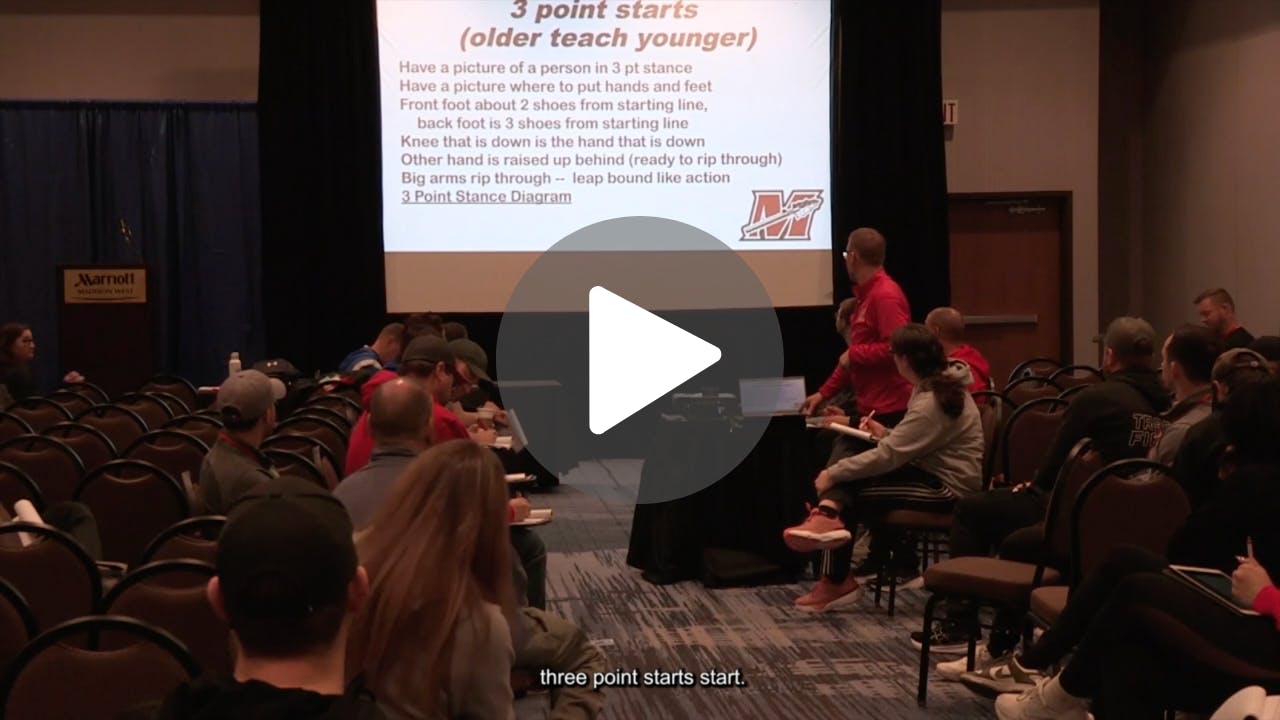
Setting Up a Reliable 3-Point Start
Coach Missaien introduces a simple approach to help athletes build consistency from the ground up:
Drill Setup 1: Chalk Line Method
1. The athlete positions themselves at the starting line.
2. Measure back two shoe lengths and mark that spot with chalk (this is for the back foot).
3. Measure one more shoe length back and mark that for the front foot.
4. The athlete then squats into position without shifting their feet.
Coaching Cues:
• The knee that’s down corresponds to the hand that’s down.
• Form a triangle with your feet and hand.
• The hand should be placed 2 to 2.5 feet in front of the front foot.
• Cue: “Pivot forward” to shift the shoulders over the front hand.
Drill Setup 2: Line Mark Method (No Chalk Needed)
Utilize lines on the gym floor or track:
• Position the back heel on one line and the front toe on the next.
• Drop into the same squat-based setup.
• Emphasize launching forward rather than upward.
Teaching Acceleration with Focus
Coach Missaien stresses the importance of isolating one technique at a time. For instance:
• Arm drive: Use the cue “Split! Split! Split!” and focus solely on that aspect.
• Launch angle: Concentrate on hand and shoulder positioning without critiquing the feet.
• Celebrate small victories—repetition fosters rhythm and builds confidence.
Coach Tip:
Encourage older athletes to
mentor younger ones on this drill. It not only strengthens team culture
but also reinforces technical consistency.
Acceleration Days
• Incorporate simple drills like cone pickups, short relays, and reaction balls.
• Focus on “long ground contacts” and hip drive, keeping fancy equipment to a minimum.
Wicket Drills for Mechanics
• Set wickets 5 to 6 feet apart to promote vertical push and proper hip height.
• Cue “push vertical to go forward” to prevent overstriding and braking.
Flight & Recovery Position
• Keep heel recovery tight (close to the glutes) and raise the knee to torso height.
• Foot strike under hip—avoid landing in front.
_________________________________________________________________________________________________________________
Relays & Handoffs – Ramon Smith
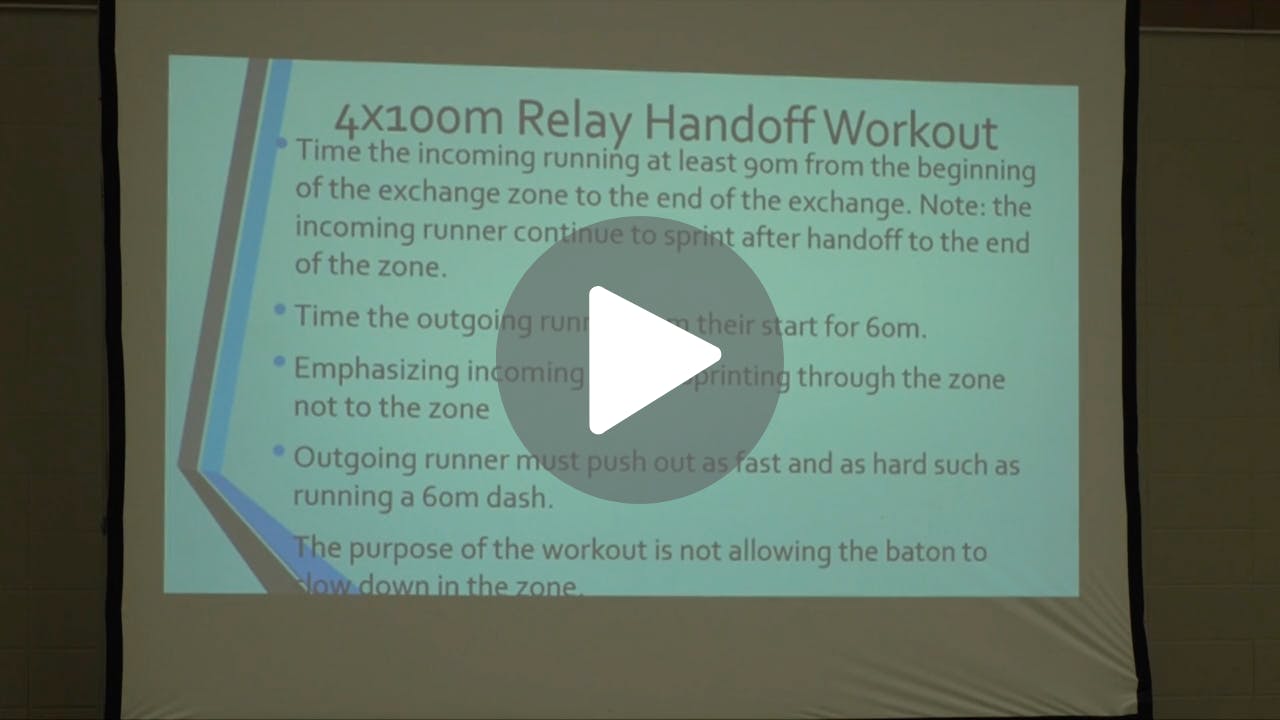
4×100 Blind-Silent Exchange
For
the outgoing runner, keep your fingers together, palm facing out, and
thumb pointing down. The incoming runner should push the baton firmly
into the target hand. Make sure to mark 15–17 paces from the zone entry
for the outgoing runner, and use a heel-toe mark for the incoming
runner. When running curves, right-hand sticks are the way to go; for
straightaways, stick to the left-hand.
4×400 Exchange
• Start with three strong acceleration strides, then turn your head to receive the baton.
• Don’t forget to practice under lactic fatigue, like at the end of 500m repeats.
_________________________________________________________________________________________________________________
Distance Training
A Full-Season Plan for the 1600/3200
Training
distance athletes goes beyond just building endurance; it’s about
layering aerobic development, honing speed endurance, and cultivating a
mindset geared for championship racing. Whether your runners are focused
on the 1600, tackling the 3200, or competing in both, a well-structured
progression throughout the year is key to laying the groundwork for
success.
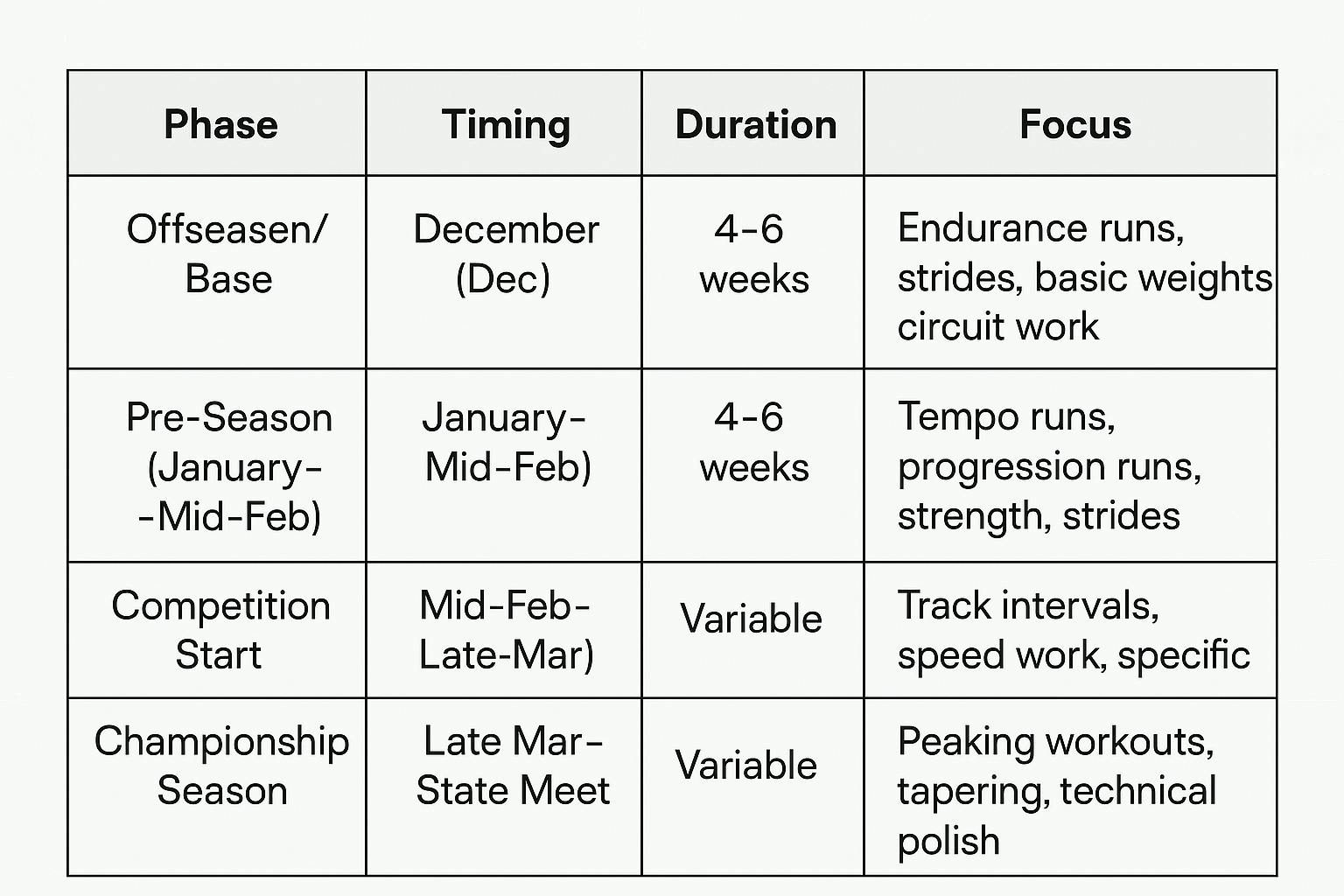
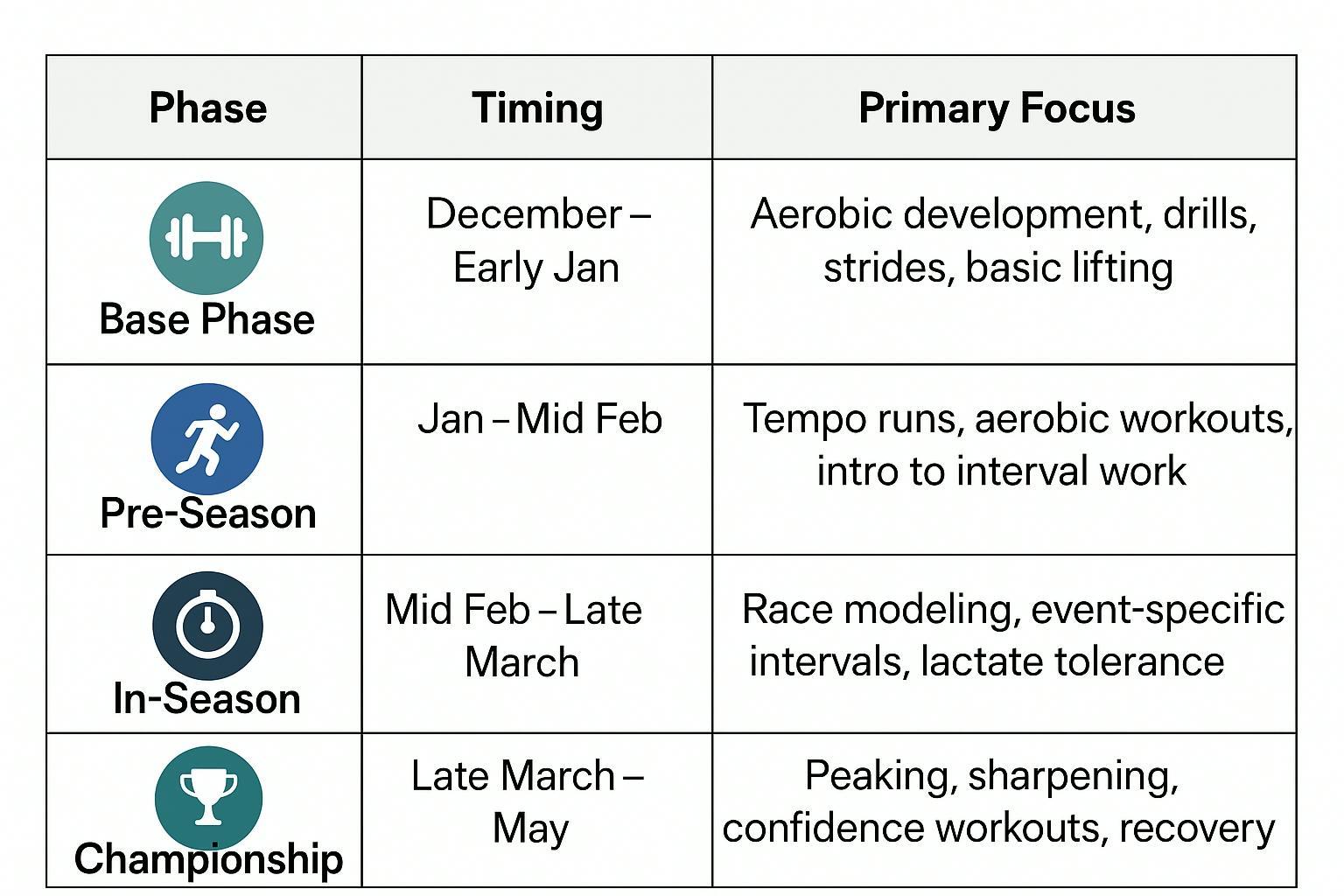
Season Overview: Periodization for Distance Runners
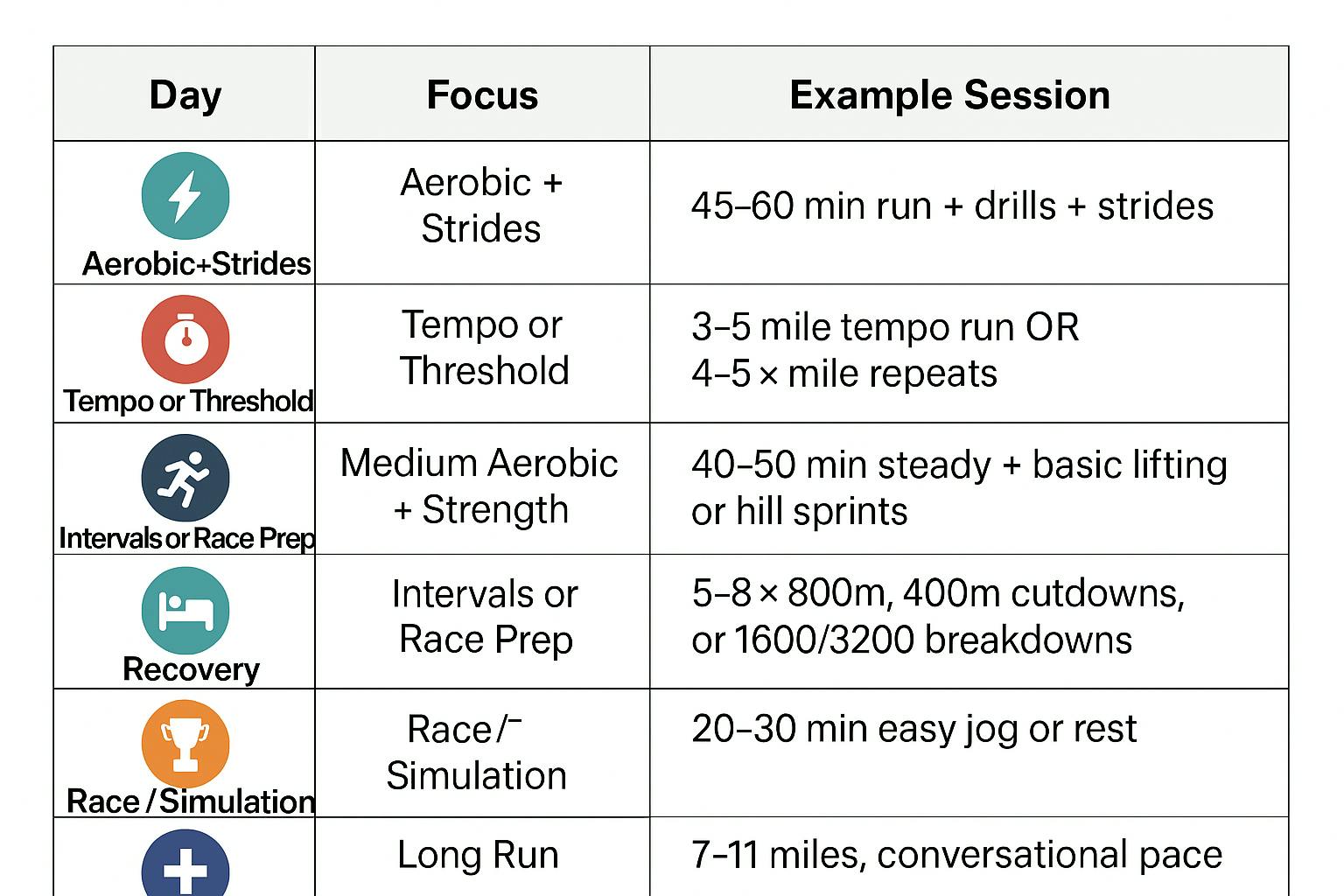
Weekly Training Template (Typical 7-Day Pre- or Mid-Season Week)
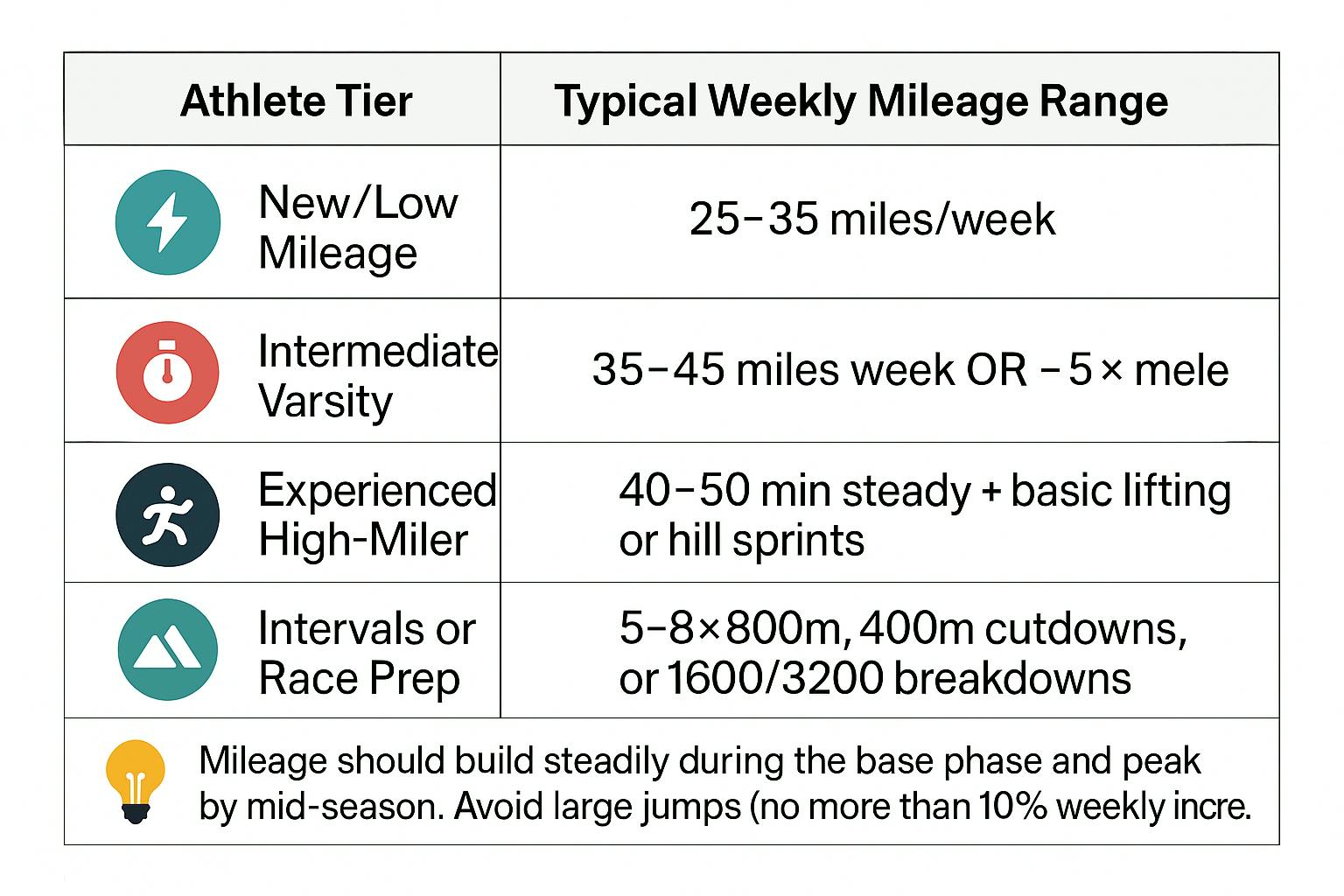
Mileage Guidelines by Athlete Type
Training Principles for Developing Championship Runners
Start with the Aerobic Base
Take your time
with intervals—use December and early January to build your mileage,
refine your mechanics, and enhance your running economy.
Begin Race Modeling Early
Once your athletes are fit, it’s time to practice race segments:
- 3×1600m at 3200 pace
- 2×1200m + 2×400m for a 1600 breakdown
- Last-lap simulation workouts
Pace Discipline is Key
Athletes need to
understand the feel of race paces—not just focus on the splits.
Incorporate threshold work and tempo reps to help them find their
rhythm.
Recovery is Part of Training Too
Easy days, rest days, and low-mileage Fridays are essential for keeping athletes healthy and on track.
Confidence: The Hidden Mileage
Confidence isn’t solely built by smashing workouts—it’s also about winning those small moments. Focus on:
- Feeling smooth during reps
- Running negative splits
- Finishing strong even when fatigued
- Controlling a race simulation
Coach Tip: Highlight when things are going well. Celebrate execution, not just the outcomes.
Late-Season Peaking: Fresh Legs, Sharp Minds
By April, your athletes should be in great shape. Now, it’s all about tapering volume and reinforcing rhythm.
Mileage Reduction:
- Cut weekly volume by 25–30% over the last three weeks.
Workout Focus:
- Keep the intensity high, but reduce the number of reps
- Prioritize recovery over volume
- Incorporate confidence-building sessions—faster surfaces, less volume, and a bit more rest
Championship Confidence Workout Example
Mid-Season: 8 × 800m on grass with 2:00 rest → Average 2:35
Peak Phase: 6 × 800m on track with 3:00 rest → Average 2:28
_________________________________________________________________________________________________________________
5. Strength & Conditioning
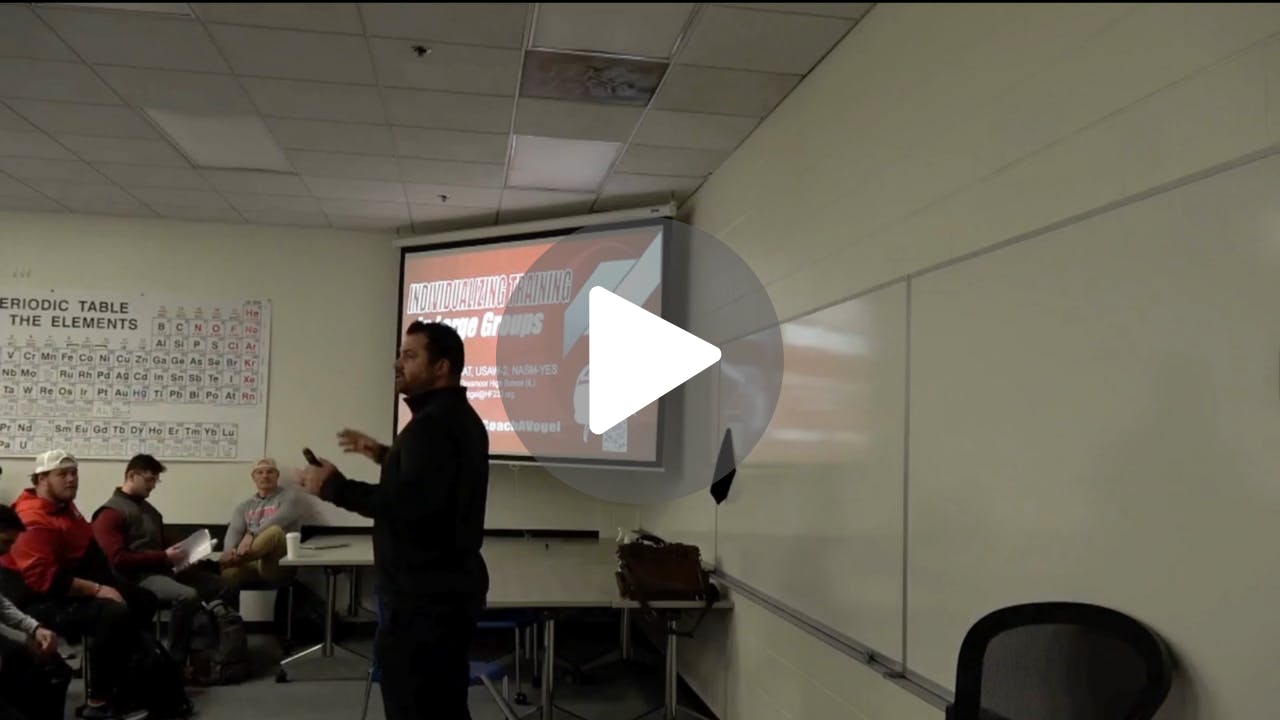
Building Systems in Large Groups – Adam Vogel
Effective strength training isn’t just about
having access to a high-end gym or personal training sessions—it's
really about having a solid structure, staying consistent, and being
able to adapt to the needs of athletes as they progress. Coaches are
sharing their insights on how to tailor training for groups of 40 to
over 100 student-athletes by using clear systems, progressions, and
fostering leadership development.
Organizing the Chaos: Training Structure by Season
In-Season (Maintenance Focus)
• Shorter lifting sessions (25–35 min)
• Focus on movement quality, bar speed, and athlete readiness
• Swap out volume for mobility, activation, or targeted recovery
Off-Season (Development Focus)
• Full sessions (35–45 min + warm-up)
• Key lifts: squat, hinge, press, pull
• Accessory work tailored to needs: mobility, power, or hypertrophy
Sample Split (4-Day Week):
Day 1: Total body power + upper strength
Day 2: Speed & plyometrics + lower lift
Day 3: Recovery focus or mobility work
Day 4: Full body complex or Olympic lifts + sprint technique
Smart Grouping: Tiered Levels for Athlete Progression
Tier 1 (Freshmen & Beginners)
• Emphasis on form, bodyweight progressions, and learning movement patterns
• Typically follow a unified program
• Focus heavily on mobility, tempo reps, and volume over load
Tier 2 (Sophomores – Developing Athletes)
• Start using barbells, velocity-based cues, and set targets
• May begin to tailor training based on specific sport needs
Tier 3 (Upperclassmen & Advanced Athletes)
• Individualized variations for goal-oriented work (strength, power, lean mass)
• Options for auto-regulation (rep ranges, RPE, jump height)
• Take on leadership roles to mentor younger athletes
Individualizing Within the Group
Correctives & Mobility Swaps
• Got tight hips? Swap out the “B2” accessory lift for some banded hip openers
• Shoulder issues? Try replacing the dumbbell press with landmine variations
Extra Volume (The Right Way)
• Athletes looking for “extra lifts” are guided on how to add volume smartly
• Coaches provide templates that align with recovery needs, not compete with them
• Avoid training fatigue by ensuring the right balance
Use “Athlete Coaches”
• Juniors and seniors help run warm-ups, demonstrate lifts, and lead small pods
• Encourages team buy-in, accountability, and program ownership
Making It Work Without the Perfect Facility
No rack? No worries! These coaches have found ways to get it done:
• In hallways (think core work and movement prep)
• In shared gyms (partner circuits and low-equipment stations)
• On turf with sleds, bands, and medicine balls
Coach Tip:
Forget
about perfection. Focus on consistency. The best programs foster trust,
progression, and a strong culture—regardless of how much space you
have.
For more training insights, templates, and system design strategies, be sure to check out Adam Vogel’s full clinic ‘Individualizing Large Groups.’
_________________________________________________________________________________________________________________
6. Athlete Development & Autonomy
Empowering Athletes
• Have them keep track of their times, distances, and notes.
• Promote self-reporting (“Did you finish your long run? What was
your split?”). Get team captains or senior athletes to create a Strava
group for accountability.
Peer Coaching
• Assign captains to specific groups (like distance, sprints, jumps).
• Let a senior thrower or jumper help run drills and do video analysis.
Parent Volunteers
• Bring in knowledgeable parents for event-specific coaching (like vault setup or video feedback).
• Make sure they have basic certification if your district requires it.
_________________________________________________________________________________________________________________
7. Practical Tips for Small-Staff Programs
Limit Team Size
• Set roster caps and run efficient large-group drills (all athletes across a goal line).
Multitask
• Pair distance athletes with their runs while working on field event drills.
Senior Leaders
• Turn your top performers into “player-coaches” under your guidance.
Low-Cost Drills
• Use cones, sticks, tennis balls, and mini-hurdles—you don’t need fancy gear to build speed.
_________________________________________________________________________________________________________________
8. Bringing It All Together
Plan Your Season: Outline the different phases, peak times, and recovery periods.
Build Culture Daily: Incorporate warm-ups and mental preparation to foster team buy-in.
Drill with Purpose: Every stick drill, hurdle wicket, and relay exchange should have a specific technical goal in mind.
Empower Athletes: Allow them to take charge of their logs, assume leadership roles, and track their progress.
Adapt & Evolve: Analyze video footage, data,
and athlete feedback. Make adjustments to wicket spacing, weekly
mileage, or timing strategies as needed.
With a solid plan, intentional drills, and a nurturing
environment, you’ll witness tangible improvements in sprints, distance,
jumps, and throws. Keep in mind that consistency in the basics and open
communication are your secret weapons for success.
Good luck out there on the track—let’s make this season the best one yet for your athletes!