Now Streaming On US Sports Radio!

US Sports Net Today!


Live Play-by-Play, Updates, Highlights and More! on US Sports Network!
[Chrome Users-You may have to click on the play button twice to listen]
US Sports Network Powered By Gorilla Sports!


US Sports Radio
The Las Vegas Raiders Play Here
Fitness and Sports Performance Info You Can Use!
The Scoreboard Mall
The Rock Almighty Shaker Of Heaven And Earth!
The Coolest Links In The Universe!

Friday, January 10, 2025

The Rock Almighty How does a Christian learn how to no longer be in subjection to the cravings and desires of their flesh? And Artist Spotlight: Michael Sweet interview! Stryper in the 80s, Sweet & Lynch

  • Author James Rondinone

PART 9 TESTIMONY

How Do Christians Learn to No Longer Be in Subjection to the Cravings and Desires of Their Flesh?

The person we had been referencing in the article had some spiritual avenues at his disposal. In my hometown, every so often, on a Saturday night on GOD TV, there would be a broadcast of worship, praise, and teaching service from the same church that this person was affiliated with. The staging area would be set up for many musicians to perform. The words from the songs were uplifting and impactful. In some cases, this was followed by a guest speaker, each of whom had a message that was unique and anointed. And then there was the presentation of the gospel to which many unbelievers responded.

I’m unaware of what else was going on for the rest of the week in the church assembly. In this instance, I would assume there were some outreaches and other worship, praise, and teaching services held throughout the week. Might there possibly be Bible studies available? So, here is my point. I have to believe that this church also had its own people in leadership to teach on the various doctrines of the faith, i.e., eternal security, redemption, sanctification, giving financially, eternal rewards, etc.


And besides learning about the tenets of the Christian faith, what else is extremely important is learning how to address the weaknesses and strengths of our sin nature. 

It appears that this might have been attempted to be handled according to some of the declarations from the article entitled, “Sex Abuse & Gay Conversion Therapy: The Dark Past of Justin Bieber’s Megachurch Hillsong” that we have mentioned on a couple of occasions. Here is some of what was said in relation to addressing gay behavior. Alex, a former member of this church, quit after a traumatic coming out where he said he was referred to his youth pastor to counseling that proposed to make him straight – the kind of conversion we now know is based on pseudoscience.112

I have never heard of pseudoscience, but what I do know is at salvation, we are made new creatures. However, the experiential realization of this positional reality (as God sees us as being a finished product) is a process. I admit that trying to grasp this and see it coming to fruition in our own lives is mysterious and painful at times. After I got saved, I still attended nightclubs, got drunk, looked for girls, said swear words, smoked cigarettes, had violent tendencies, harbored impure thoughts about others, had fears of speaking in front of people, had pornographic inclinations, and had a very bad view of myself, but the one thing I knew beyond a shadow of doubt was that God had come into my life! However, in my experience, I was an extreme mess.

How could I possibly learn how to be an overcomer in all or any of these areas of weakness?

Like this fellow believer, God provided me with spiritual guidance to attend a particular church, which likewise had a music ministry along with worship, praise, and teaching at least three times a week. It was connected to a headquarters facility located not too far away from the branch ministry I was attending. The headquarters provided live radio broadcasts Monday through Friday, varying educational degrees in Christian ministry, street witnessing outreach, a monthly newsletter, and if a branch church put in a request for a guest speaker, usually this would be granted. I loved this church. The teachings were anointed with God’s saturating presence. I was learning about my new faith. But I still had issues with the inclinations and passions of my sin nature. Old ways of thinking, feeling, speaking, and in some cases, acting remained the same. I needed a heavenly life raft.

Then, one day something dawned on me. As I listened to the pastor of the branch ministry speak, one thing that resonated with me was his expansive knowledge about who he was in Christ, as evidenced in his command of bringing forth pertinent Scripture after Scripture from his tongue without looking in the Bible. And there it was all along. The solution for my many issues was to learn, memorize, meditate, and apply God’s Word concerning each and every area of weakness of my sin nature.

And along with this, there was something else I had learned. Whenever I thought about myself, others, or the circumstances of life from a human perspective, I would lose the presence of God permeating my life. There were many times when I would hear anointed music and messages under the power of the Holy Spirit, and I was unable to be impacted by His individual and corporate ministry because I was operating in the wrong mindset. The following verses illustrate this perfectly.

Romans 8:5-6 For they that are after the flesh do mind the things of the flesh; but they that are after the Spirit the things of the Spirit. For to be carnally minded is death; but to be spiritually minded is life and peace.

What this tells us [is] that they who live under the influences of the corrupt and sinful desires113 of the sin nature are characterized as being carnally minded, and as such, they focus their thoughts on what their body wants. On the other hand, those who live after the Holy Spirit think about what the Spirit wants, and as [such,] their mind is controlled or dominated by114 Him.                                                  

Romans 8:6 For to be carnally minded is death; but to be spiritually minded is life and peace.

With these thoughts in mind, we can conclude that if we are carnally minded, i.e., think only about what [our] body wants115, we will experience misery and condemnation. However, if we are spiritually minded, i.e., making His thoughts the object of the mind, the end and aim of the actions, to cultivate the graces of the Spirit, and to submit to His influence; … to seek those feelings and views which the Holy Spirit produces, and to follow His leadings,116 we will experience life (eternal resurrection life; the only path of happiness117) and peace [repose (state of being at rest) and true bliss118].


All this sounds great, but how do we cultivate the influences of the Spirit? 

We cultivate His influences by making them the object of our minds. You might be thinking you have some idea of what I mean, but not really. That’s ok. This idea of cultivating the Spirit’s graces is easy to say but not necessarily easy to understand.


In respect to the question at hand, how does a Christian learn how to no longer be in subjection to the cravings and desires of their flesh? 

Which grace of the Spirit do you think will help us in this endeavor? There are nine graces of the Spirit per Galatians 5:22-23. Any guesses?

But the fruit of the Spirit is love, joy, peace, longsuffering, gentleness, goodness, faith, Meekness, temperance: against such there is no law.                                                     

The fruit of the Spirit that will help us is temperance. What is temperance? Temperance means being able to say no to one’s desires.119 It also means to have mastery over one’s desires and impulses.120 Did you hear that? God’s Word says we can have mastery over our desires and impulses, that is, if we want to have mastery over them.

If you keep on referring to yourself by saying, oh, God can’t change me. I am a lying Christian; I am a fornicating Christian; I am an adulterous Christian; I am a gay Christian; etc., and I will never change, then you won’t. You will be a new person in Christ, living as the old person you used to be. Is this how you want to continue to live as a son or daughter of God? If you are not sure whether this is what is going on in your life, then ask yourself these questions.

Do you proclaim that Jesus has changed your life, and yet you exhibit no changes in your behavior?

Do you proclaim that Jesus has changed your life, and yet you express to others, believers and unbelievers, that He condones certain sinful sexual actions?

If the answers are yes and yes, then this question remains to be answered.

Do you really want to exhibit Christ-likeness to others?


What is Christ-likeness?

Christ-likeness is operating in the fruit of the Spirit and exhibiting the characteristics of these nine elements toward others while amidst the circumstances of life.

Where you are at right now is where I was years ago in my walk with God, at a crossroads. Do I continue to live to gratify the sinful desires of my sin nature, or do I make the necessary decisions to cultivate the fruit of the Spirit in my life? I hope your answer is the latter. If it is, then what I am going to present to you next is what I believe will help you to cultivate the spiritual grace called temperance.

While it’s true that we should learn how to cultivate each of the nine elements, we need to work on them one at a time. And with respect to this study, temperance will be the one we will focus on. Are you ready to embark on making certain decisions that will help you be an overcomer in the area of eros sexual desires or propensities? If so, the next chapter will reveal how to do this.


Endnotes

112 Sex Abuse & Gay Conversion Therapy.

113 UBS New Testament.       

114 Weust.

115 UBS New Testament.

116 Barnes’ Notes. 

117 Barnes’ Notes. 

118 Jamieson, Faucet, and Brown Commentary.

119 UBS New Testament.

120 Weust.

Amazon: https://amzn.to/2ITJ1wj

Website: https://bit.ly/3mWKJ2r             

New Covenant Ministries - Ministerios NuevoPacto - Harbor Church, Block Island                                                                                                                                                                                                         

Sunday & Thursday Worship - Domingo & Jueves 7:00PM                   

My name is James Rondinone. I am a husband, father, and spiritual leader.

I grew up in Massachusetts and began my own spiritual journey early on in life.

I attended Bible college, having completed a two-year Christian Leadership Course of Study and graduated as valedictorian (Summa Cum Laude).

Studying and teaching the Word of God has been a passion of mine for over 20 years.


Thursday, January 9, 2025

US Sports Baseball: Three Tips to Make Your Baseball Team Mentally Tougher and Top 10 Relief Pitchers in MLB entering 2025! (Who's No. 1?!)


Three Tips to Make Your Baseball Team Mentally Tougher

  • By Grant Young

Baseball demands a lot of mental training because it is a game of failure and adversity. Unlike sports like basketball or soccer where a player might have multiple opportunities to score in a game, in baseball, even the best hitters fail to get a hit more often than not. The most common anecdote baseball players and coaches share to illustrate this is how a hitter who gets a hit around 30% of their at-bats as a professional will likely make it to the MLB Hall of Fame. 

This means that players have to deal with a lot of failure and learn to cope with it mentally. Additionally, the game can be slow-paced, with periods of inactivity followed by intense moments requiring split-second decisions. This requires players to stay focused and mentally sharp throughout the game, which can be mentally taxing. 

However, teaching mental toughness in baseball can be, well, tough for these reasons: 

1. Many players come from a background where physical skill and talent are often emphasized over mental resilience. 

2. Some players may have never been taught how to cope with failure, pressure, or adversity, so coaches and instructors face an uphill battle of not just imparting technical skills, but also reshaping players' attitudes and mental approaches to the game. 

3. Each player may respond differently to various mental training techniques, so it can be challenging to find the right approach for each individual. 

While there’s no one-size-fits-all solution to cultivating mental toughness within your baseball team, a good place to start is by heeding the wisdom that successful baseball coaches have utilized. This is why we’ve pulled three tried-and-true mental toughness tips from well-respected baseball coaches that they’ve used to win the mental war that every baseball player must battle. 

Winning Mindset - Daily Affirmation

Winning Mindset was developed by former nationally ranked, All-Ivy League wrestlers, Gene and Jeff Zannetti to help individuals and teams reach their full potential in sports, school, and life. Gene and Jeff have studied the best athletes, coaches, teams & experts in the world to learn the secrets of performance success. Winning Mindset coaches have worked with thousands of athletes, teams, professionals & coaches.

In their ‘Baseball Mindset: Confidence Crash Course’ course, Jeff Zannetti explains the power of baseball players using daily affirmations, which are short phrases they’re saying to themselves on a regular basis in order to talk themselves up and inspire confidence. 

Coach Zannetti goes on to say that boxing icon Muhammad Ali would say, “I’m the greatest of all time!” as his daily affirmation, which instilled the belief that he’d actually become the greatest. 

The important part of affirmations is that they are simple, easy to remember, personalized to whatever goals the player wants to have for themselves, and phrased as if they’re going to happen, rather than the player merely wanting them to happen. If they want to be all-conference, then their affirmations — which can be either thought or spoken aloud — should say that they’re going to be all-conference. If they want to pound the strike zone, the affirmation should be centered on them doing just that. 

Another good tip for this is to have players write their affirmations down and place them somewhere that they’ll be looking at often, such as a bathroom mirror or their locker, because actually seeing the affirmation written down will keep it top of mind. 

Because mental toughness relies on being confident, this tip should be a must for all baseball players, regardless of what their stats may read. 

Andy McKay - The Thought Process That Really Matters 

Andy McKay is currently the Assistant General Manager of the Seattle Mariners. Before that, Coach McKay is currently Director of Player Development for the Seattle Mariners. He began his coaching career in 1993 at the University of Tampa where he helped coach them to a NCAA Division II National Championship.

In his ‘Coaching the Mental Game’ course, Coach McKay discusses how baseball is played in 15-second intervals because that’s typically how much time there is between pitches. Because of this, a player should renew their mental focus and fortitude every 15 seconds when they’re on the field in order to remain on track with their goal. 

He then adds that mental toughness lives within those 15-second intervals. Similar to Winning Mindset’s aforementioned point, he discusses that there’s no difference between the mind and the body because the body is always going off of what the mind is telling it. 

Coach McKay noted how the phrase, “muscle memory,” is a fallacy because it implies that the body can do anything without the mind’s help. 

Therefore, the mental side of the game must be practiced and honed as much as the physical side, because the two can’t thrive without the other. 

Pete Meyer - Control The Controllables

Pete Meyer is the Head Coach of the men's Baseball Team at Lisle High School in Illinois. In his ‘The Mental Game - Part 1 with Paul Babcock & Pete Meyer’, Coach Meyer and Coach Babcock discuss how they believe the three most important words in baseball are “control the uncontrollables”. 

There are so many aspects to a baseball game that are out of a player’s control. Whether it’s the weather, the opposing pitcher, the score, the umpire, the crowd, or innumerable other factors, none of them are something a player can control in the moment — and all can take the players’ focus away from the task at hand. 

Getting your team to understand this — and keeping them accountable to it by calling them out when complain about an uncontrollable — will build a resilient, focused, and mentally tough baseball team from the top down.

Wednesday, January 8, 2025

US Sports Partner Spotlight: The Wellness Company


Rectangular Logo

Your heart is the most important muscle in your body. Are you doing enough to keep it strong?
Critical nutrients in this breakthrough formula may help maintain your body’s cardiovascular health and blood flow.
We recommend this clinical-grade formula for daily use by anyone concerned with overall heart health.
UPGRADED FORMULA INCLUDES TAURINE, BEET ROOT & GRAPE SEED EXTRACT!
https://bit.ly/HealthHeartFormula

US Sports Radio Affiliate Partner
https://bit.ly/USSportsRadioToday
http://www.USSportsRadio.net

Tuesday, January 7, 2025

The Rock Almighty. Therapy Is The Super-Spreader Of Wokeness and Whatever Happened To Rage Of Angels?


Therapy Is The Super-Spreader Of Wokeness

  • Author Nicole Chardenet

Well this explains everything, I thought to myself. The fox is coaching the henhouse!

Author Lisa Selin-Davis explains the perpetuation of wokeism in her recent The Free Press Substack article, How Therapists Became Social Justice Warriors.

I had no idea social justice had infiltrated the mental health industry, which makes me rethink whether greater resources for affordable mental health help will alleviate or multiply pervasive societal mental illness. Because wokeness is a primary driver.

Selin-Davis traces the short history of how therapists got ‘woke’ and trained to view the patient as a collective part of a greater group, whether it was a ‘dominant’ group or a ‘marginalized’ one, rather than treating them, as therapists have historically have, as an individual.

God help you now if you’re unfortunate enough to be white, male, or ‘cis-heteronormative’. Because you and your privilege are ground zero for what ails others. And their antidote to your mental distress is woke mind poison.

The therapist training Selin-Davis describes sounds frighteningly like those hellish DEI corporate workshops we read and hear too much about.

First, start with a dictatorial commitment to ‘antiracism’, whatever that means this week. Then be sure to give all the ‘right’ answers in class, or risk being shamed and penalized.

What galvanized the social justice-izing of mental health counseling was the rise of Donald Trump, the death of George Floyd and street protests . One student described a ‘civility pledge’ she had to sign toward the end of her training, stating her commitment to acknowledge all the social justice warrior evils: Racism, ableism, sexism, classism, nativism, heterosexism, politically incorrect country music, etc.

Vulnerable, unhappy people, oppressed by mental health struggles, come to these freshly-minted head specialists and pay for more mental poison.

Mental dis-ease begins with social justice

One woman in the article illustrates how Critical Social Justice ideology creates and perpetuates pre-existing mental illness.

The social justice warrior cared deeply about diversity and equity, but found herself struggling with her ‘whiteness’ and her constant fear she was oppressing others without even trying.

Critical Race Theory teaches a hopeless narrative for everyone, but particularly for white people: They’re born into white supremacy and can never escape it, and oppress others simply by existing. The woman felt guilt as a lesbian, too, as Queer Theory teaches ‘cis’ is “associated with colonization and white supremacy and oppression.”

WTF?

She’d internalized social justice’s self-hatred lessons that the only acceptable authenticity is that of the marginalized. If you’re not—and apparently someone granted privilege to lesbians when she wasn’t looking, your only permissible response is a never-ending demand for public confession for your sins of being born ‘privileged’.

Instead of working to achieve genuine social justice, and existing happily lesbian with her girlfriend, the woman became consumed with CSJ-manufactured guilt as she anguished over her alleged ‘internalized white supremacy’. Social Justice created her unhealthy pathologies that diverted her from a path of helping others, to counseling she might not have otherwise needed, and, as it turned out, might have been better off without.

She found a black therapist to help her with her race and gender issues and all went very well for several months. It went tits-up, ironically, when she began making real mental health progress. Getting better weakened her ‘wokeness’ which threatened her therapist’s social justice commitment to a victim-centered identitarian worldview. When the patient criticized cancel culture the therapist accused her of assimilating ‘white supremacy culture’ and making the black therapist feel ‘unsafe’.

If there’s one word that must never pass a mental health professional’s lips unless the patient has turned on them with a knife, it’s ‘unsafe’. That’s a social justice distortion most often applied to challenged ideas for which the recipient has no rational answer.

Eventually, the therapist ended the relationship with the patient for being insufficiently attentive to her presumed birth-granted skin power, which was even more harmful for the patient. She was in essence ‘cancelled’, the very worst punishment for the non-conforming social justice warrior, by someone she’d trusted with her psychological vulnerability.

Social justice activism drove the patient both into and then out of therapy, when the good it did her did so-called ‘harm’ to the therapist.

Interestingly, a therapy modality that perpetuates the problem it seeks to reduce results in a prolonged financially remunerative arrangement for the therapist which can last for years, even decades.

It’s an ironic position for a mental health professional: If you do your job well, success is rewarded with profit loss.

I can’t help but think the patient could have saved herself many months, and a lot of stress and money, by reading books outside her social justice bubble that might have challenged and illuminated her in more psychologically healthy ways, especially books challenging the myopic social justice self-flagellating prison.

The therapist, treating her patient as a presumed ‘oppressor’ rather than an individual with her own unique neuroses and traumas, worked to reinforce the pervasive ‘woke’ ideology of helplessness and hopeless oppression. She told the patient, ‘You’re not free because of homophobia and sexism. You’ll never be free.’ 

What a supremely bleak and depressing view of one’s future, not to mention humanity. How utterly demoralizing it must be to believe that ultimately, struggle is useless, including against genuine oppression - so why even bother trying? Why protest in the streets, why bother striving to become a better person, if you remain forever either an assigned victim or an oppressor, regardless of your most sincere efforts?

Ideology vs empowerment

Under the old therapy modality, the patient was guided toward healthier mental perceptions, coping, and resilience skills, along with a growing inner strength, the exact opposite of the victimist mindset, the very definition of powerlessness.

In fact, it’s victimhood that often drives people into therapy, the point being to not allow whatever makes her feel like a victim control her life.

In the proper setting, one is encouraged to grow mentally stronger and develop personal power, which is what the aforementioned therapy client did until her therapist pulled her back from the cliff edge of psychological health.

Selin-Davis’s article notes that some ideologized newbie therapists claim they could never take on a Trump-supporting client.

I can’t imagine another group of people as much in need of real mental health help as the MAGAs. They’re subject to their own toxic, victimizing, self-defeating and self-destructive ideologies, greatly resembling their social justice antagonists.

MAGAs, like SJWs, need to challenge their self-perception as victims, whether they were victimized against their will with a neglectful childhood or an abusive partner, or whether they agreed, consciously or not, to adopt identitarian victimhood.

But ultimately, if you can’t find a marginalized group to join, simply make up your own label! If you’re a group of one, congratulations! You’re marginalized! So none of it is your fault!

Empowerment, genuine empowerment, not woke-warrior lip service, is the sworn enemy of victimhood ideology. The less you see yourself as a victim, the less you act as a victim. The more you see your power to change your life, and you engage that power, your life will most likely improve.

It’s a direct threat to those who prefer to reject personal responsibility because they’re marginalized.

The message of covert disempowerment promoted by emotionally unintelligent social justice warriors self-oppresses and benefits those with real power unwilling to share any of it.

I wonder if the SJW’s therapist felt threatened by the very freedom from psychological pain to which she’d led her patient, perhaps longing to seize some of that freedom herself but risking her job and potential ostracism when her peers found out she questioned the core tenets of social justice ideology.

It would lay to waste everything she’d been taught and believed in.

Donald Trump and his lackeys play to this same mindset for Team MAGA, blaming everyone for the working class’s plight without ever challenging them to aspire higher, educate themselves, to take charge of their lives more, or to demand better politicians to address their real interests. It benefits Trump and the Republicans to keep their base feeling victimized - if the voters took charge of their lives rather than blaming immigrants and progressive elites, they might not need the GOP anymore.

Who needs a saviour when you can save yourself?

The futility of eternal victimhood

Mental un-health is socially contagious. It includes anorexia, suicide, and depression, but happiness is also contagious. One study found that having a happy neighbor increases one’s happiness probability by 34%.

Hanging out with a more positive crowd and taking breaks, whether it’s vacation or just some time off from thinking about systemic racism, rape culture or colonialism, might be more beneficial, not to mention time and money-saving, than a therapist with an unexamined sense of her own self-imposed victimhood.

It’s frightening to think that people in real mental distress visit professionals who feed their pathologies and turn them away from the timeless skills of empowerment, self-challenge, coping and resilience that results in stronger psychological health.

The Buddha, 3,500 years ago, taught human beings the secret to happiness and mental well-being not by wallowing in the injustices of the world, but in learning to co-exist with and alleviate it with good deeds, to strive not to contribute to others’ unhappiness, and to challenge one’s own self-harming mental perceptions. He deconstructed how our beliefs can cause us as much, and arguably more, pain than any actual victimization we’ve experienced.

The more new-ish mental health treatment Cognitive Behavior Therapy, or CBT, closely resembles Buddhist teachings. CBT seeks to challenge ‘cognitive distortions’, the ‘mental constructs’ Buddhists encourage followers to root out. It challenges thoughts, beliefs and attitudes that may or may not be real, that may hurt us.

One such cognitive distortion in the social justice movement (and Judaeo-Christianity) is the distasteful notion of original sin - that you can be born into a negative state through no fault of your own. It was the putative basis of the Genesis tale of Adam and Eve, purporting to explain why humanity is so ugly (it’s our fault for disobeying God!) and it’s extended into CRT-based antiracism, which teaches the cognitive distortion that you can be born into an inescapable white supremacy, just as Jews and Christians believe you can never escape the taint of Adam’s and Eve’s original sin, and all you can do is strive ever harder to be a better person.

Ideological victimhood dies without validation from others, and people who abandon victimist thinking and take charge of their lives, are deeply threatening to those who won’t. The ‘woke’ and the MAGAs each hew to a toxic, self-limiting, self-destructive self-image in which nothing is ever their fault.

Rejecting victimhood is the Kryptonite of ‘wokeness’ and MAGAtry.

Evidence, logic, rationalism, reason and hard data are their sworn enemies.

Mental health is the primary tool in the arsenal of The Silent Majority, those of us who want to take back our power from the perma-victims of modern discourse, who hold themselves, not to mention others and their social justice causes, back.

Therapy can still be beneficial, and Selin-Davis’s articles lists the rebel therapists banding together to offer un-woke therapy for those who don’t want their therapists to dictate some issues are ‘off the table’ because it makes them feel ‘unsafe’.

If you can’t afford therapy, no problem! Good books will challenge what you think you believe to be right in social justice.

You can read them for free from the library or order them on-line, used copies super-cheap.

I just saved you a whackload of money, and maybe hastened your journey to a healthier mental outlook.

You’re welcome ;)


Not all mental health struggles can be addressed with a few books, so if you need a therapist’s help Selin-Davis’s article offers non-woke therapy sources to start. Also research and interview potential therapists to make sure they won’t undermine your progress. It’s okay to be liberal or progressive or supportive of social justice, but the key thing to remember is they shouldn’t be pushing any particular political worldview on you.

If your mental health issues come from your social justice work, start with a few of these books:

The Righteous Mind - Why Good People Are Divided By Politics and Religion - Jonathan Haidt

Cynical Theories: How Activist Scholarship Made Everything about Race, Gender, and Identity―and Why This Harms Everybody - Helen Pluckrose and James Lindsay

Woke Racism: How A New Religion Has Betrayed Black America - John McWhorter

I Feel, Therefore I Am: The Triumph of Woke Subjectivism - Mark Goldblatt

The Content Of Our Character: A New Vision of Race in America (this book is over 30 years old but it’s as fresh and relevant today as it was in 1990) - Shelby Steele

Trans: When Ideology Meets Reality - Helen Joyce

My Problem With Everything: My Journey Through the New Culture Wars - Meghan Daum

The Morning After: Sex, Fear & Feminism - Katie Roiphe

War Before Civilization - Lawrence Keeley (On how violent pre-colonial Indigenous cultures were)

Emotional Intelligence 2.0: Harness the Power of the #1 Predictor of Success - Dr. Travis Bradberry & Dr. Jean Greaves

This last is one of the best damn books I’ve ever read that will put you on the road to more highly fortified mental health.

Grow Some Labia! by Nicole Chardenet - https://www.growsomelabia.com/

Nicole Chardenet lives and works from her rebel's den of iniquity in Toronto, Ontario. She helps people reclaim their power on her website when she's not working as a freelance sales agent. She writes to bring reason, rationalism, science, and free inquiry back to progressive liberals.

Grow Some Labia! by Nicole Chardenet - https://www.growsomelabia.com/

How therapists became social justice warriors - https://www.thefp.com/p/how-therapists-became-social-justice-warriors

Monday, January 6, 2025

US Sports Football Sprint Out Passing: Move the Pocket for Success and Los Angeles Chargers vs. Las Vegas Raiders Game Highlights


Sprint Out Passing: Move the Pocket for Success

  • By Keith Grabowski

Why Sprint Out?

The sprint out game provides a diverse package that builds upon other components of the passing game.  Overall, the concepts used in an offense can be adapted to fit the quarterback on the move.

Sprint out fits into any offense and any type of personnel grouping.  It’s simple to teach and it gives an offense efficiency in moving the ball down the field.

Kevin Kelley, who spent the 2021 season as the head coach of FCS passing leader Presbyterian,  starts by pointing out a flaw in the thought process that many coaches mention as why to not sprint out...that it “takes away half of the field.” His answer is simple. You aren't taking away half of the field because they have to cover the other half of the field.

The ability to move the pocket and the launch point of the quarterback can help create and attack holes in defensive coverage. 

Moving the launch point certainly is a way to alleviate pressure and get the quarterback cleaner looks.  For the offensive line, the movement will help them as well.

Protection

As mentioned, changing the launch point to deter pressure is a big benefit offered by the sprint out passing game.  The protection is relatively simple and doesn’t require the refined technique of the dropback game.  Where the dropback game protection forces an offensive lineman to deal with two-way go’s as well as having to be sound in twists and stunts, the movement of the pocket simplifies both technique and scheme.

Matt Drinkall, TE Coach at Army, begins with the understanding of protection being full-gap 7- man protection.  He doesn’t like to call it turnback. He sets it up so there are two protecting the front side edge.  His version of sprint out allows the QB to get on the move but be set up to throw which he feels gives a higher completion percentage, especially when moving to the opposite side of his throwing arm.  Here’s how he does it.

With a spread set, the protection can be adapted to six-man with the single running back utilized to protect the front side edge.

Like Coach Drinkall, Eric Marty, now the offensive coordinator for the USFL Michigan Panthers doesn’t teach the protection as a turnback, and he never asks a lineman to reach a frontside defender.  This philosophy makes it much easier for the offensive line.  He explains how they protect against an even front with the single running back assigned to the frontside edge.

Concepts

The concepts for sprint out can be very simple and build off of each other.  Coupled with some compliments, this is a segment of an offense that defensive coordinators will have to spend time planning to stop. 

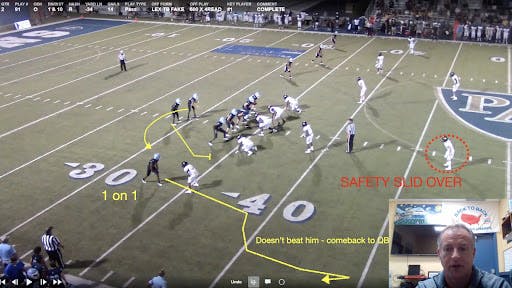
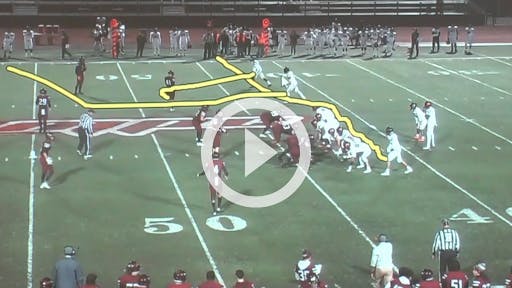
To start with, sprint out can be used from any type of formation 3x1, 2x2, 3x2, and 4x1. For Coach Kelley, it starts with something simple like a one-on-one to the single WR side.  The safety is slid over and not in a great position to help.  The WR will run and out-and-up but come back if he doesn’t beat the corner as illustrated below.

null

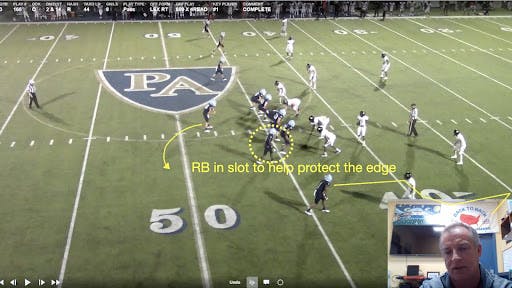
In this example, Coach Kelley moves the running back into empty to put him in a position to help on the edge.  The same out-and-up with comeback rule is run.

null

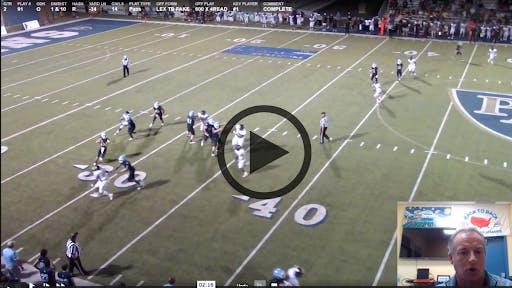
He illustrates the multiplicity of the concept and when run against looks that he shows is unstoppable when executed properly, Coach Kelley breaks down all of these examples in this video

null

Once more receivers are added to the sprint out, the possibilities of how to attack the defense expand.  Coach Drinkall likes to incorporate some form of smash with one route attacking vertically and another route attacking the flat.  He explains his outside concept in this video.

Many offenses utilize the Snag concept which allows for a quicker timing from dropback as well as multiplicity from the types of 3-man surface formations and personnel groups. Coach Marty loves the concept as part of his sprint-out attack.  Like Drinkall mentions, it does create a type of smash concept with a high-low to stretch the defense and attack zone coverage.  It also creates some natural traffic for defenders to negotiate which makes it a great man-beater as well.  He explains it here.

null

Those are just a few examples of how concepts can be adapted to sprint out.  The idea is to be efficient in teaching so that dropback and sprintout concepts do not need to be exclusive to one category.  The carry-over will cut down teaching and allow for route technique to be perfected.

Using Sprint Out Situationally

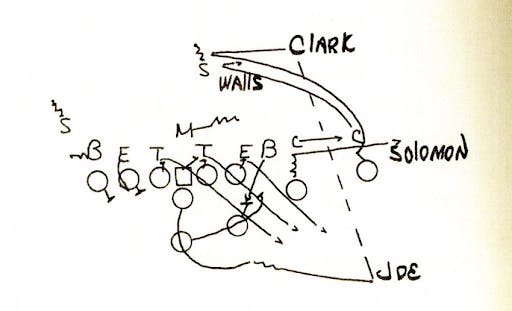
It fits into any field zone and virtually any down and distance.  Bill Walsh made a living on Sprint Right Option with his Hall of Fame quarterbacks Joe Montana and Steve Young.  Sprint right option is still a play that can be seen at every level of football. Many times it is a play reserved for the goal line area because it creates rubs and allows receivers to get open in an area with reduced vertical space. (see diagram below):

null

Coach Kelley carries an entire menu for this area of the field.  He shares his variations in this video.

Complimentary plays

In general, any effective concept in an offense warrants the use of complimentary plays.  Defenses work hard to take away effective plays thus opening opportunities to use other plays to exploit the weaknesses the defense creates to stop a concept.

Coach Drinkall thinks about how movement affects a defensive back who has to stop the sprint out and he creates concepts to take advantage of that.  

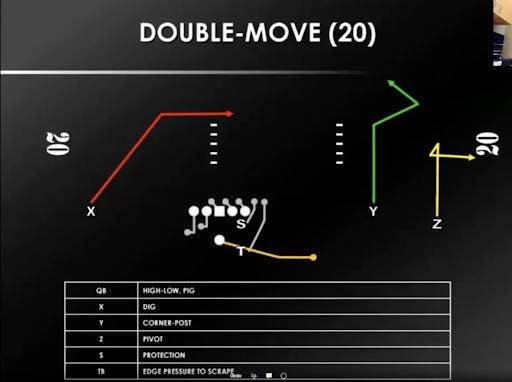
His first idea is to tag a double move which takes advantage of an overplay by the defensive back.  When the defender is jumping a corner route, utilizing a corner-post allows for a big play opportunity.  Remember, in his version of the sprint out, the QB sets his feet to throw, thus making this a viable option.  It would be much more difficult on the run for the QB. He illustrates it in this diagram.

null

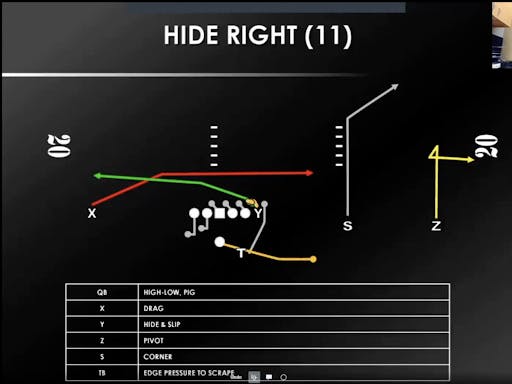
Compliments don’t have to be shot plays all of the time.  Simply attacking the linebacker movement to the sprint out side creates opportunities for a short pass and run after catch with a drag or shallow. 

null

In addition, throwback screens, sprint draws, and even trick plays can be built off of the sprint out concept.

Conclusion

Changing the launch point is a smart way to take away the effectiveness of pressure. Because it can incorporate the concepts used in dropback, it’s an efficient way to provide the offense multiplicity.  With a little thought, even a small package can be developed for an offense to realize these benefits.

Sunday, January 5, 2025

The Officer Tatum Show on US Sports: Rapper Ice-T LOSES IT On Cop and In What States Are Radar Detectors Legal to Use


In What States Are Radar Detectors Legal to Use

  • Author Jan

A fair amount of people that own cars in the United States have their own radar detectors. Their reason for having one is because they feel the speed limit presently is too low.

Most Americans are not satisfied with a moderate speed while driving. They want to be the fastest driver on the road, as well as get to the places they’re going to in record time.

The radar detector serves as their alarm whenever there are police near by. Once the radar detector alarm sounds, they can ease up on the gas pedal and slow down their speed.

The radar detectors work by picking up a signal from the policeman's radar gun. Unfortunately they are not effective 100%of the time.

Because of the radar detectors being used by so many motorist, cops have resorted to hiding in alleyways or behind bridges, in an attempt to avoid being detected by the radar detectors.

Motorists on the other hand are being clever themselves, they are aware of these tactics from the police. So to overcome the cops strategy of being deceptive, more enhanced, top-dollar detectors have entered the market.

Although the police are always improving their techniques of catching the radar detector users, they are not able to keep the road radar detector free.

Another form of radar detection are laser jammers. They work by transmitting an invisible light source back to the original police laser gun. The return signal confuses the laser gun and the officer is unable to clock the driver's speed.

Radar detectors are legal in many cities and states throughout the United States. But, in some of the states that allow radar detectors they have some restrictions.

I have prepared a list below that discusses the states with laws against radar detectors and the states with restrictions.

-Virginia, Georgia currently prohibits the use of radar detectors.

-The District of Columbia does not allow radar detectors. Radar detectors are also not allowed in all commercial vehicles and all vehicles over 18,000 pounds or heavier.

-Alabama, Alaska, Arkansas, Arizona, California, Colorado, Connecticut, Delaware, Florida, Georgia, Hawaii, Idaho, Illinois, Indiana, Iowa, Kansas, Kentucky, Louisiana, Maryland, Massachusetts, Michigan, Minnesota, Mississippi, Montana, Nebraska, New Hampshire, New Jersey, Maine, New Mexico, Nevada, New York, North Dakota, Ohio, Oklahoma, Oregon, Pennsylvania, Rhode Island, South Carolina, South Dakota, Tennessee, Texas, Utah, Vermont, Virginia, Washington, West Virginia, Wisconsin and Wyoming have all banned mounting radars and/or obstructions on the windshield.

-Missouri and North Carolina have no restrictions on window obstructions.

-Radar jammers are not allowed in any state. This is a federal law.

-Alabama prohibits radar detectors on all commercial vehicles.

-New York does not allow radar detectors on commercial vehicles over 18,000 pounds.

-New Jersey and Ohio prohibits radar detectors on all commercial vehicles.

Florida does not allow radar detectors on commercial and personal vehicles over 10,000 pounds.

-The following states permit radar detectors in private vehicles but not in commercial vehicles: Alaska, Montana, Iowa, Arkansas, Maryland, Nevada, Connecticut, Idaho, New Hampshire, Rhode Island, Pennsylvania, Indiana, Kansas, Arizona, Maine, Kentucky, Delaware, West Virginia, Michigan, South Carolina, Louisiana, Missouri, Tennessee, Nebraska, Mississippi, Wisconsin, Vermont, New Mexico, Hawaii, North Carolina, Massachusetts, North Dakota, Oklahoma, Illinois, Oregon, South Dakota, Texas, Utah, West Virginia, and Wyoming,

In Illinois, radar detectors are only regulated in commercial vehicles of over 26,001 pounds.

-On US military bases, radar detectors are legal to have but illegal to use. (??)

-Laser Jammers are illegal to use in California, Illinois, Colorado, Minnesota, Oklahoma, Nebraska, South Carolina, Texas, Utah, Tennessee, -Virginia, and Washington D.C. And since there is no federal law banning them, they can be used in other states.

If you are considering buying a radar detector be sure to know what your state's law is regarding the use of them. Also do some research on the different types of radar detectors available to suit your needs.

Before you start shopping for a radar detector, make sure you understand what options are available.

Such as:

Corded Radar Detectors

Cordless radar detectors

Remote-Mount Radar Detectors

The Factors:

Range

Filtering

Smartphone or GPS connectivity

Budget

Take your time in selecting the right radar detector. Lighten up on the heavy foot with the gas pedal and be safe.

Saturday, January 4, 2025

Matt Walsh Show Highlight On US Sports: You’ll Never Believe What This “Fat Consultant” Is Claiming and Maximizing your Athletic Recovery


Maximizing your Athletic Recovery | CoachTube

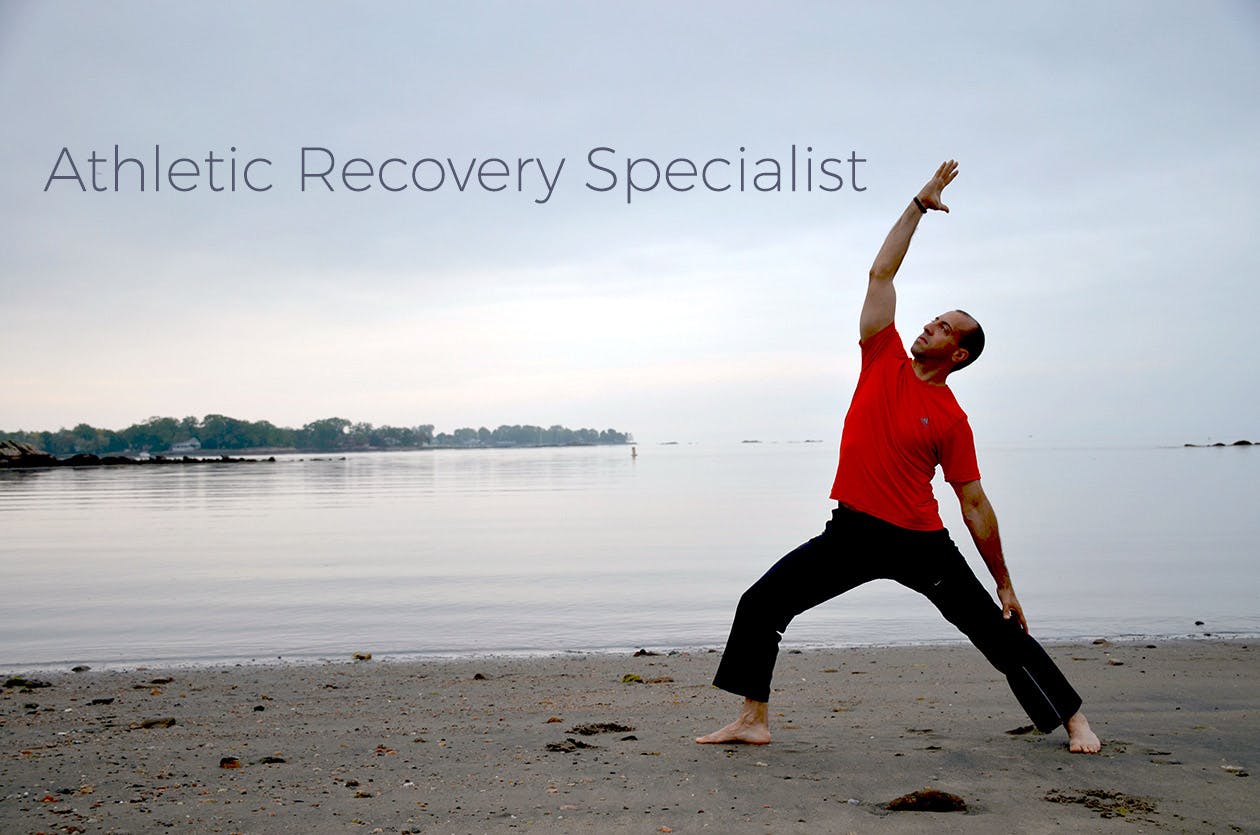
  • By Jason Papalio

Recovery is an undervalued and overlooked means of training and preparation for athletes. Building recovery into any training program is important because it’s the time the body adapts to the stress and stressors of exercise and the real training effect takes place. Recovery also allows the body to replenish energy stores and repair damaged tissues. Spending some additional time focusing on rest and recovery can pay dividends beyond additional training time.

You need enough flexibility to move well (movement prep and efficiency) and remain pain free. Do static stretching post workouts for at least 5 to 10 minutes or more. Attempt to self identify tight areas and work on them daily. The greater the training intensity and load on the body, the greater the need for planned recovery. Without sufficient time to repair and replenish, the body will continue to breakdown from intense training. An athlete's ability to recover from workouts is just as important as the training itself.

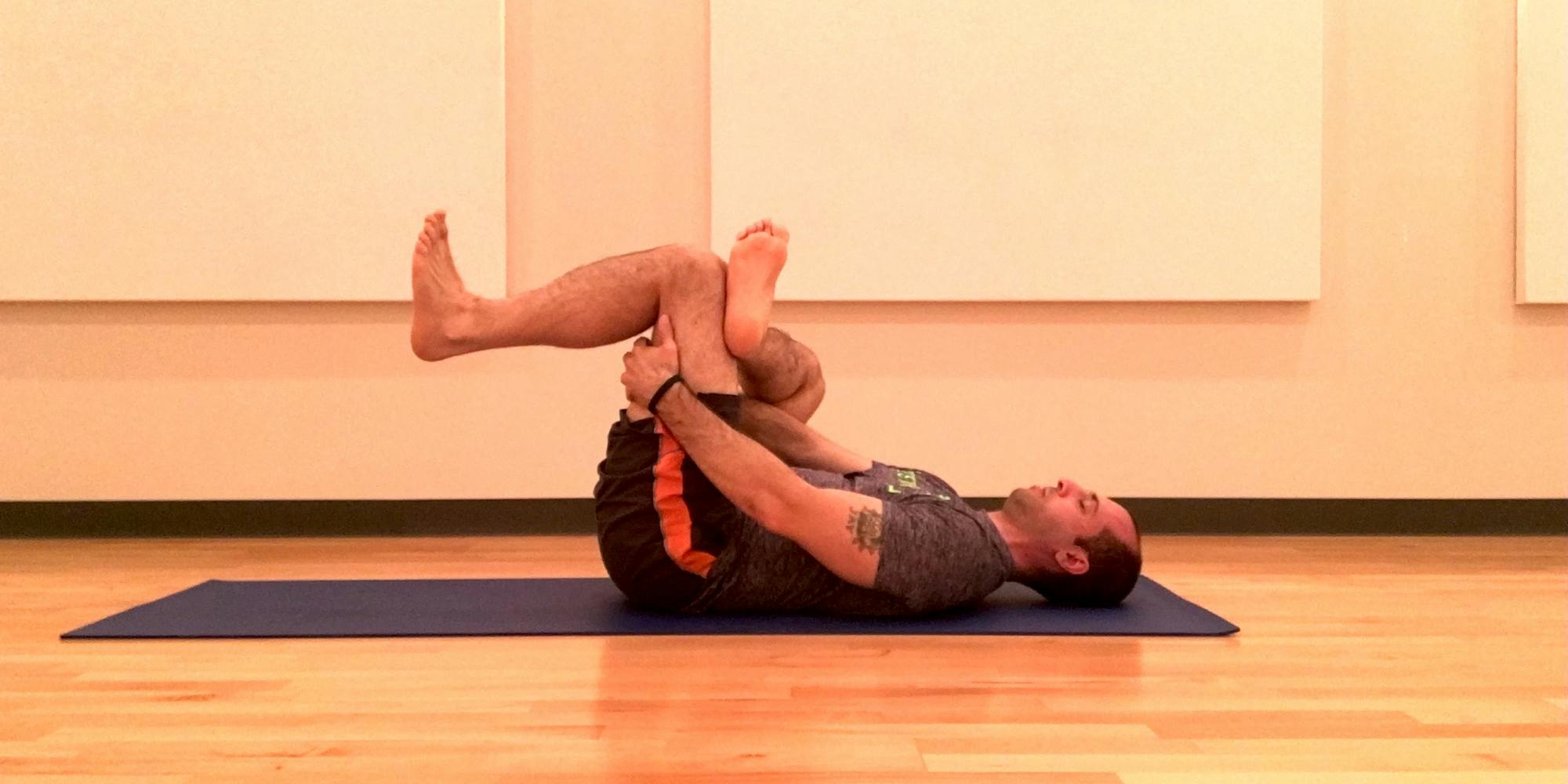
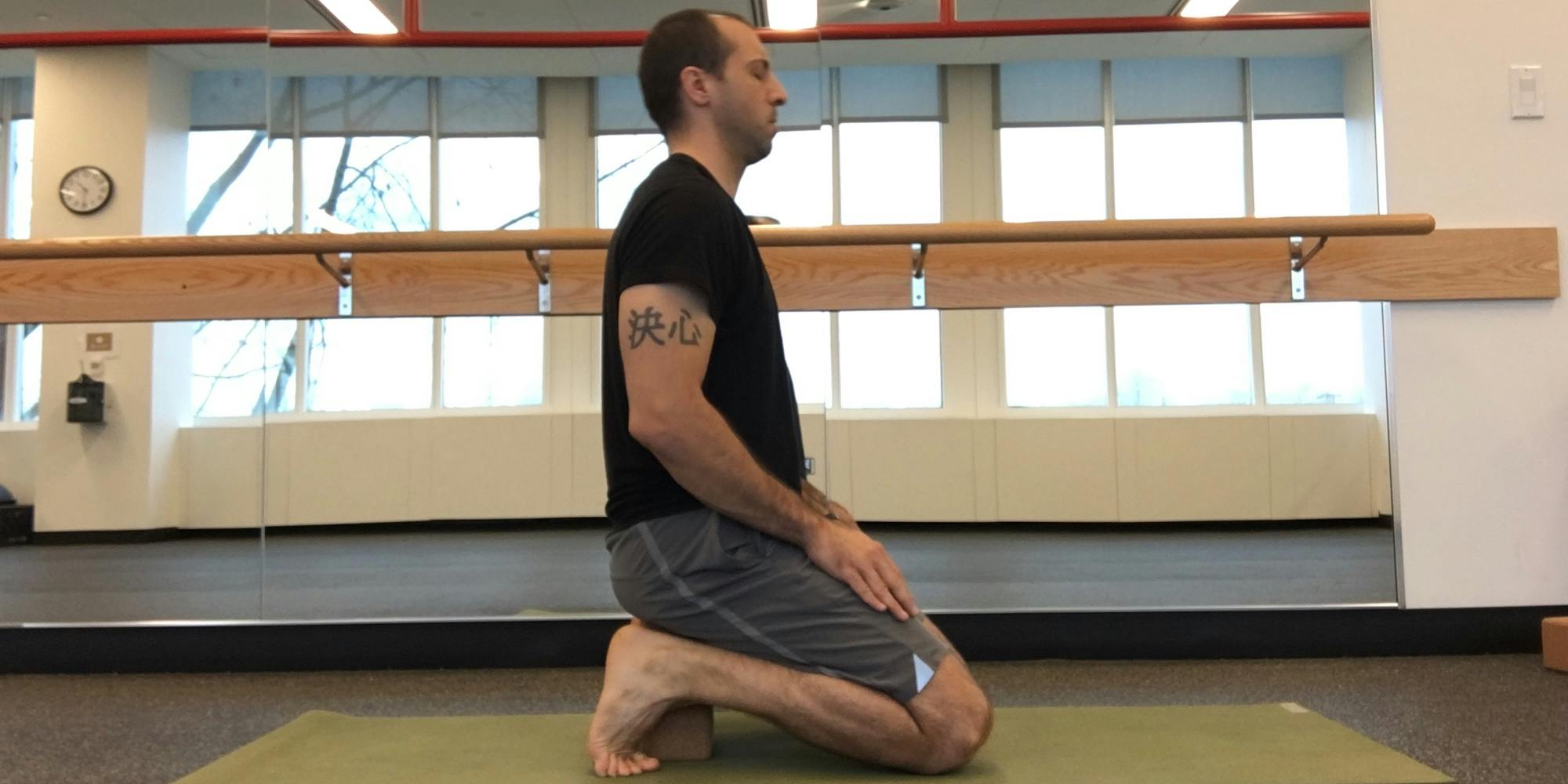
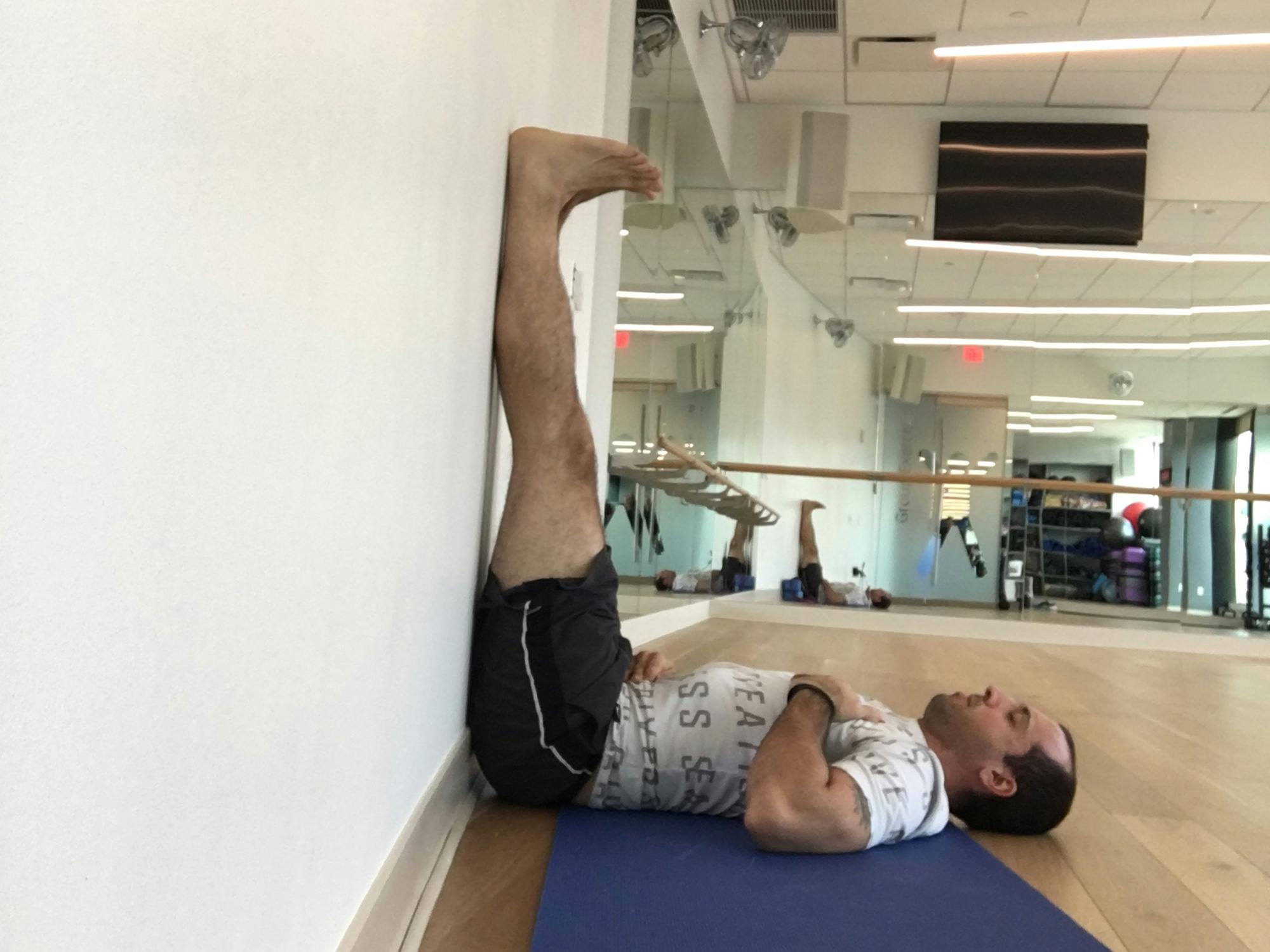
Perform the following 3 exercises after practice, at night before bed, after a game or on a lighter recovery day.

null

Hips are the cornerstone for athletes and movement within your sport (movement prep and efficiency). Open hips relieve the stress transferred to the knees when the hips are tight. Less knee strain means a greater range of motion while playing your sport and reduced risk to the ACL (anterior cruciate ligament)

null

By keep the toes as flexible as possible the impact that they face, day in and day out, play after play, is lessened and cases of: planter fasciitis & turf toe are reduced. Great to keep the shins free of strain and the tops of the feet open, again contributing to an increase in speed and movement efficiency.

null

Allowing our legs to find the rest they need is important to building long term strength and muscle adaptation.  Many athletes complain of feeling like their legs are heavy or their lower backs are hurting, and this pose will help alleviate common soreness experienced by the intensity of training.

Learn more about Jason and see his courses on CoachTube!

null