Now Streaming On US Sports Radio!

US Sports Net Today!


Live Play-by-Play, Updates, Highlights and More! on US Sports Network!
[Chrome Users-You may have to click on the play button twice to listen]
US Sports Network Powered By Gorilla Sports!


US Sports Radio
The Las Vegas Raiders Play Here
Fitness and Sports Performance Info You Can Use!
The Scoreboard Mall
The Rock Almighty Shaker Of Heaven And Earth!
The Coolest Links In The Universe!
Showing posts with label Softball recruiting video softball prospect 2026 softball recruiting video softball player softball team softball workout 1B 2b SS 3B Pitcher softball softball pitcher. Show all posts

Friday, November 28, 2025

US Sports Softball Coachlab Youth Softball Strength: A Guide to Foundational Training


Presented on US Sports by CoachTube.
Youth Softball Strength: A Guide to Foundational Training
by Austin Wasserman
The Youth SOFTBALL Strength Book: A Guide to Foundational Training was created to help youth athletes (Ages 7-14), Master the Basics and learn the Foundational Blocks of Strength Training!
Makes a great gift for the student-athlete and coach in your life!
https://tinyurl.com/YouthSoftballStrength

The Coolest Sports, The Hottest Talk, Music, and Fun.
News you can use.
US Sports Radio
http://www.USSportsRadio.net

Monday, November 10, 2025

US Sports Softball Feat. Kim Ng talks about the AUSL on SportsCenter


Presented on US Sports by CoachTube.

Featured course:
Drills, Drills, Drills: Hitting feat. Josh Bloomer
Move, Move, Move - Interactive session on ways/techniques to immediately help your players move in a more efficient way offensively. These drills can be used by players just learning to hit or hitters at the highest level.
https://bit.ly/4hReQp7

Video credit:
Kim Ng talks about the AUSL on SportsCenter from the espnW Summit
Athletes Unlimited
https://theausl.com/

The Coolest Sports, The Hottest Talk, Music, and Fun.
News you can use.
US Sports Radio
http://www.USSportsRadio.net

US Sports Coachlab Softball: Drills, Drills, Drills: Hitting feat. Josh Bloomer

Move, Move, Move - Interactive session on ways/techniques to immediately help your players move in a more efficient way offensively. These drills can be used by players just learning to hit or hitters at the highest level.

Learn more @ https://bit.ly/4hReQp7

The Coolest Sports Talk, Music, And Fun.
News you can use.
US Sports Radio
http://www.USSportsRadio.net

Thursday, October 23, 2025

US Sports Softball: Developing Hitters - Steve Singleton, Univ. of Texas and USA vs New Zealand Highlights


Developing Hitters - Steve Singleton, Univ. of Texas


The Coach

Texas head softball coach Mike White officially announced on July 1, 2019, the addition of Steve Singleton as an assistant coach on the Longhorns staff. 

A former shortstop and second baseman with the Minnesota Twins organization of Major League Baseball, Singleton possesses 14 combined years of college and pro playing and coaching experience. Book this course...

Prior to Texas, he spent two seasons (2017, 2018) as the hitting coach of the Fort Myers (Fla.) Miracle (High Single A) and was originally contracted to be the hitting coach for the Pensacola (Fla.) Blue Wahoos (AA) in 2019 before deciding to accept the open assistant coach role with the Longhorns. He served as the U.S. hitting coach for the 2018 MLB All-Star Futures Game and spent time with the Twins during 2019 Spring TrainingPrior to his time with the Miracle, Singleton led all offensive development for the rookie level Gulf Coast League Twins (Fort Myers, Fla.) in 2016. With the squad he served as both a first- and third-base coachAt the collegiate level, Singleton was previously an assistant coach and recruiting coordinator at Florida SouthWestern State College (Fort Myers, Fla.) from Jan.-Dec. 2015.  

Singleton served as the Vice President of Baseball Operations for Scout Sports (Sealy, Texas) in 2014, where he ran the scout baseball division, a high school recruiting, video and showcase company. He also spent time in 2013 as the hitting and head infield instructor for Baseball Rebellion (Durham., N.C.) An 11th round draft pick out of the University of San Diego (2006), Singleton played in 654 career games from rookie to AAA level as a shortstop and second baseman in the Twins organization. Singleton began his scholastic career at the University of San Diego before leaving school early when drafted by the Twins. He eventually went on to earn both a bachelor’s degree in sports management (2014) and a master’s degree in athletic administration (2017) from Southern New Hampshire University. He has two sons, Steven and Matthew.  Book this course....


Tuesday, October 7, 2025

US Sports Softball: Fastpitch Softball Conditioning Training and HIGHLIGHTS 🇲🇽 Mexico vs 🇺🇸 USA WBSC U-18


Sport specific conditioning or game speed practicing are not new concepts, but often overlooked is the different workout needs of softball position players. Softball athletes perform short explosive movements followed by time at rest, but each position has different amounts of rest time. Softball pitchers and catchers operate at a different interval than either infielders or outfielders. This at rest frequency difference needs to be taken into consideration during their strength and conditioning program. Many athletes now have specifically tailored fitness programs. Taking this into consideration, let us look at how a fitness program can be developed for three different groups.

The Power Hitters:

The power hitters are players whose greatest asset is their ability to generate bat speed through the strike zone. These players can hit home runs and for a high average. Power players defensively typically be the catcher or corner infielder players. For this group, the fitness program emphasizes the lower and upper body and core strength development. Conditioning sessions put added emphasis on incorporating medicine ball plyometrics for trunk torque and power development and improving speed-endurance to condition them for distances less than 40 yards.

The Speed Players:

The speed player's role is defined by their ability to quickly accelerate and maintain a high terminal running velocity. Offensively this group includes your slappers, single hitters and base stealers. Defensively, this group is usually your middle infielders and outfielders. Even though speed player's training emphasizes speed and agility, they can also be some of the strongest players on the team. Speed player's typical strengthening routine involves full body exercises like lunges and squats, with less of an emphasis on upper body strength. Agility can be enhanced through cone drills, ladder drills, and short shuttles. The speed endurance targets acceleration and running distances under 40 yards through resistance sprints and form running.

The Pitchers:

Arguable, the pitcher is the most influential player that effects the game's outcome. Not only do they need to be pitch explosively, but they also must have the endurance to pitch multiple games per week with, potentially, long innings. Their lower body and core must be exceptionally strong and powerful while maintaining wide range of motion and flexibility. Like speed players, pitchers strength training focuses are full body workouts with a slightly greater emphasis on lower body strength. Pitchers also need to do extra grip strengthening work and as hip flexors and adductors to improve lower body mobility.

Final Training Considerations:

Off-season and in-season fitness training sessions have dramatically different emphasis. In the off-season, a strong emphasis is placed on strength development and explosive power. Conversely, in-season training is for maintenance, fine-tuning, and injury prevention.

All three groups have the same basic training, but the amount of sets and repetitions differ depending of the areas of emphasis. All groups should perform full body strength training like squats, lunges, and plyometrics to develop strength and power. Injury prevention is also addressed with abdominal stability, full body flexibility, low back strength development, and shoulder and rotator cuff work. All groups also have conditioning days for endurance development where they run stadium sprints or shuttle runs. Over the course of a week, the athletes have covered all the strength and conditioning development areas, but with varying amounts of time based on their emphasis.

NYSS Find Their Strengths

Sunday, September 14, 2025

US Sports Softball: Softball Conditioning - Core Training is the Secret to More Power and Pitching by THSCA Softball

 Pitching

  • Author Marc Dagenais

We know that the trunk plays an important role in softball.

More specifically, the trunk and the muscles of the abdominal region are responsible for (1) generating rotational power and (2) stabilizing the trunk which necessary to transfer a maximum amount of power from the lower body muscles to the upper body (the trunk links the two). The power generated by the trunk and the lower body muscles (transmitted to the upper body through a stable trunk) are vital for actions such hitting, pitching, and throwing.

As you can see, it's very important for a softball player to have a stable, strong, and powerful abdominal region not only to be successful on the field, but also to prevent injuries.

This is why proper abdominal training is so important. However, too many softball players don't train their abdominal region properly. Too often, most of their abdominal training consists of leg raises and floor-based crunches and sit-ups. While these exercises help develop a "six-pack" and good-looking abs, they do very little to increase performance and prevent injuries.

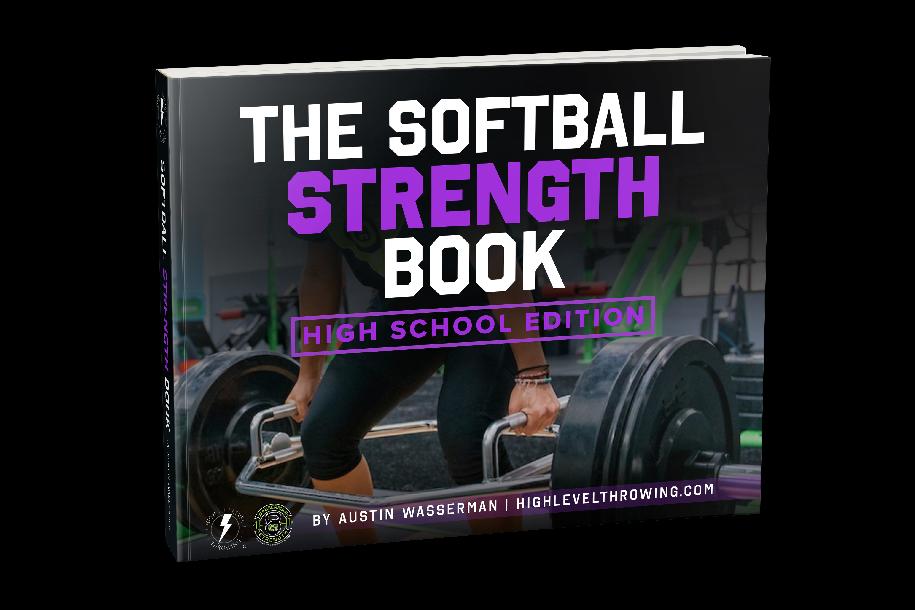
The Softball Strength Book: High School Edition 

The abdominal region is often referred to as the "core". However, the "core" is more than just the rectus abdominis (the "six-pack" muscle). According to many exercise specialists, the core can be defined as the lower trunk musculature. The major muscles of the lower trunk musculature are the rectus abdominis ("six-pack" muscle), the external and internal obliques, the transversus abdominis (deep internal abdominal muscle) and the erector spinae (lower back muscle). abs big Softball Conditioning Core Training is the Secret to More Power

Now, the problem with leg raises and floor-based crunches and sit-ups is that they mostly target one muscle: the rectus abdominis ("six-pack" muscle) and while it may help make you feel good about yourself by developing good-looking abs, this muscle doesn't contribute to the generation of rotational power or the stabilization of the trunk (transmission of power from the lower to the upper body).

In other words, it is a pretty useless muscle in softball. So, if your routine consists mostly of leg raises and floor-based crunches and sit-ups, you are pretty much shooting yourself in the foot!

Most of the influence in abdominal training comes from the bodybuilding field where the only goal is to make the abdominal muscles that you can see (mainly the "six-pack" muscle) bigger, more defined and good-looking. They really don’t care about performance but we do and that's why we need to do things differently.

To train your core properly, you must integrate into your routine exercises that will (a) involved many muscles of the core and (b) force the trunk to stabilize. The key is to target deeper abdominal muscles such as the transversus abdominis, a deep internal abdominal muscle that plays a key role in stabilizing the trunk and transferring power from the lower to the upper body. Any exercise that is not a leg raise or a floor-based crunch or sit-up (or a close variation of it) is likely to accomplish these two goals. Throw away that old-school and ineffective ab exercises and starts using innovative, highly effective core training exercises.

Marc Dagenais, MHK, CSCS, is a softball peak performance coach that helps players and teams hit with more power and be more dominant on the softball field. To get tons of great FREE softball drills to boost your game, visit us at: http://www.softballperformance.com/softball-drills

National Youth Sports Strategy

Friday, August 29, 2025

US Sports Softball: 3 Softball Drills To Do At Home and 2025 USA Softball All-Star Showcase: Game 1 Highlights


  • By Brandon Ogle

All while simply using regular household items to work on their game. It’ll not just get them more focused on the sport, but also at the same time, I’m sure you will see some rapid improvement with their on-field performance. Throughout this article, I’ll walk you through some at-home drills you can teach your players.

Drill #1: Posterboard Strike Zone

This drill you can do with a number of different things, but I’ll suggest using a posterboard. Grab some tape and create a strike zone on the board. Then, tape it about a foot off the ground. Once you have your strike zone built, head upstairs and grab a few pairs of socks rolled up (in other words, your softballs). The last item you’ll need is a camera. Anything will do here, you can even tell them to grab one of their parent’s phones. Set it behind where you’ll be pitching from and set it to record video.

Finally, now that you’re ready to practice, work on the motion of going through the windup and throwing the socks (i.e. softball) into the posterboard. With the video footage, you’ll be able to dissect the motion and overall throwing process. Some valuable insight that most youth players never evaluate.

Drill #2: Arm Strength and Hands Drills

A major part of being an effective softball player is having soft hands and a strong arm. An easy drill for this only requires a net or a wall. For the hands aspect of this category, all you have to do is throw the ball off the wall. This will allow you to practice various ground balls, short hops, and so on. Then, for arm strength, just use the wall as a way to practice throwing. Work on arm motion particularly here.

Don’t have a solid wall to use? No worries, just use a tennis ball and the garage. Trust me, it works just as well.

Drill #3: Take Some Cuts

This final drill might just be the simplest one for your players to practice. For this, they’ll just need a mirror and a bat. The player will get in front of the mirror and simply take full cuts while seeing in-person how their stance looks, as well as the swing. While it might sound like a nominal drill, it’s actually key to developing a consistent swing.

As for how often it would be recommended to do this drill, I’d suggest having them take 15-20 swings at a time on 3 different instances each day.

Practice, Practice, Practice!

In the end, one of your primary jobs as a youth softball coach is to develop the work ethic necessary to grow as a player and a person. Even though you won’t be working first-hand on these drills with your players, you will be the one responsible for growing their love for the game!

NYSS Twitter Focus on Fun

Thursday, August 14, 2025

US Sports Softball: Welcome to the Big Leagues and Indiana vs. Pennsylvania Little League Softball WS Championship Highlights

ESPN: Live Sports & Scores


  • Author Janine Tucker

Why is it that when you are faced with losing someone – the significance and impact they have made on your life becomes absolutely crystal clear? And all you want is just a little more time to say all the things…or get one last hug.

My dad passed away in October of 2021. What I would give to hear just one more life lesson from him.

Growing up, sports was a constant in my life thanks to my dad – who was also known as “Coach.” He coached my brothers and sister and me for as long as I can remember. Softball, basketball, baseball, soccer – he encouraged us to try all the sports.

I played softball when I was younger, yet dad made me practice with my brother’s baseball team – said it would build character.

Dad would come home from a long day at work and call for my brother and me and we would head out to the back yard to have a catch. Dad would talk to us about what it meant to be a good teammate. About the importance of discipline, taking care of your body and working hard to make your teammates look good.

He emphasized having grit and never giving up. I can hear him now – “Janine…I want you to realize that people are watching you. Your talents, no matter what they might be…will get recognized. Your work ethic and your mannerisms will get noticed….The energy you give off, the way you treat people is important.”

“Your actions…do speak louder than your words.”

His words prepared us for the times we would make mistakes, poor decisions or face obstacles in our lives. He would always emphasize it is what we do NEXT that counts.

He would say, “Janine, each roadblock you face is a steppingstone, a learning experience. Life’s battles don’t always go to the smartest, strongest or fastest, but to those who have the courage to fight on. Little did I know how those moments with him would shape my professional life and the person I am today.

My dad loved baseball. He had a short stint as a professional baseball player before he hurt his elbow. That experience gave him a story that he told again and again with such fervor and passion…it left an incredible impression on me.

This was his “Welcome to the Big Leagues” story and it went like this…

In 1955 my dad was in the army, stationed in Korea.

The most important personal items he brought with him were his baseball glove and a ball. He would throw every day with his best friend. They would run some sprints and throw some more.

His army captain at the time was Captain John Smith, brother of Mayo Smith – the manager of the Philadelphia Phillies. Captain Smith saw my dad pitching and made a phone call.

One day dad is pitching next to a rice field in Korea – the next thing he knows he is trying out for a professional baseball team.

When dad showed up that first day of spring training, he was shocked to see hundreds of ball players. He said to one of the coaches, “That looks like a lot of men trying out for one team.” The coach laughed and said, “Son, they’re just the pitchers.”

Doing his best to stay calm – dad took the mound for the first time – and faced a rookie outfielder, Felipe Alou. Dad was confident he could strike him out and fired a fast ball, right under Alou’s chin, just to loosen him up. His next pitch was a beautiful curve…Alou sort of lunged and fell as he was swinging at it.

Dad heard the “crack!” of the bat hitting that ball….

Now, they had this sign out in center field about 430 feet away and dad’s jaw dropped as the ball sailed over it.

In the third inning, Alou came up again. This time, dad threw him a fantastic knuckle ball – a pitch where the ball seems to be floating, but as it gets to the plate it dips and sinks drastically.

It’s just an impossible pitch and Alou looked silly when he swung at it.

Now about 400 feet down the left field line, the ballpark had these high-tension wires about 100 feet up…and that baseball started to rise as it got to those wires. Homerun #2 for Alou.

At the end of the game, my dad sat next to the pitching coach – a man who had been in the big leagues for some 20 years and asked, “Coach, how the heck would you pitch to Alou?” “You want the secret?” said the old coach. “I’ll tell you….get the men out who bat before him. Keep them off the bases. Then when he hits his triple or home run, he won’t hurt you too much.”

“You see – he’s a big-league hitter son. And you don’t stop a big leaguer.”

Those words stuck with my dad. Throughout his life, my dad showed me that the words “big leaguer” don’t just apply to baseball players.

There are big league truck drivers, waitresses, doctors, and teachers. Big league entrepreneurs, students, spouses and big-league human beings. My dad even wrote speeches about it – winning national contests across the country – inspiring thousands of people to shoot for the big leagues in sports, business and in life.

He encouraged people to “step up to the plate” – and strive to be a big leaguer in whatever path they chose to pursue. My dad taught me that Big Leaguers think about their destiny. They live with a purpose. They are ordinary people doing extraordinary things.

They push themselves, have a tireless work ethic, are competitors, are motivated. They aren’t satisfied with being good – they want to be great.

“Big leaguers are driven and inspired by those who have come before them.” – he would say. “They strive to realize not only their goals, but their potential. They want to make a difference.”

He would say, “Janine, there’s no place in the big leagues for short cuts, laziness, disorganization, or uninspired performance.”

As I look back on the countless times I heard his big-league story – and ALL the lessons that came with it – I realized he was preparing me for life as a coach.

I spent over 32 years coaching women’s lacrosse at the collegiate level.

My dad was so proud.

He knew the valuable lessons sports would teach about life and how those life lessons shape our character. My dad worked tirelessly to pass those lessons on to me and my siblings.

He taught us that when the playing of a game is over, it’s life lessons of decency, respect, sportsmanship, competition and fair play are never over.

I did my best to pass those lessons on to my players in honor of my dad and all the great coaches I had in my life. I just hope – when it is my time to leave this earth – My dad greets me at the Pearly Gates, gives me a big hug and says – “Janine, welcome to the Big Leagues.”

ISNation provides the resources you need and connects you to the people you need for every step in your sports journey. Learn more......

NYSS Twitter Be a Role Model

Wednesday, July 30, 2025

US Sports Softball: 3 Softball Drills To Do At Home and Coming Home featuring Oklahoma Softball Alumni


  • By Brandon Ogle

All while simply using regular household items to work on their game. It’ll not just get them more focused on the sport, but also at the same time, I’m sure you will see some rapid improvement with their on-field performance. Throughout this article, I’ll walk you through some at-home drills you can teach your players.

Drill #1: Posterboard Strike Zone

This drill you can do with a number of different things, but I’ll suggest using a posterboard. Grab some tape and create a strike zone on the board. Then, tape it about a foot off the ground. Once you have your strike zone built, head upstairs and grab a few pairs of socks rolled up (in other words, your softballs). The last item you’ll need is a camera. Anything will do here, you can even tell them to grab one of their parent’s phones. Set it behind where you’ll be pitching from and set it to record video.

Finally, now that you’re ready to practice, work on the motion of going through the windup and throwing the socks (i.e. softball) into the posterboard. With the video footage, you’ll be able to dissect the motion and overall throwing process. Some valuable insight that most youth players never evaluate.

Drill #2: Arm Strength and Hands Drills

A major part of being an effective softball player is having soft hands and a strong arm. An easy drill for this only requires a net or a wall. For the hands aspect of this category, all you have to do is throw the ball off the wall. This will allow you to practice various ground balls, short hops, and so on. Then, for arm strength, just use the wall as a way to practice throwing. Work on arm motion particularly here.

Don’t have a solid wall to use? No worries, just use a tennis ball and the garage. Trust me, it works just as well.

Drill #3: Take Some Cuts

This final drill might just be the simplest one for your players to practice. For this, they’ll just need a mirror and a bat. The player will get in front of the mirror and simply take full cuts while seeing in-person how their stance looks, as well as the swing. While it might sound like a nominal drill, it’s actually key to developing a consistent swing.

As for how often it would be recommended to do this drill, I’d suggest having them take 15-20 swings at a time on 3 different instances each day.

Practice, Practice, Practice!

In the end, one of your primary jobs as a youth softball coach is to develop the work ethic necessary to grow as a player and a person. Even though you won’t be working first-hand on these drills with your players, you will be the one responsible for growing their love for the game!

NYSS Stay In The Game