Showing posts with label William Bailey Earns All-American Status At NCAA Indoor Track and Field Championships Women's Track and field olympic. Show all posts
Showing posts with label William Bailey Earns All-American Status At NCAA Indoor Track and Field Championships Women's Track and field olympic. Show all posts
Want to make your athletes faster? Then you've come to the right place! In this course, Coach Jonas Dodoo offers his Speedworks training to show how his program can truly make your athletes stronger and faster. On top of that he even offers:
Debunking training myths
Case Studies on acceleration and improvements
Ways to prevent and minimize injury
With all of this, your athletes are sure to become faster, stronger, and have better acceleration with any sport they play.
Coach Jonas Dodoo is a world renowned sprints coach who is known for his technical expertise in sprinting.
Jonas developed his passion for speed and power at Hartbury College while being taught by and studying Coach Dan Pfaff. Coach Dodoo has worked with mutiple elite athletes across a range of different sports, while his main successes have been in Olympians and World Champions in track & field. He currently has a group of elite of sprinters from the National Institute at Loughborough and he is also a consultant at Premiership, Championship Football, and Rugby clubs working with their staff and first team players.
Two Points of Focus When Coaching and Training Hurdles
By Grant Young
Pinpointing and diagnosing mechanical issues in athletes can be particularly challenging for hurdle training due to several factors:
1. Complexity of Technique: Hurdling requires a
unique blend of speed, timing, and coordination, with the need to clear
hurdles efficiently while maintaining forward motion. This complexity
means that even small mechanical errors can have a cascading effect on
an athlete's performance. Coaches must be adept at identifying these
subtle errors, which can be tough given the fast-paced nature of the
event.
2. Variability Among Athletes: Each athlete presents a
unique set of physical attributes, including height, stride length, and
strength. These differences can influence hurdle technique, making it
difficult for coaches to apply a one-size-fits-all approach. What may
work for one athlete could lead to problems for another, complicating
the identification of issues.
3. Perceptual Challenges: Athletes often
perceive their own performance differently than coaches observe it. An
athlete may feel they are executing a technique correctly, while a coach
may see noticeable flaws. This disconnect can lead to miscommunication,
making it harder for coaches to accurately diagnose and correct
mechanical issues.
4. Subtlety of Errors:
Many mechanical issues manifest in subtle ways that aren’t immediately
obvious. For instance, slight misalignments in foot placement or body
angles may not be detected without close observation or video analysis.
Coaches need to be thorough in their assessments and often require
advanced technology to catch these nuances.
Because of these many factors, it’s important that coaches know
what to look for when assessing mechanical mishaps their athletes may be
dealing with during their hurdles. This is why we’ve pulled two points
of focus when training hurdles from two elite hurdles coaches that you
can keep an eye on next time you’re trying to decipher why your athletes
aren’t setting their personal bests.
Kenny Anderson - Training Focus
Kenny Anderson enters his fifth season as the Director of Track & Field/Cross Country at Central Methodist in 2024-25.
The
2022-23 season was a stellar year for Anderson and the Eagles, as 13
school records and one conference record were broken. The CMU Women won
their second-straight Heart Indoor Conference Championship, which
included five individual conference titles. As a result, Anderson was
named both the Heart Conference and the USTFCCCA South Central Region
Women’s Indoor Coach of the Year. Altogether, the Eagles garnered nine
NAIA All-American selections, the most at a single national meet in
program history.
One of his most crucial points in the clinic is that all training exercises and drills should be focused on producing the fastest time possible. Since that’s always the goal when competing, it should also always be the goal when competing.
Going off of this, training and drills should emphasize the rhythm of hurdles. According to Coach Anderson, rhythm for a hurdler is the type of speed that allows hurdlers to use their techniques to the maximum.
When emphasizing rhythm in drills, Coach Anderson likes to use seven, nine, or 12 hurdles, because he thinks that’s the sweet spot to establishing rhythm without doing too much to tire your athletes out.
Patience
is imperative when it comes to training hurdle athletes. If you’re
executing perfect practice plans, utilizing drills that emphasize
rhythm, and diagnosing all of your athlete’s mechanical flaws as soon as
they occur, it would still be illogical to assume you’ll see tangible
changes from your athletes’ times before six weeks. Coach Anderson says that usually, around six to seven weeks, he begins to see changes in his athletes’ times from the start of the season.
Jamie West - Common Technical Issue #1 - Take Off Spot
Jamie West has been a track and field coach for
15+ years. Coach West hurdled at Davis High School and went on to hurdle
at D1 Weber State University. Coach West was a 2-time state champion in
the 100m hurdles.
Jamie West has enjoyed coaching
hurdlers from all over the State of Utah as well as some hurdlers
nationally and internationally.
In her ‘Hurdle Drills, Technique, and Corrections’
clinic, Coach West discusses the most common technical issue she sees
during the take-off phase and addresses how a coach can fix it.
To her, the most common technical issue at this phase is the athlete taking off too close to the hurdle. Some other common ones are if
the hurdler isn’t aligned when they’re coming into their leap, with a
third one being the athlete either not planting or dropping their hips
when they enter the take off.
When the athlete is
jumping too close to the hurdle, the body will likely compensate by
pulling backward, the body’s momentum will go upward, and the lead leg
might have to be shifted somewhere off-center. All of these will slow the runner down considerably.
Coach
West also wants to make sure coaches are entering their take off on
their heel, planting firmly, rather than on the ball of their foot. This
is because all of that momentum that’s going into the ground with the
heel is going to propel the athlete when they commence their take off.
Training an endurance athlete can be a deceptively hard task for any track and field coach.
The
natural instinct when it comes to training any long-distance runner is
to, well, have them run. Yet, while running is of course a crucial
component to building up a long-distance runner’s endurance,
there should be much more that goes into their training regimen because
there’s a lot more nuance to being a good distance runner.
Perhaps the most crucial part of success as a long-distance
runner is building up stamina and endurance. And the best way to build
this without overworking your runners is to establish a challenging yet
doable training pace.
Having a training pace is great for a
few reasons. It improves a runner’s vVO2 max (the rate at which your
heart can pump oxygen to your muscles), conditions a runner’s lungs,
increases their top speed when competing, and makes them better equipped
for shorter races.
While finding a runner’s ideal
training pace can be a difficult task, there are few people in the world
better suited to help you do so than Houston Franks.
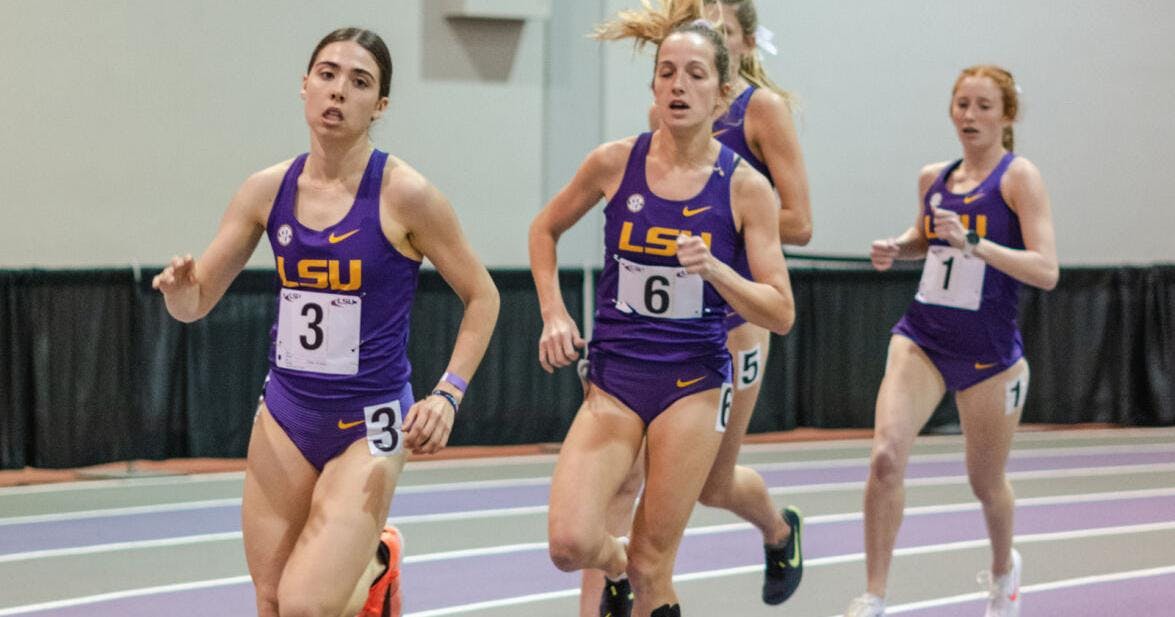
Coach
Franks is currently the assistant coach for LSU track and field’s
mid-distance and distance squads, in addition to being the head coach
for the cross-country team. And LSU’s distance program has flourished in
the past four seasons under Coach Frank’s direction.
The
2023 cross-country season saw Franks and the Lady Tigers tie the
program’s highest finish of third at the NCAA South Central Regional.
This came a season after leading LSU to the program’s first third-place
finish in 2022.
Coach Franks prides himself on the training pace that all of his LSU distance runners prepare for their races at. His ‘How to Find the Proper Training Paces for Endurance Athletes’
course discloses some of his best lessons on how distance coaches at
every level can help their runners find the perfect training pace that
will not only keep them prepared in a safe, efficient manner but will
also have them perfectly equipped to execute at their best when it
becomes time to compete.
Test to Get vVO2
The first part of calculating a distance runner’s ideal training pace is figuring out what their vV02 is.
As
we mentioned previously, a runner’s vVO2 is the rate at which their
heart can pump oxygen to their muscles, and is used to find their
maximal aerobic capacity value. While this sounds complicated to
decipher, Coach Franks has a relatively simple method of doing so.
Coach Franks believes the two
most effective training times/distances for calculating an accurate
vVO2 are by doing either a two-mile time trial or a 10-minute running
test.
Not only are both of these training exercises excellent for
getting an accurate vVO2 reading. But they’re each easy to do for a
large group of people. The two-mile time trial is especially easy to do
for an entire team at once because the coach can just wait at the end of
the two-mile mark and record what each of their runner’s times are.
From there, all the coach needs to do is calculate each runner’s pace per mile. This is why the two-mile run is especially easy, because it’s just each runner’s final time divided by two.
This
is how to get each runner’s vVO2. From there, a coach will want to use
that number and incorporate it to figure out what the ideal training
pace for each runner should be, depending on which race they run.
For
a runner who wants to find their ideal training pace for a 10k race, it
should be about 92% of their vVO2. 100% of a runner’s vVO2 is a great
calculator for about a 3,000m race, while 120-136% of their vVO2 should
be used for an 800m runner.
These percentages are going to vary depending on the level you’re
coaching. If you’re a high school coach, it might not be reasonable to
expect these exact percentages. But because you’ll be using each
runner’s specific vVO2, the percentages should more or less give you an
accurate estimate of what each runner’s training pace should be.
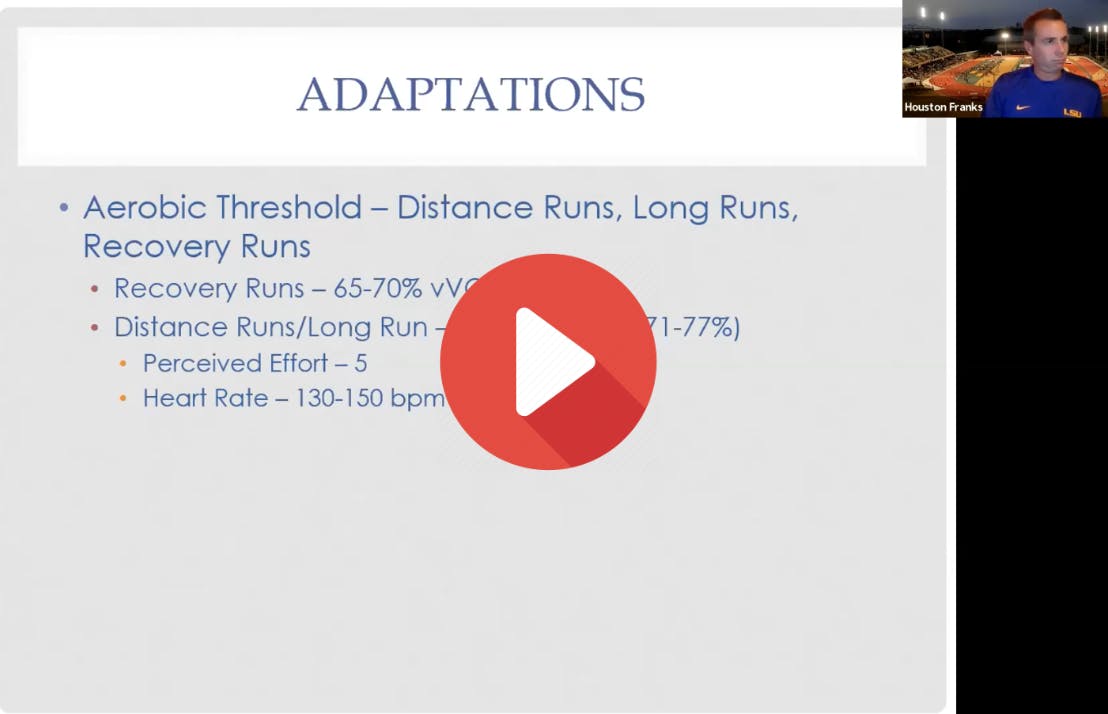
Aerobic Threshold
Coach Franks notes that a distance runner’s
aerobic threshold (a steady-state effort that the runner could maintain
for extended periods of time, where their breathing will be light and
they will not ever get exhausted) will be at around 65% of their vVO2.
Therefore, a recovery run pace after any demanding workout should be at around 65% at the slowest, but ideally would be closer to 70%.
A longer distance run training pace (that isn’t necessarily about training for a specific competition) should be at around 75% of that aerobic threshold.
If
a coach or runner wants to recalibrate whether this is an accurate
training pace, one way they can do so is by measuring their heart rate
while at their aerobic threshold. If it’s between 130-150 bpm then the runner is in a perfect spot.
Final Thoughts
An interesting thought Coach Franks had near the
end of his course was regarding the age-old debate about whether runners
should typically be training for a set number of miles or a set
duration/time.
Coach Franks believes this is going to differ depending on the athlete, coach, and/or team. But as
long as the runner’s ultimate decision blends a balance of effort,
individualism, and honesty with themselves about where they’re at in
their training journey (whether they’re competing for a specific race or
are in the offseason), whichever method they opt for should be
sufficient for succeeding.
Presented on US Sports Net by CoachTube Featured Course: The A-Z of Sprinting - Ryan Banta by Ryan Banta https://bit.ly/BackToTheBasicsOfSpeed Description
Want your sprinters
to become even faster? Then you've come to the right place! In this
course, Coach Ryan Banta reveals 6 different workouts you need your
athletes to be doing to reach new PRs. He also includes things like:
Biomechanics Plyometrics Cool Downs He even shows off the forms he uses for practice that will help your organization for practice. https://bit.ly/BackToTheBasicsOfSpeed
On today's show we have a hot sprint prospect out of Europe, and a look back the best of the indoor season. Enjoy
Video credits: College Track & Field Recruiting Video - Quinten de Vos - Fall 2025 - Slamstox Learn more with the Slamstox app https://apple.co/3UMg7Us
Presented on US Sports by CoachTube. Featured course: Strength Training for Sprinters: Improving Athletes Globally by Ryan Banta https://bit.ly/3wrb3Lr In
this course, you will learn the step-by-step methods of building a
unique weight program for your athletes. Strength training is critical
for all sports. However, it's the "when" and "why" that might be the
most important factor in developing strength. Join me as I educate all
coaches on how to keep athletes from getting stuck at performance
barriers and provide proven methods to maximize their potential. Get started today! https://bit.ly/3wrb3Lr
America's fastest
man and the 60m record holder went head-to-head for a national title and
by a mere one one-hundredth of a second Noah Lyles held off rival
Christian Coleman for the victory as both clinched spots at Worlds in
Glasgow From NBC Sports https://apple.co/3xD3Fey https://amzn.to/3uLljhc
WASHINGTON (May 23, 2023)
- Howard University track & field program sends more than a dozen
Bison to Jacksonville, Fla., to compete in the NCAA East Preliminary
Round. The four-day event (May 24-27) will take place on the campus of
the University of North Florida.
FOLLOW THE ACTION
Tickets for the 2023 NCAA East Preliminary Round are available
here.
Bison Nation can also follow all the action via ESPN+ and/or
live results.
MEET PREVIEW
Thursday (May 18),
the National Collegiate Athletic Association (NCAA) unveiled its
Division I Men's and Women's Outdoor Track & Field Championships
First Round Preliminaries where HU led the Mid-Eastern Athletic
Conference (MEAC) with more than a dozen Bison.
Overall, HU saw a
program-best 16 Bison on the qualifier list, including 11
student-athletes competing individually. Furthermore, The Mecca is the
only institution in the league with a relay squad making the
cut (men's 4x100 and women's 4x400).
MEN
Four Bison are competing in the 110-meter hurdles, led by graduate
Dylan Beard (Baltimore). Entering the meet, he has the second-fastest time in the nation (13.29).
Seniors Jermanie Byrd (Miami Gardens, Fla.) and
Kameron Davis (Miami) and junior Zachary Hawkins (Lithonia, Ga.) joins Beard in the event.
Senior sprinter Ashton Daniel
(Athens, Ga.) represents HU in the 200-meter dash after posting a
qualifying time of 20.71 at the MEAC Outdoor Championships (May 9-11).
Howard’s 4x100 relay squad looks to keep its season alive after running a school record 40.00 in Norfolk, Va.
In the field, second-year Bison
Chase Drewery (Waldorf, Md.) takes part in the triple jump after leaping 15.43 meters at the conference championships.
WOMEN
All-American senior Jessica Wright (Durham, N.C.) and junior
Darci Khan (Stockbridge, Ga.) headline the women’s side.
Wright looks to make the National round for second straight year in the 400-meter hurdles, producing a 55.81 time (4th in the country) at the Tom Jones Memorial (April 14-15). Freshman
Aniya Woodruff (Harrisburn, N.C.) joins Wright in the event, clocking in at 58.37 (MEAC Outdoor Championships).
Khan enters the week
with the nation’s ninth-fastest mark in the 100-meter hurdles,
recording a 12.96 time at the Texas Relays (March 29-April 1). Fellow
classmate
Kaya-Rae Dunbar (Burtonsville, Md.) will also compete in the race after posting a 13.40 mark at the conference championships.
Second-year Bison sprinter
Tiffani-Rae Pittman (Bowie, Md.) represents HU in the 100-meter (11.45; Texas Relays) and 200-meter dashes (23.29; MEAC Outdoor Championships).
This year’s 4x400 relay squad looks to get back to the National level, running a 3:31.24 mark in Austin.
UPCOMING SCHEDULE
Qualifiers from the
meet will advance to the 2023 NCAA Outdoor Track & Field
Championships, which will be held June 7-10 in Austin, Texas.
College track recruiting video of Kyra Keurentjes, available fall 2018 [Video Below]
MADE scholarships helpt scholieren en studenten bij het verkrijgen van een studiebeurs in de sporten tennis, golf, zwemmen, hockey, atletiek, voetbal, basketbal, volleybal, honkbal, softbal, skien, ijshockey. Kijk voor meer informatie op http://www.madescholarships.com/nl of neem contact op via info@madescholarships.com
Made Scholarships can help you find financial aid for American universities, to play college sports in the USA. We help student athletes obtain scholarship for tennis, golf, swimming, field hockey, track and field, soccer, basketball, volleyball, baseball, softball, Sji racing, icehockey.
For more information please visit www.madescholarships.com or contact us via info@madescholarships.com Presented On US Sports Net By CoachTube Track and Field!
In this course you will learn how you can significantly increase sprint speed without additional sprinting. It is a well proven method based on improved sprint technique and development of strength specific to the technique.
Session 1. Introduction and background Session 2. Sprint technique (form) Session 3. Muscle actions Session 4. Strength training Session 5. Explosive strength training Session 6. The training program
Coach Credentials
Dr. YessisFounder of Sports Training, Inc, Professor Emeritus at Cal State
Dr. Michael Yessis received his Ph.D. from the University of Southern California and his B.S. and M.S. from City University of New York. He is president of Sports Training, Inc., a diverse sports and fitness company. Dr. Yessis is also Professor Emeritus at California State University, Fullerton.
Dr. Yessis has served as training and technique consultant to several Olympic and professional teams. He is considered an authority in technique analysis and enhancement and the creation and application of specialized strength exercises to develop and improve physical abilities and sprinting is a leader in sprint analysis and enhancement with specialized strength exercises.
He is a contributor to Football Gridiron and has written more than 2,500 articles on fitness and sports training that have appeared in magazines such as Muscle & Fitness, Shape, Scholastic Coach, Fitness Management, National Strength and Conditioning Association Journal, Track and Field Coaches Review, Peak Performance, Running Times. Book This Course Today!
Coach Geopfert reviews the long jump and breaks down his coaching methods into three distinct areas. First, proper runway mechanics and sprint training is reviewed. Next, takeoff drills are demonstrated using boxes to improve body alignment and jumping power. Finally, two in-air techniques and special landing exercises are shown to develop the best technique for the athletes jumping style.
Travis Geopfert · National Assistant Coach of the Year· 5 NCAA Champions· 55 All-Americans · 63 Conference Champions · 87 NCAA Qualifiers · 2013 NCAA Team Champions 2014 National Assistant Coach of The Year, Travis Geopfert coaches at the University of Arkansas and leads the Razorback field events. Travis is recognized as one of the best coaches in the United States. His athletes have won NCAA Championships, SEC Championships and had world-leading performances. Coach Geopfert is recognized across the globe as a world-class coach in long jump and triple jump, taking athletes to the Olympics and World Championships. Coach Geopfert has also coached on several international teams for the United States of America. Coach Geopfert has helped the Razorbacks win multiple SEC Championships and NCAA Championships, his athletes always out perform the competition, winning titles and earning All-American honors year after year. Now, you can learn his methods and training program with this exclusive coaching course produced by Digital Track and Field.
Antonio Garcia | Track and Field Scholarships | Athletes USA | Recruiting Video
Speed Training Workouts
By: William Collins
I am about to reveal the key of productive athletes with regards to getting more muscle and quicker motion within their efficiency. As a tennis coaching instructor I wondered why there was no enhancement in efficiency with my coaching drills. I discovered that my aged coaching plan would only create more powerful athletes rather than faster ones. Fortunately I did not give up. I soon studied new methods to assist me and found these speed training workouts which may be completed in your own home without the aid of a coach. The regimen is simple to execute and only took me about twenty minutes to go through the session. Speed Training Workouts: Plyometrics What I’d like to show you are the straight forward and easy plyometric workout routines. Plyometrics are basically a sort of aerobics workout routines in which the muscle tissues are stretched prior to it. This will enable it to contract with better force. Unlike other routines, this would build your muscle tissue for velocity and quickness. Plyometric workout routines are important and need to be executed properly, however the types that I learned will be the straight forward ones. Some of the plyometric exercises that I went through are: mountain climbers leap squat, burpees around the floor, runner lunge and facet hurdle hops. Right after my workout, I could already feel the contraction of my muscle tissue.
Speed Training Workouts to Increase Efficiency and Velocity Usually, this workout not only raises your speed but also velocity, strength and power. Additionally, it is secure and enjoyable when the exercise is properly carried out. It does not call for any coaching devices to execute these workouts and also you do not need to go to a court, a gym or outside to carry out these routines. These workouts could be done nearly any place in your house at any time of the day. The plyometric workouts not only increased my efficiency but also my skills. The outcome was apparent right after a couple of days of instruction. I even surprised my training partner with my overall performance. Quicker muscle tissues are great and benefit just about any athletic ability like sprinting, kicking a ball, swinging a bat or catching a ball. It assists with pace and energy that are essential when you are trying to outmatch your opponent. Keep in mind that muscle tissues can increase velocity and quickness provided that you make certain you follow the right instructions and technique. Make certain to warm-up completely just before beginning on these plyometric speed training workouts.
A woman naturally has more fat-as
previously mentioned, 10 percent than that of an equal well-trained man.
As the fat is a kind of limited fuel in the activity of durability
(birds' migratory basically rely on fat), women can run for very long
without "hitting the wall", that is, the fuel exhaustion and your legs
have to move slowly with difficulty to the painful moment. Nena Cusick
said to me, "I have taken part in the marathon game 35 times and never
hit the wall. Though I was, I could hold out." It is generally
admitted that more proportion of fat means less proportion of muscles.
However, some study reports demonstrate that compared to the muscles per
pound, women are as strong as men.
It is quite the contrary to a
fantastic statement. Gathering the materials provided by 361 schools,
more than 125 track coaches and several public reports, Doctor Kristin
New Jersey Medical College Joan Gillet from Nevada University came to a
conclusion that a woman as well as a man who is well trained is not apt
to be injured. One exception is women's knees are a bit likely to be
injured for their joints are softer. Moreover, women benefit by
exercise as much as men do. Leroy Gushier and J Moore made a comparison
of men to woman under a close supervision plan. They says that women's
state of health are amended as men after exercise in the Document of
Physical Medicine and Function Recovery. Someone holds that men need and
benefit from exercise, while women dose not. That is no more than a
fraudulent myth. This view is particularly dangerous after menopause,
because some parts of the heart immune system of women have disappeared,
and they start to have a heart attack as easily as men. Then why do people generally consider women as the second-rate citizens in terms of track and field. The main reason seems to be the aspect of culture. Catharine Reims does
not only think deep in the problem but also take many of her
conclusions into a sensible and insightful book called Running for
Health. When I converse with her, she talked indignantly about how the
society complicit in blocking women from discovering the pleasures of
athletics. She said: "women are conscious that they are spending too
much time on sitting. But no one has ever told them to go out and learn
an exercise as men. Women are only told to make a graceful bending down
posture when doing household duties so as to achieve the goal of
exercise. If you were a woman, people would always urge you on taking
some stupid exercise at home, in the office or on the way to market
hall. This results from cultural prejudice".
US Sports Network News! Having fun and helping the peeps'. Using Sports as a platform to Inform, Educate, Inspire, While Entertaining you with the best of sports, talk, music, and fun. Be on the lookout for our frequent 'Teachable Moments' This will be a sports and media experience like you never expected. We always welcome your feedback. If you like us or even if you don't, we are always going to love you! Thanks for stopping by!