Showing posts with label Baseball player baseball coach NCAA Baseball 2027 Baseball recruiting High School Baseball MLB Baseball draft prospect. Show all posts
Showing posts with label Baseball player baseball coach NCAA Baseball 2027 Baseball recruiting High School Baseball MLB Baseball draft prospect. Show all posts
The MLB App is the #1 destination for live baseball video and audio, directly on your iOS device. Watch and listen live or on-demand! Free download @ The Apple Store @ Amazon
Presented on US Sports by:
XTERRA Fitness helps people realize their fitness goals through durable and expertly designed equipment. From training programs to advanced features, XTERRA Fitness products provide everything needed to bring adventure and achievement home.
Former Dodgers great Sandy Koufax said, “I became a good pitcher when I stopped trying to make them miss the ball and started trying to make them hit it.” Although Koufax was known for his knee-buckling curveball, this quote applies perfectly to the art of a sinkerball. The sinker isn’t designed to be a major strikeout pitch. It doesn’t have the coolness factor of a 100mph fastball or a 12-6 curveball, but it does do one thing effectively: get hitters out.
The sinker is effective because it consistently forces hitters to turn over on the ball and induce a ground ball. Keeping the ball on the ground in the infield provides a number of ways to record outs. For example, take a situation where there are runners on the corners with one out. If you want to get out of this jam without anyone crossing home plate, you have two strategies to work towards. If you possess a dominant strikeout pitch, then you can go for the strikeout and then attempt to get the final hitter out. However, not everyone has nasty strikeout pitches they can lean on in jams. In this case, you try to get the hitter to turn over into a ground ball double play. In essence, this is the core use for a sinker.
Understanding the Grip
The nice thing about the sinker is that it isn’t a difficult pitch to learn the grip and release for. In fact, you can start out with the same grip as the two-seamer. Helpful Baseball Drills Provides a terrific narrative on how to get this grip.
“Place your index and middle fingers over the seams where the seams are closest together. With the sinker you could try placing the index and middle fingers on the outside edge of the seams. And the thumb rests directly underneath these two fingers in the open area on the baseball.” The more pitches you learn how to throw, the more you’ll realize the importance of mastering the grips before even learning how to throw the pitch.
Release: Tighter Grip
No matter what sinkerball pitcher you talk with, they’ll all stress the importance of a firmer grip. As evidenced by an MLB.com article, this grip creates friction against the air and “is what makes the ball sink, but it’s also what makes the pitch a few miles per hour slower than a normal fastball.” As a result, you witness a greater break in your sinker pitch. Another important note in terms of the release is to always keep your hand and fingers on top throughout the release. This will ensure the sinking occurs in a downward motion. As you can tell, there isn’t much to the release, but it is still critical to practice the release because one miscue can lead to batting practice taking place in an actual game.
Less Stress on the Body,Longer Outings, Longer Careers
In today’s baseball environment, one of the players most susceptible to major injuries is pitchers. Whether it be shoulder or elbow injuries, youth leagues are placing more and more restrictions on the amount of innings and pitches that can be thrown to attempt to diminish these risks. The sinker is a perfect weapon to combat these injury risks that are much more common when throwing higher percentages of curveballs or fastballs. The wrist doesn’t get twisted much, nor is there significant torque placed on the elbow or shoulder, which is a plus. Helpful Baseball Drills provides a great tidbit to lessen the risk even further. “Trying to apply the most pressure with the middle finger keeps the arm flowing in a natural motion, and less likely of an arm injury.” By focusing on characteristics like this, the sinker can be an arm-preserver for youth pitchers looking to take their careers to high school and beyond.
Keeping Hitters Off Balance: Mix-and-Match Pitches
Despite all of the positive qualities of a sinker, I’m not trying to persuade pitchers to scratch all of their pitches and throw 100% sinkers. It can be a terrific situational pitch complimenting others. The best all-around pitchers have a number of above-average pitches in their arsenal. With this said, I suggest pitchers work on mixing-and-matching their various pitches. As Warren Spahn once said, “Hitting is timing. Pitching is upsetting timing.” The best way to offset their timing is to have numerous pitches coming out of similar arm angles in a manner that the hitter doesn’t know what’s coming next. As I mentioned in the grip section, it has a similar grip as a two-seam fastball, but with a slightly altered release. If thrown successfully, the hitter could guess a heater is coming before it quickly dips on its way to the plate, thus inducing a grounder. The key is to focus enough time on the sinker just as you would for a curveball or changeup.
A Sinkerball Pitcher’s Worst NightmareAvoid Hanging the Sinker
If a sinker ball pitcher is hanging his pitches, then a baseball game can start to look like batting practice in an instant. This is because when the sinker is thrown up in the zone, it won’t experience the break that makes it so successful. For this reason, it’s easy to see why the sinker is a much more effective pitch for control pitchers as opposed to power arms. Much like a hanging curveball, the hanging sinker can be a bad omen for pitchers. After all, the point of a sinker is to induce ground outs and not fly outs. So, as a result, the pitch should start at the belt before breaking.
Top Sinkerball Arms in the Game
In recent years, we’ve seen a number of pitchers combat their lack of pitch speed with a ground ball-inducing sinker. Here are a few that have dominated the pitch:
-Brandon Webb – Despite struggling with injury issues, Webb possessed one of the most dominant sinkers of his era. Combated with a nasty changeup, curveball, and a fastball, Webb won the 2006 NL Cy Young Award. Thanks to his impressive arsenal of pitches, Webb wasn’t merely just a ground ball pitcher, but also racked up a solid number of punch-outs in his career.
-Chien-Ming Wang – The former New York Yankees’ pitcher has struggled with injuries in recent years. However, during his prime, he consistently stifle hitters with a power sinker. The unique part about his sinker was the speed he threw it with, as it consistently sat in 91-94 mph range. Furthermore, the efficiency he had in regards to the sinker’s command allowed him to achieve so much success early in his career.
Keep It Low
The best piece of advice I can give to an aspiring sinker is to keep the ball low. As I mentioned numerous times, a hanging sinker is a pitcher’s worst nightmare. It is nothing more than an average batting practice pitch. At the same time, don’t forget about perfecting the rest of the pitches in your arsenal to keep hitters guessing. In the end, you know the sinker is working when the hitters are hitting the ball on the ground.
Sports help kids build confidence and grow into healthy, active adults. Learn how organizations, communities, and policymakers can use @HealthGov’s National #YouthSports Strategy to support youth sports: https://bit.ly/2lQ85f6
Maidenform.com offers bras, panties and shapewear for modern women with their own fashion sense. Shop for t-shirt bras, bralettes, push-up bras, thongs, hipsters, boyshorts, body shapers and more at attractive prices.
Being able to throw strikes is the most important part of youth baseball pitching. We have all seen youth baseball games that drag on forever because the pitcher can’t put the ball over the plate.
While most kids are worrying about trying to throw the ball as hard as possible, or asking when they can learn how to throw a curveball, actual success on the mound stems from throwing consistent strikes.
And because a kid’s enthusiasm for baseball is strengthened by succeeding, teaching kids how to be accurate while pitching is a paramount part of increasing their enthusiasm for the sport.
Coach Scott Shepperd knows a thing or two about properly teaching pitchers. Shepperd recently served as pitching coach at the University of Texas, San Antonio for two seasons. Prior to that, Shepperd was the pitching coach for Hallmark at Incarnate Word the previous two seasons. Under his tutelage, the Cardinals pitching staff lowered the team's ERA by more than three runs per game. His nine years of coaching at the Division 1 level have taught him a ton about what it takes to build and maintain a successful pitching staff.
And while succeeding in Division 1 baseball requires much more than succeeding at the game’s lower levels, the first and foremost part of the equation is throwing strikes.
Shepperd’s ‘Developing Strike Throwers’ course takes coaches through all of the different components of teaching accuracy on the mound. He details the various mental and physical aspects that go into this endeavor, and we have pulled a few of our favorite lessons from Shepperd’s course, and distilled them into easily digestible sections that should provide you with a better idea of how to make your own pitching staff throw consistent strikes.
One of the most common misconceptions when it comes to throwing consistent strikes is that pitchers should remain on the corners of the strike zone. This is often because young catchers will be setting up on the outside corner, prompting their pitcher to throw it there because they’re afraid of their pitcher leaving it over the middle.
Aside from when the game plan is to expand the zone in a strikeout situation, Coach Shepperd instructs his catchers to always set up over the strike zone’s middle.
“We’re encouraging the pitcher to throw the ball over the plate, and encouraging contact,” Coach Shepperd says.
He then discusses how he never uses the term “perfect pitch” with his pitchers. The reason he avoids doing so is because it makes pitchers feel a need to pinpoint a ball to a specific spot, rather than execute their pitch to one segment of the strike zone. And this usually doesn’t lead to good outcomes.
One important point Coach Shepperd alludes to in this section is that the art of executing pitches has just as much to do with the catcher as it does with the pitcher. The way a catcher sets up, frames, and generally receives the ball can often be the difference between a ball and a strike.
This is important for youth catchers to understand as well, so they can keep that in mind as they continue to progress in the sport.
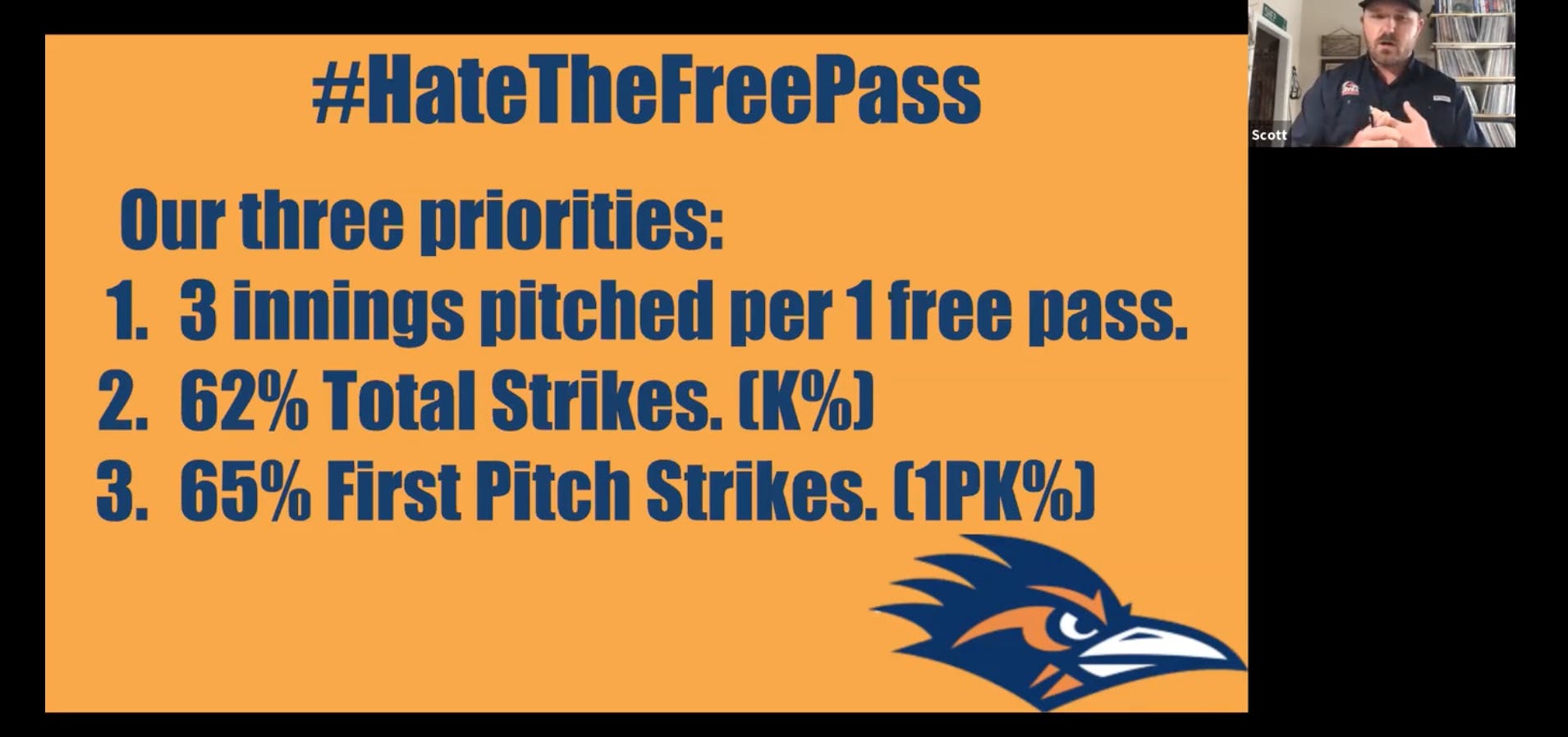
Coach Shepperd keeps his pitching staff’s focus on three priorities when they’re on the mound. Those three priorities (in order) are:
1. Only allow 1 free pass for every 3 innings pitched.
2. Have a 62% strike percentage.
3. 65% first pitch strikes.
The first priority is simple. For every three innings pitches, only allow one free pass (a walk or a hit by pitch). This equates to less baserunners, which equates to less runs scored and more games won.
The reason that Coach Shepperd decided on 62% for total strikes is because that was the MLB average for strikes that were thrown in the season he created these three priorities. And since then, Coach Shepperd has found that if his pitching staff has thrown 62% or more strikes in a game then it usually amounts to a good performance.
Coach Shepperd notes that the 65% first pitch strikes is the third priority because it’s the toughest to achieve. Yet, he keeps it at that number because it gives his pitchers a reachable goal, but is still tough.
Of course, none of these numbers are realistic if you’re coaching youth baseball. But the point is that regardless of what level you’re coaching at, minimizing free passes, throwing strikes, and throwing first pitch strikes should be a central priority for you.
Another important point Coach Shepperd drills into his players’ heads is that they’re in control of the game. They have the ball in their hand, and they’re in the diamond’s center. Yet, all they need to do is hit those three priorities to be a hero for his team.
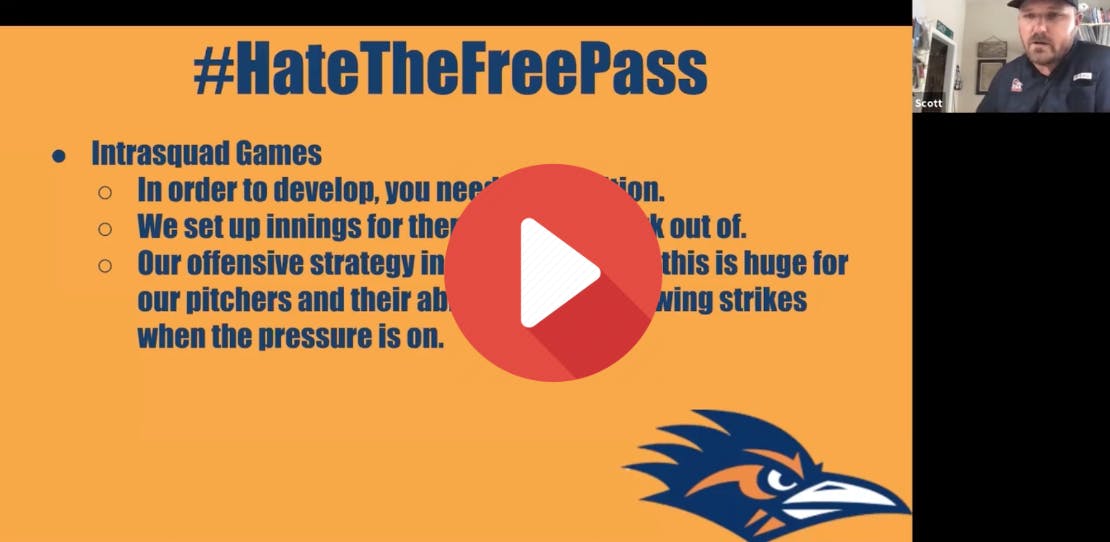
Coach Shepperd claims that intrasquad scrimmages (when his team divides into two smaller squads and plays) is, “our biggest factor in developing strike throwers, because we play a lot of them.”
He then discusses how his pitchers need to compete and feel the pressure during these moments when the games don’t count, so that they’re prepared for those feelings when the games do begin to matter.
In these intrasquads, Coach Shepperd will curate scenarios for his pitchers to perform under (such as, entering the game with runners on first and second base with no outs), in order to get those necessary repetitions.
Feeling the pressure is a main reason why pitchers struggle to throw strikes. Which is why getting pitchers acclimated to the pressure as early and as often as possible is crucial.
If your youth team doesn’t have enough players to field a full intrasquad scrimmage, you could set up a live batting practice, where a pitcher faces a series of hitters with little or no fielders aside from a catcher.
Utilizing Coach Sheppherd’s wisdom will have your pitchers executing strikes in short order.
Sports help kids #GetActive and learn new skills – but don’t forget about fun! Learn about @HealthGov’s National Youth Sports Strategy and help make fun the top priority in #YouthSports: https://bit.ly/2lIHPUc
Shohei Ohtani, Aaron Judge, Cal Raleigh lead the way among the top fantasy baseball picks ahead of the 2026 MLB season. Now streaming on US Sports Radio
The term ‘Five-Tool Player’ gets tossed around frequently in baseball circles. While it does come up often, this doesn’t prove the true rarity of this type of player. Each year come draft time, scouts are looking for these unique prospects that can do a little bit of everything. After all, don’t the skills of power hitting and speed seem to be quite different? It’s difficult to find a guy that can steal a bag and then a hit a homer his next at-bat. Here, I’ll show you what makes up a true ‘Five-Tool Player.’
Speed
I think it would be fair to say that some players are born with great speed, while others might have to make adjustments to see improvements. In terms of baseball, speed has various implications. The statistic most will look to first is stolen bases. Yes, this is part of it, but five-tool players utilize their speed in many other areas. First off, on offense, they take advantage of the speed to beat out groundballs in the infield, turn doubles into triples and just run the bases more efficiently. Depending on the position they play on defense, the speed attribute comes into play as well. For infielders, there will less opportunities to display it, but outfielders have plenty of chances. Five-tool outfielders will catch balls in the alleys that the average outfielder would let drop. Speed is just the start to a five-tool player, but is still important. It can be developed through improving form and quickness off your first-step.
The nice thing about speed is that it isn’t real difficult to practice. One simple method for improving it is sprints. Just doing 10-20 yard sprints can pay significant dividends. Likewise, this can be done running forward, laterally or backwards to enhance the various movements that can be utilized on the baseball field. Remember, with speed, it doesn’t mean you have to possess pure speed, sometimes it just means you are the smartest with your steps and always take the best route to the ball!
Arm Strength
Arm strength is a trait that all players will need. On a side note, arm endurance should be included with it. Essentially, this is the ability for infielders to make all the throws across the diamond. Whether it be a short chopper you have to charge in on or a ball to your backhand, five-tool players must be able to fire it over to first with pace. Outfielders need arm strength to gun down runners at all of the bases as well as home plate. Suffering a dead arm is common amongst baseball players and is something you can avoid with arm strength. There are many ways to develop it. A couple common ones I encourage include weight training and long toss. However, one drill you could do requires just a ball and a partner. You’ll place your throwing arm upwards at a 90o angle. Then hold that elbow with your glove. Finally, just throw the ball to your partner while emphasizing the use of the wrist. This is just one of many potential exercises, but the key is to develop the ability to make all throws.
Hitting for Average
Every manager loves to have hitters at the top of the order who can consistently get on base. This means if you can hit for average, you’ll likely find your way onto the field. The trait of hitting for average requires the player to be able to hit the ball to all fields and potentially be able to bunt when the opportunity presents itself. In order to develop this trait, I believe you need great instincts. You need to understand concepts like what is going on in the game and what the pitcher is trying to get you to do. If the pitcher throws something outside, you need to be able to go with it and hit the ball to the opposite field. Likewise, if the infielders are back behind the bags, it might be wise to lay one down and beat it out. The best practice to improving this is game experience and plenty of time in the batting cage. Similarly, this course from former MLB third-baseman Luis Ortiz on CoachTubebreaks down small things you need to think about each time you step up to the plate. Not only will this help you increase your contact rate, but it should simplify the overall process.
Hitting for Power
Power hitting is one thing that everyone loves to see. After all, these extra base hits usually bring in runs each time they occur. At the same time, when you have the talent to hit it deep, pitchers will start pitching around you and put you on base with a walk. With power hitting being included, isn’t it starting to become apparent that becoming a true five-tool player is a rare occurrence? Elite power hitters do possess some of the same abilities as average hitters, such as the ability to hit to all fields. In order to develop true power hitting ability, you need pure strength. Players that are top-notch in this category emphasize the use of strength and conditioning programs. To get to this level, it is important to put in plenty of work in weight training. However, just pure strength won’t hit home runs. Otherwise, we might see guys like John Cena manning first base for the Cubs! To be a great power hitter, you need a quick and fluid swing that doesn’t contain any hiccups. This can be derived from work with a manager and time in the cage.
Fielding
The final trait of a five-tool player is fielding. Without steady fielding abilities, you’ll rack up the errors and become a liability on the field. Truly, I believe good fielding is directly drawn from consistent reps at the position you’re playing. The more comfortable you feel at the position, the better you’ll perform come game-time. In terms of a five-tool player’s ability in fielding, they are going to be the type of players that can read the ball right upon contact. The best way to achieve this trait is through plenty of experience generated through game playing and practice drills. With this ability, they can take away base hits consistently. Along with this, they possess the ability to make the ‘spectacular’ play happen. Whether that be diving across the outfield or doing a behind-the-back flip to the second baseman, five-tool players are some of the best defensive players on the field.
Developing an All-Around Game
As you can probably tell, developing a true five-tool player is no easy process. Many of these traits don’t necessarily overlap on a consistent basis. You don’t usually see a player with immense power potential also have the talent to lay down a bunt and beat it out. However, a five-tool player has this possibility in his or her back pocket. For players looking to earn this five-tool status, I recommend putting in the work to reach it. Despite being in a different sport (soccer), I was able to interview a professional athlete, Shea Groom, and one of the things she stressed was learning from her teammates and opponents. While everyone has a unique game, there are many ways you can look to improve each of these five skillsets.
Best Five-Tool Players to Study
As I’ve made clear throughout this article, there isn’t a ton of five-tool players. However, there are a couple that are worth analyzing to see what a true five-tool player looks like.
- Mike Trout – The Los Angeles Angels is already arguably one of the best players in baseball despite only being 24 years old. Speed isn’t a question, based on his 49 stolen bases in the 2012 season. He’s an all-around hitter that can hit to all fields, as well as knock it out of the park. For fielding and arm strength, just check out Baseball Tonight each night and I’m sure you’ll see a few web gems.
- Bryce Harper – A second player worth studying is fellow youngster, Bryce Harper. The Nationals’ All-Star has put together a 2015 season that displays each of the five-tools on a nightly basis. From enormous power potential to an average well over .300, Harper possesses a similar skillset to Trout.
Practice!
While you might think five-tool players are just blessed with enormous ability, this is not entirely true. Yes, many of these players with five-tool status have enormous talent, but that doesn’t mean you can’t develop your game to improve each of these skill attributes. With this being the case, the best way to get to that point is practice. Each of the five tools can be improved for any baseball player if they are willing to put in the time in the weight room and field to achieve it!
Want to help kids find sports they love? Sign up to be a coach or volunteer in a local youth sports program. Learn more ways to support youth sports in the National Youth Sports Strategy: https://bit.ly/2lIHPUc
US Sports Network News! Having fun and helping the peeps'. Using Sports as a platform to Inform, Educate, Inspire, While Entertaining you with the best of sports, talk, music, and fun. Be on the lookout for our frequent 'Teachable Moments' This will be a sports and media experience like you never expected. We always welcome your feedback. If you like us or even if you don't, we are always going to love you! Thanks for stopping by!